
Pulp Fiction, 1891 · page 8 of 16
The Argosy, Vol. XI No. 19 — page 8: what you’re looking at
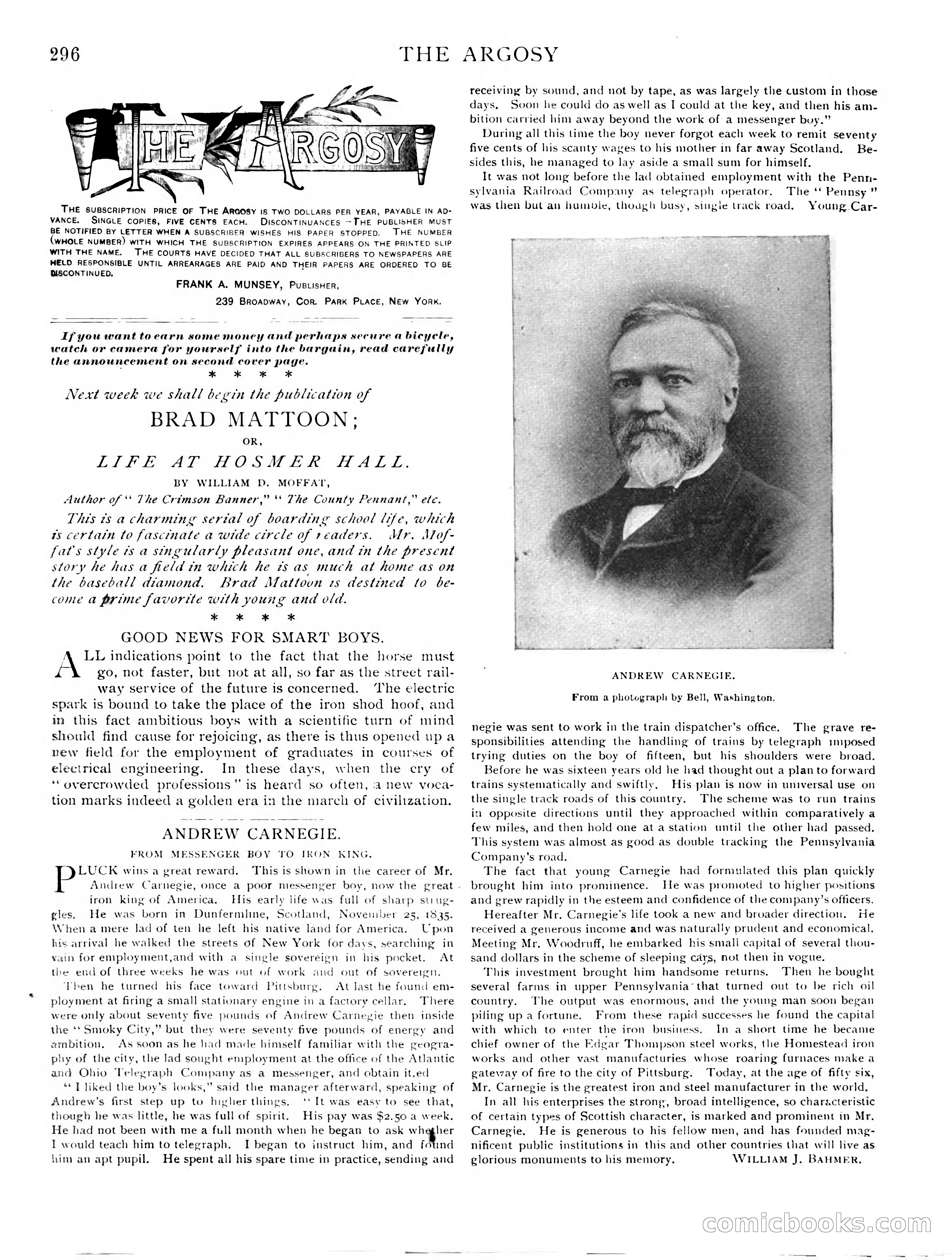
A restored page from Pulp Fiction, 1891. Page through the whole issue in the reader above.
📄 Transcribed text from this page (OCR, searchable)
Machine-transcribed from the original scan — historical spelling and the odd misread are preserved.
THE SUBSCRIPTION PRICE OF THE ARGOSY IS TWO DOLLARS PER YEAR, PAYABLE IN AD- VANCE. SINGLE COPIES, FIVE CENTS EACH. DISCONTINUANCES ~THE PUBLISHER MUST BE NOTIFIED BY LETTER WHEN A SUBSCRIBER WISHES HIS PAPER STOPPED. THE NUMBER WHOLE NUMBER) WITH WHICH THE SUBSCRIPTION EXPIRES APPEARS ON THE PRINTED SLIP WITH THE NAME. THE COURTS HAVE DECIDED THAT ALL SUBSCRIBERS TO NEWSPAPERS ARE HELD RESPONSIBLE UNTIL ARREARAGES ARE PAID AND THEIR PAPERS ARE ORDERED TO BE DISCONTINUED, FRANK A. MUNSEY, PuatisHer, 239 Broapway, Cor. PARK PLAce, New York. Ifyou want toearn some money and perhaps secure a bicyele, watch or camera for yourself into the bargain, read carefully the announcement on second cover page. * *K * * Next week we shall begin the publication of BRAD MATTOON; OR, LIFE AT HOSMER HALL, BY WILLIAM D. MOFFAT, Author of ‘' The Crimson Banner,” ‘* The County Pennant,” etc. This 7s a charming serial of boarding school life, whitch ws certain to fascinate a wide circle of readers. Mr. Mof- fal’s style tsa singularly pleasant one, and in the present story he has a field in which he ts as much at home as on the baseball diamond. Brad Mattoun is destined to be- come a prime favorite with young and old. * F* K XK GOOD NEWS FOR SMART BOYS. AM LL indications point to the fact that the horse must go, not faster, but not at all, so far as the street rail- way service of the future 1s concerned. The electric spark is bound to take the place of the iron shod hoof, and in this fact ambitious boys with a scientific turn of mind should find cause for rejoicing, as there is thus opened upa vew field for the employment of graduates in courses of electrical engineering. In these days, when the cry of ‘‘overcrowded professions" is heard so often, a new voca- tion marks indeed a golden era in the march of civilization. ANDREW CARNEGIE. FROM MESSENGER BOY TO IRON KING. LUCK wins a great reward, This is shown in the career of Mr. Pp Andrew Carnegie, once a poor messenyer boy, now the great iron king of America. His early life was full of sharp strug- gles. He was born in Dunfermline, Scotland, November 25, 1835. When a mere Jad of ten he left his native land for America. Upon his arrival he walked the streets of New York for days, searching in vain for employment,and with a single sovereign in his pocket. At the end of three weeks he was out of work and out of sovereign. Then he turned his face toward Pittsburg. At last he found em- ployment at firing a small stationary engine in a factory cellar. There were only about seventy five pounds of Andrew Carnegie then inside the ‘* Smoky City,” but they were seventy five pounds of energy and ambition, As soon as he had made himself familiar with the geogra- phy of the city, the lad sought employment at the office of the Atlantic and Ohio Telegraph Company as a messenger, and obtain it.ed ** EP liked the boy's looks,” said the manager afterward, speaking of Andrew's first step up to higher things, ‘It was easy to see that, though he was little, he was full of spirit. His pay was $2.50 a week. He had not been with me a full month when he began to ask whegher I would teach him to telegraph. I began to instruct him, and Mind im) an apt pupil. He spent all his spare time in practice, sending and THE ARGOSY receiving by sound, and not by tape, as was largely the custom in those days, Soon he could do as well as IT could at the key, and then his am- bition carried him away beyond the work of a messenger buy.” During all this time the boy never forgot each week to remit seventy five cents of lis scanty wages to his mother in far away Scotland. Be- sides this, he managed to lay aside a small sum for himself. It was not long before the lad obtained employment with the Penn- sylvania Railroad Company as telegraph operator. The ‘ Pennsy ” was then but an humble, though busy, singie track road. Young. Car- ANDREW CARNEGIE. From a photograph by Bell, Washington. negie was sent to work in the train dispatcher’s office. The grave re- sponsibilities attending the handling of trains by telegraph imposed trying duties on the boy of fifteen, but his shoulders were broad. Before he was sixteen years old he had thought out a plan to forward trains systematically and swiftly. His plan is now in universal use on the single track roads of this country. The scheme was to run trains in Opposite directions until they approached within comparatively a few miles, and then hold one ata station until the other had passed. This system was almost as good as double tracking the Pennsylvania Company's road. The fact that young Carnegie had formulated this plan quickly brought him into prominence. He was promoted to higher positions and grew rapidly in the esteem and confidence of the company’s officers. Hereafter Mr. Carnegie’s life took a new and broader directiou. He received a generous income and was naturally prudent and economical. Meeting Mr. Woodruff, he embarked his small capital of several thou- sand dollars in the scheme of sleeping cars, not then in vogue. This investment brought him handsome returns. Then he bought several farms in upper Pennsylvania’ that turned out to be rich oil country. The output was enormous, and the young man soon began piling up a fortune. From these rapid successes he found the capital with which to enter the iron business. In a short time he became chief owner of the Edgar Thompson steel works, the Homestead iron works and other vast manufacturies whose roaring furnaces make a gateway of fire to the city of Pittsburg. Today, at the age of fifty six, Mr. Carnegie is the greatest iron and steel manufacturer in the world, In all his enterprises the strong, broad intelligence, so characteristic of certain types of Scottish character, is marked and prominent in Mr. Carnegie. He is generous to his fellow men, and has founded mag- nificent public institutions in this and other countries that will live as glorious monuments to his memory. WILLIAM J. BAHMER. CoOmicboooks.c©