
Pulp Fiction, 1920 · page 107 of 160
Argosy, Vol. 120, No. 1 — page 107: what you’re looking at
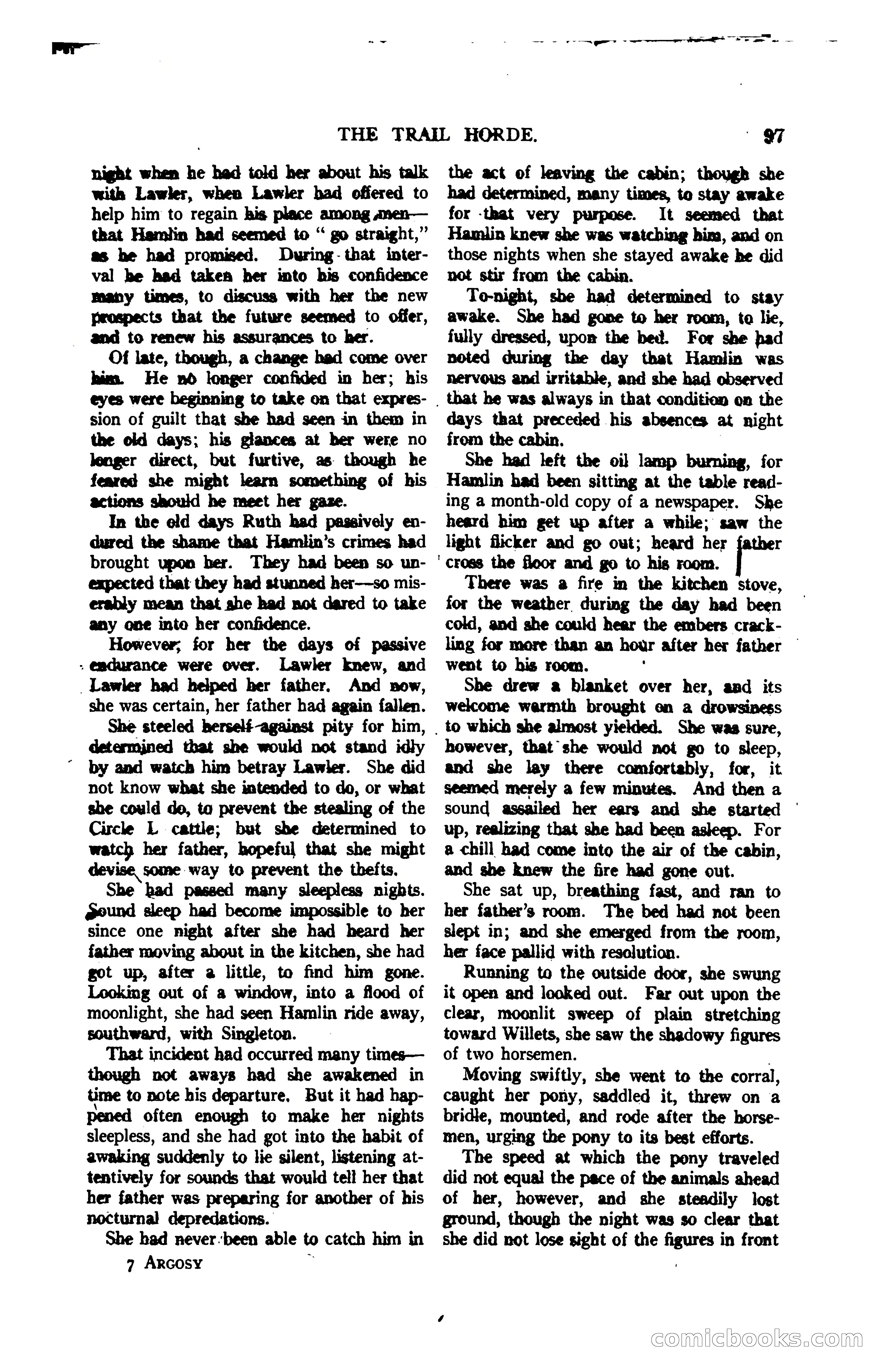
A restored page from Pulp Fiction, 1920. Page through the whole issue in the reader above.
📄 Transcribed text from this page (OCR, searchable)
Machine-transcribed from the original scan — historical spelling and the odd misread are preserved.
THE TRAIL HORDE. night when he hed told her about his talk with Lawler, when Lawler had offered to help him to regain his place among ;nen— that Hamlin had seemed to “ go straight,”’ as he had promised. During- that inter- val be had taken her into his confidence many times, to discuss with her the new prospects that the future seemed to offer, and to renew his assurances to her. Of late, though, a change had come over him. He nd longer confided in her; his eyes were beginning to take on that expres- sion of guilt that she had seen in them in the old days; his glances at ber were no lenger direct, but furtive, as though he feared she might learn something of his actions should he meet her gaze. In the old days Ruth had passively en- dured the shame that Hamlin’s crimes had brought upon her. They had been so un- expected that they had stunned her—so mis- erably mean that ahe had not dared to take any one into her confidence. However; for her the days of passive . endurance were over. Lawler knew, and _ Lawler had helped her father. And now, she was certain, her father had again fallen. She steeled herself-against pity for him, determjned that she would not stand idly " by and watch him betray Lawler. She did not know what she intended to do, or what she could de, ta prevent the stealing of the Circle L cattle; but she determined to watch her father, hopeful that she might devise some way to prevent the thefts. She bad passed many sleepless nights. gound sleep had become impossible to her since one night after she had heard her father moving about in the kitchen, she had got up, after a little, to find him gone. Looking out of a window, into a flood of moonlight, she had seen Hamlin ride away, southward, with Singleton. That incident had occurred many times— though not aways had she awakened in time to note his departure. But it had hap- pened often enough to make her nights sleepless, and she had got into the habit of awaking suddenly to lie silent, listening at- tentively for sounds that would tell her that her father was preparing for another of his nocturnal depredations. She had never‘been able to catch him in 7 ARGOSY ess | 7 the act of leaving the cabin; though she had determined, many times, to stay awake for -that very purpose. It seemed that Hamlin knew she was watching him, and on those nights when she stayed awake he did not stir from the cabin. To-night, sbe had determined to stay awake. She had gane to her room, ta lie, fully dressed, upon the bed. For she had noted during the day that Hamlin was nervous and irritable, and she had observed _ that he was always in that condition on the days that preceded his absences at night from the cabin. She had left the oi] lamp burning, for Hamlin had been sitting at the table read- ing a month-old copy of a newspaper. She heard him get up after a while; saw the light flicker and go out; heard her cross the floor and go to his room. There was a fire in the kitchen stove, for the weather during the day had been cold, and she could hear the embers crack- ~~ we we ling for more than an hour after her father | went to his room. She drew a blanket over her, and its welcome warmth brought en a drowsiness _ to which she almost yielded. She waa sure, however, that she would not go to sleep, and she lay there comfortably, for, it seemed merely a few minutes. And then a sound assailed her ears and she started | up, realizing that she had been asleep. For a chill had come into the air of the cabin, and she knew the fire had gone out. She sat up, breathing fast, and ran to her father’s room. The bed had not been slept in; and she emerged from the room, her face pallid with resolution. Running to the outside door, she swung it open and looked out. Far out upon the clear, moonlit sweep of plain stretching toward Willets, she saw the shadowy figures of two horsemen. Moving swiftly, she went to the corral, caught her pony, saddled it, threw on a bridle, mounted, and rode after the horse- men, urging the pony to its best efforts. The speed at which the pony traveled did not equal the pece of the animals ahead of her, however, and she steadily lost ground, though the night was so clear that she did not lose sight of the figures in front CO 1TOO S CO@