
Pulp Fiction, 1920 · page 112 of 160
Argosy, Vol. 120, No. 1 — page 112: what you’re looking at
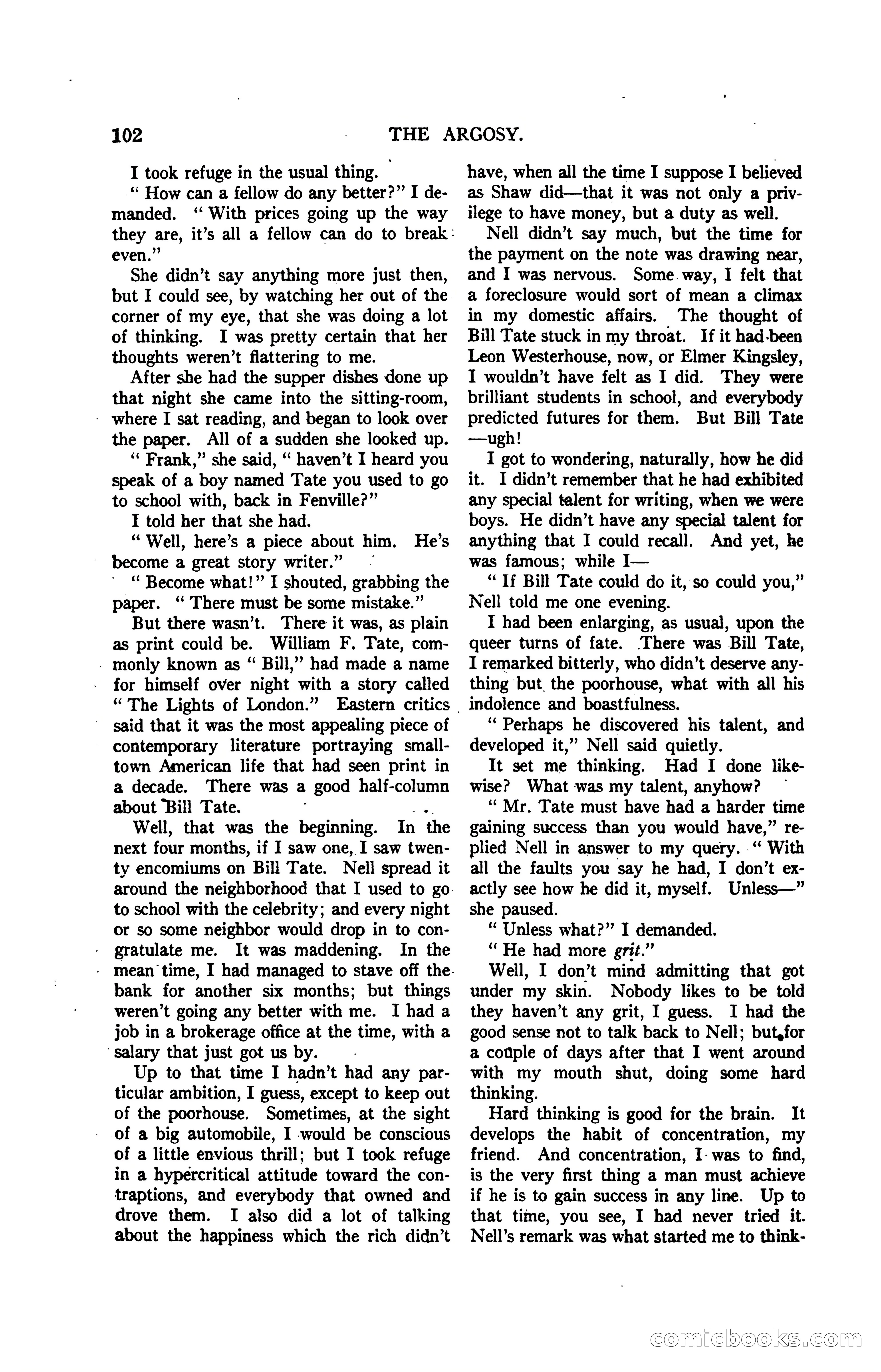
A restored page from Pulp Fiction, 1920. Page through the whole issue in the reader above.
📄 Transcribed text from this page (OCR, searchable)
Machine-transcribed from the original scan — historical spelling and the odd misread are preserved.
102 I took refuge in the usual thing. “ How can a fellow do any better?” I de- manded. ‘ With prices going up the way they are, it’s all a fellow can do to break: even.” She didn’t say anything more just then, but I could see, by watching her out of the. corner of my eye, that she was doing a lot of thinking. I was pretty certain that her thoughts weren’t flattering to me. After she had the supper dishes done up that night she came into the sitting-room, - where I sat reading, and began to look over the paper. All of a sudden she looked up. ‘“‘ Frank,” she said, “‘ haven’t I heard you speak of a boy named Tate you used to go to school with, back in Fenville?” I told her that she had. “Well, here’s a piece about him. He’s ' become a great story writer.” ‘“‘ Become what!” I shouted, grabbing the paper. ‘‘ There must be some mistake.” But there wasn’t. There it was, as plain as print could be. William F. Tate, com- - monly known as “ Bill,” had made a name for himself over night with a story called “The Lights of London.” said that it was the most appealing piece of contemporary literature portraying small- town American life that had seen print in a decade. There was a good half-column about Bill Tate. _ Well, that was the beginning. In the next four months, if I saw one, I saw twen- ty encomiums on Bill Tate. Nell spread it around the neighborhood that I used to go. to school with the celebrity; and every night or so some neighbor would drop in to con- gratulate me. It was maddening. In the - mean time, I had managed to stave off the. bank for another six months; but things weren’t going any better with me. I had a job in a brokerage office at the time, with a ‘salary that just got us by. Up to that time I hadn’t had any par- ticular ambition, I guess, except to keep out of the poorhouse. Sometimes, at the sight of a big automobile, I would be conscious of a little envious thrill; but I took refuge in a hypercritical attitude toward the con- traptions, and everybody that owned and drove them. I also did a lot of talking about the happiness which the rich didn’t Eastern critics | THE ARGOSY. have, when all the time I suppose I believed as Shaw did—that it was not only a priv- ilege to have money, but a duty as well. Nell didn’t say much, but the time for the payment on the note was drawing near, and I was nervous. Some way, I felt that a foreclosure would sort of mean a climax in my domestic affairs. The thought of Bill Tate stuck in my throat. If it had-been Leon Westerhouse, now, or Elmer Kingsley, I wouldn’t have felt as I did. They were brilliant students in school, and everybody predicted futures for them. But Bill Tate —ugh! I got to wondering, naturally, how he did it. I didn’t remember that he had exhibited any special talent for writing, when we were boys. He didn’t have any special talent for anything that I could recall. And yet, he was famous; while I— “Tf Bill Tate could do it, so could you,” Nell told me one evening. I had been enlarging, as usual, upon the queer turns of fate. There was Bill Tate, I remarked bitterly, who didn’t deserve any- thing but, the poorhouse, what with all his indolence and boastfulness. ‘Perhaps he discovered his talent, and developed it,” Nell said quietly. It set me thinking. Had I done like- wise? What was my talent, anyhow? ‘““ Mr. Tate must have had a harder time gaining success than you would have,” re- plied Nell in answer to my query. .“ With all the faults you say he had, I don’t ex- actly see how he did it, myself. Unless—” she paused. “Unless what?” I demanded. “He had more grit.” Well, I don’t mind admitting that got under my skin. Nobody likes to be told they haven’t any grit, I guess. I had the good sense not to talk back to Nell; but,for a coaple of days after that I went around with my mouth shut, doing some hard thinking. Hard thinking is good for the brain. It develops the habit of concentration, my friend. And concentration, I- was to find, is the very first thing a man must achieve if he is to gain success in any line. Up to that time, you see, I had never tried it. Nell’s remark was what started me to think- EO 1NOO S CO@