
Pulp Fiction, 1920 · page 114 of 160
Argosy, Vol. 120, No. 1 — page 114: what you’re looking at
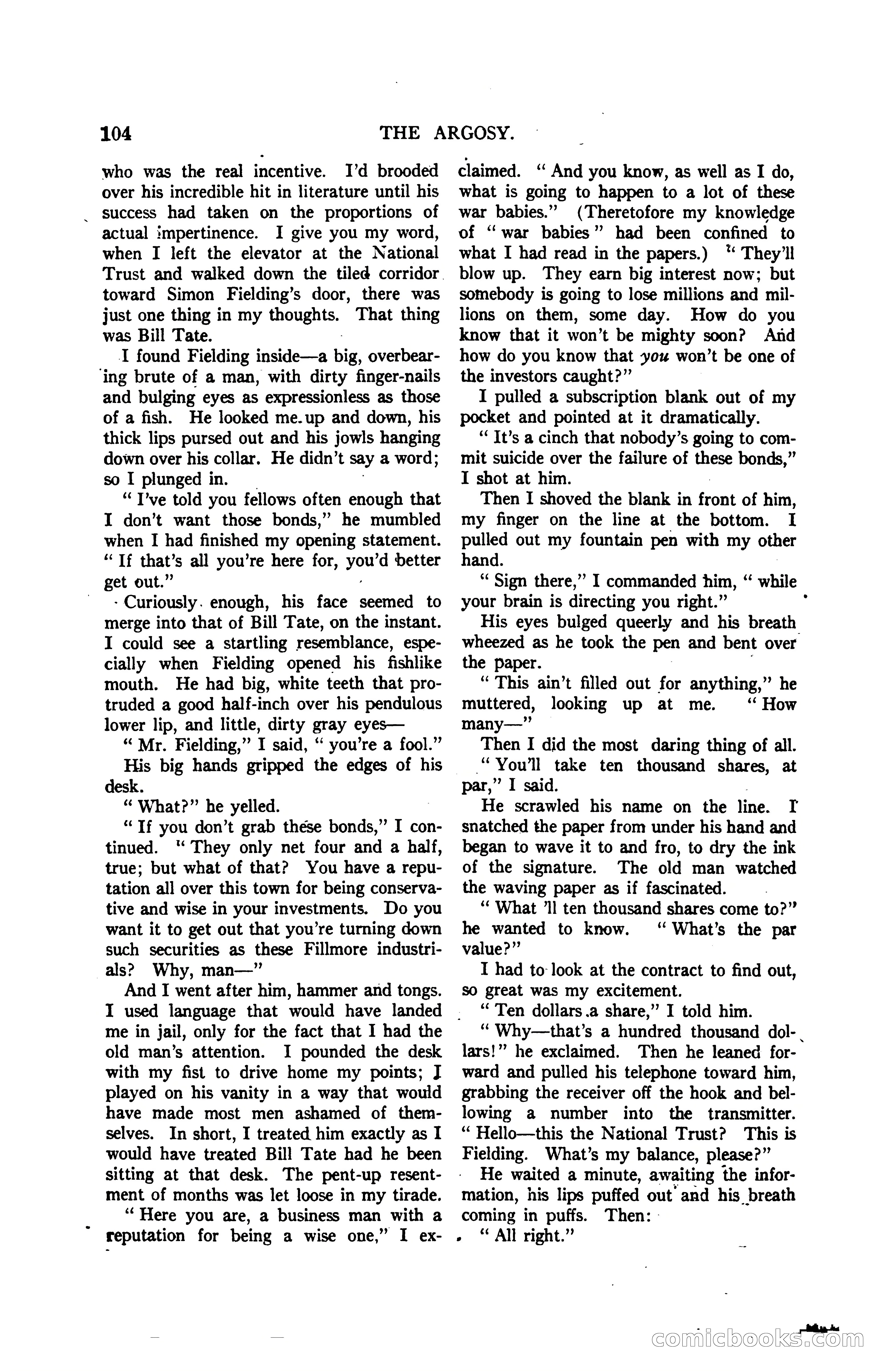
A restored page from Pulp Fiction, 1920. Page through the whole issue in the reader above.
📄 Transcribed text from this page (OCR, searchable)
Machine-transcribed from the original scan — historical spelling and the odd misread are preserved.
104 THE ARGOSY. who was the real incentive. I’d brooded over his incredible hit in literature until his _ success had taken on the proportions of actual impertinence. I give you my word, when I left the elevator at the National Trust and walked down the tiled corridor. toward Simon Fielding’s door, there was just one thing in my thoughts. That thing was Bill Tate. I found Fielding inside—a _ overbear- ‘ing brute of a man, with dirty finger-nails and bulging eyes as expressionless as those of a fish. He looked me.up and down, his thick lips pursed out and his jowls hanging down over his collar. He didn’t say a word; so I plunged in. “T’'ve told you fellows often enough that I don’t want those bonds,” he mumbled when I had finished my opening statement. “‘ Tf that’s all you’re here for, yous better get out.” _ + Curiously. enough, his face seemed to merge into that of Bill Tate, on the instant. I could see a startling resemblance, espe- cially when Fielding opened his fishlike mouth. He had big, white teeth that pro- truded a good half-inch over his pendulous lower lip, and little, dirty gray eyes— “ Mr. Fielding,” I said, “‘ you’re a fool.” His big hands gripped the edges of his — desk. “ What?” he yelled. “Tf you don’t grab these bonds,” I con- tinued. ‘ They only net four and a half, true; but what of that? You have a repu- tation all over this town for being conserva- tive and wise in your investments. Do you want it to get out that you’re turning down such securities as these Fillmore industri- als? Why, man—” And I went after him, hammer and tongs. I used language that would have landed | me in jail, only for the fact that I had the old man’s attention. I pounded the desk with my fist to drive home my points; J played on his vanity in a way that would have made most men ashamed of them- selves. In short, I treated him exactly as I would have treated Bill Tate had he been sitting at that desk. The pent-up resent- ment of months was let loose in my tirade. ‘“‘ Here you are, a business man with a reputation for being a wise one,” I ex- . claimed. ‘‘ And you know, as well as I do, what is going to happen to a lot of these war babies.” (Theretofore my knowledge of ‘war babies” had been confined to what I had read in the papers.) * They’ll blow up. They earn big interest now; but somebody is going to lose millions and mil- lions on them, some day. How do you know that it won’t be mighty soon? And how do you know that you won't be one of the investors caught?”’ I pulled a subscription blank out of my pocket and pointed at it dramatically. “It’s a cinch that nobody’s going to com- mit suicide over the failure of these bonds,” I shot at him. Then I shoved the blank in front of him, my finger on the line at the bottom. I pulled out my fountain pen with my other hand. *¢ Sign there,” I commanded him, “ while your brain is directing you right.” His eyes bulged queerly and his breath wheezed as he took the pen and bent over the paper. ‘This ain’t filled out for anything,’’ he muttered, looking up at me. ‘“ How many—” Then I did the most daring thing of all. “You'll take ten thousand shares, at par, ” 'T said. He scrawled his name on the line. I snatched the paper from under his hand and began to wave it to and fro, to dry the ink of the signature. The old man watched the waving paper as if fascinated. : ‘‘ What ’ll ten thousand shares come to?” he wanted to know. ‘“ What’s the par value?” I had to-look at the contract to find out, SO great was my excitement. “Ten dollars.a share,’’ I told him. “ Why—that’s a hundred thousand dol-_ lars!”’ he exclaimed. Then he leaned for- ward and pulled his telephone toward him, grabbing the receiver off the hook and bel- lowing a number into the transmitter. “ Hello—this the National Trust? This is Fielding. What’s my balance, please?” He waited a minute, awaiting the infor- mation, his lips puffed out and his breath coming in puffs. Then: - “¢ All right.” eomichookesce