
Pulp Fiction, 1920 · page 137 of 160
Argosy, Vol. 120, No. 1 — page 137: what you’re looking at
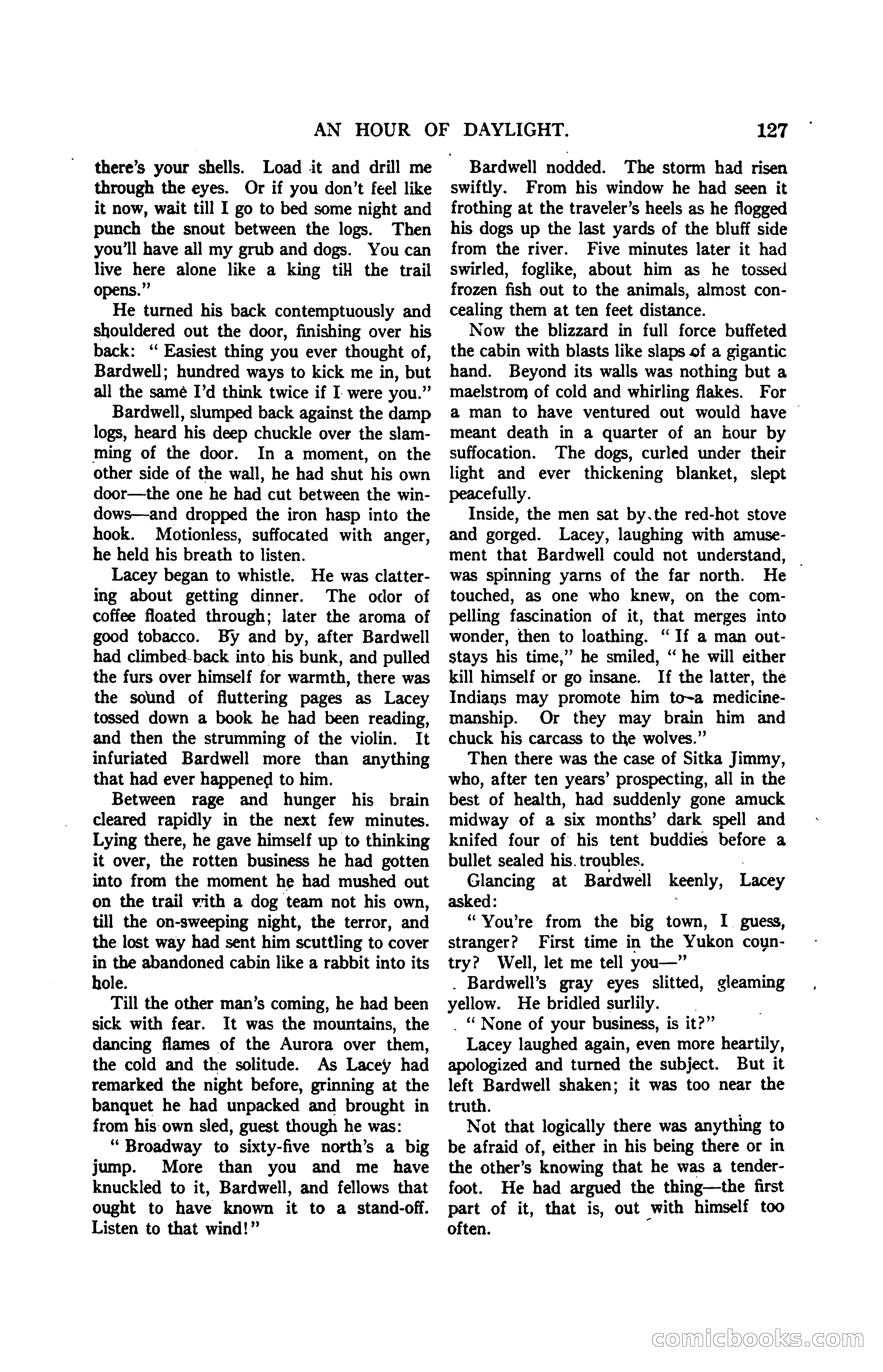
A restored page from Pulp Fiction, 1920. Page through the whole issue in the reader above.
📄 Transcribed text from this page (OCR, searchable)
Machine-transcribed from the original scan — historical spelling and the odd misread are preserved.
AN HOUR OF DAYLIGHT. there’s your shells. Load it and drill me through the eyes. Or if you don’t feel like it now, wait till I go to bed some night and punch the snout between the logs. Then you'll have all my grub and dogs. You can live here alone like a king ti the trail opens.” He turned his back contemptuously and shouldered out the door, finishing over his back: ‘ Easiest thing you ever thought of, Bardwell; hundred ways to kick me in, but all the samé I’d think twice if I- were you.” Bardwell, slumped back against the damp logs, heard his deep chuckle over the slam- ming of the door. In a moment, on the other side of the wall, he had shut his own door—the one he had cut between the win- dows—and dropped the iron hasp into the hook. Motionless, suffocated with anger, he held his breath to listen. Lacey began to whistle. He was clatter- ing about getting dinner. The odor of coffee floated through; later the aroma of good tobacco. By and by, after Bardwell had climbed-back into his bunk, and pulled the furs over himself for warmth, there was the sound of fluttering pages as Lacey tossed down a book he had been reading, and then the strumming of the violin. It infuriated Bardwell more than anything that had ever happened to him. Between rage and hunger his brain cleared rapidly in the next few minutes. Lying there, he gave himself up to thinking it over, the rotten business he had gotten into from the moment he had mushed out on the trail with a dog team not his own, till the on-sweeping night, the terror, and the lost way had sent him scuttling to cover in the abandoned cabin like a rabbit into its hole. Till the other man’s coming, he had been sick with fear. It was the mountains, the dancing flames of the Aurora over them, the cold and the solitude. As Lacey had remarked the night before, grinning at the banquet he had unpacked and brought in from his own sled, guest though he was: ‘“‘ Broadway to sixty-five north’s a big jump. More than you and me have knuckled to it, Bardwell, and fellows that ought to have known it to a stand-off. Listen to that wind!” 127 Bardwell nodded. The storm had risen swiftly. From his window he had seen it frothing at the traveler’s heels as he flogged his dogs up the last yards of the bluff side from the river. Five minutes later it had swirled, foglike, about him as he tossed frozen fish out to the animals, almost con- cealing them at ten feet distance. Now the blizzard in full force buffeted the cabin with blasts like slaps of a gigantic hand. Beyond its walls was nothing but a maelstrom of cold and whirling flakes. For a man to have ventured out would have — meant death in a quarter of an hour by suffocation. The dogs, curled under their light and ever thickening blanket, slept peacefully. Inside, the men sat by.the red-hot stove and gorged. Lacey, laughing with amuse- ment that Bardwell could not understand, — was spinning yarns of the far north. He touched, as one who knew, on the com- pelling fascination of it, that merges into wonder, then to loathing. ‘“ If a man out- stays his time,” he smiled, “ he will either kill himself or go insane. If the latter, the Indians may promote him to~a medicine- manship. Or they may brain him and chuck his carcass to the wolves.” Then there was the case of Sitka Jimmy, who, after ten years’ prospecting, all in the best of health, had suddenly gone amuck midway of a six months’ dark spell and knifed four of his tent buddies before a bullet sealed his. troubles. Glancing at Bardwell asked: “You're from the big town, I guess, stranger? First time in the Yukon coun- try? Well, let me tell you—” . Bardwell’s gray eyes slitted, gleaming yellow. He bridled surlily. | _ “ None of your business, is it?” Lacey laughed again, even more heartily, apologized and turned the subject. But it left Bardwell shaken; it was too near the truth. Not that logically there was anything to be afraid of, either in his being there or in the other’s knowing that he was a tender- foot. He had argued the thing—the first part of it, that is, out with himself too often. " keenly, Lacey GOMIIG OOO S CO@