
Pulp Fiction, 1920 · page 154 of 160
Argosy, Vol. 120, No. 1 — page 154: what you’re looking at
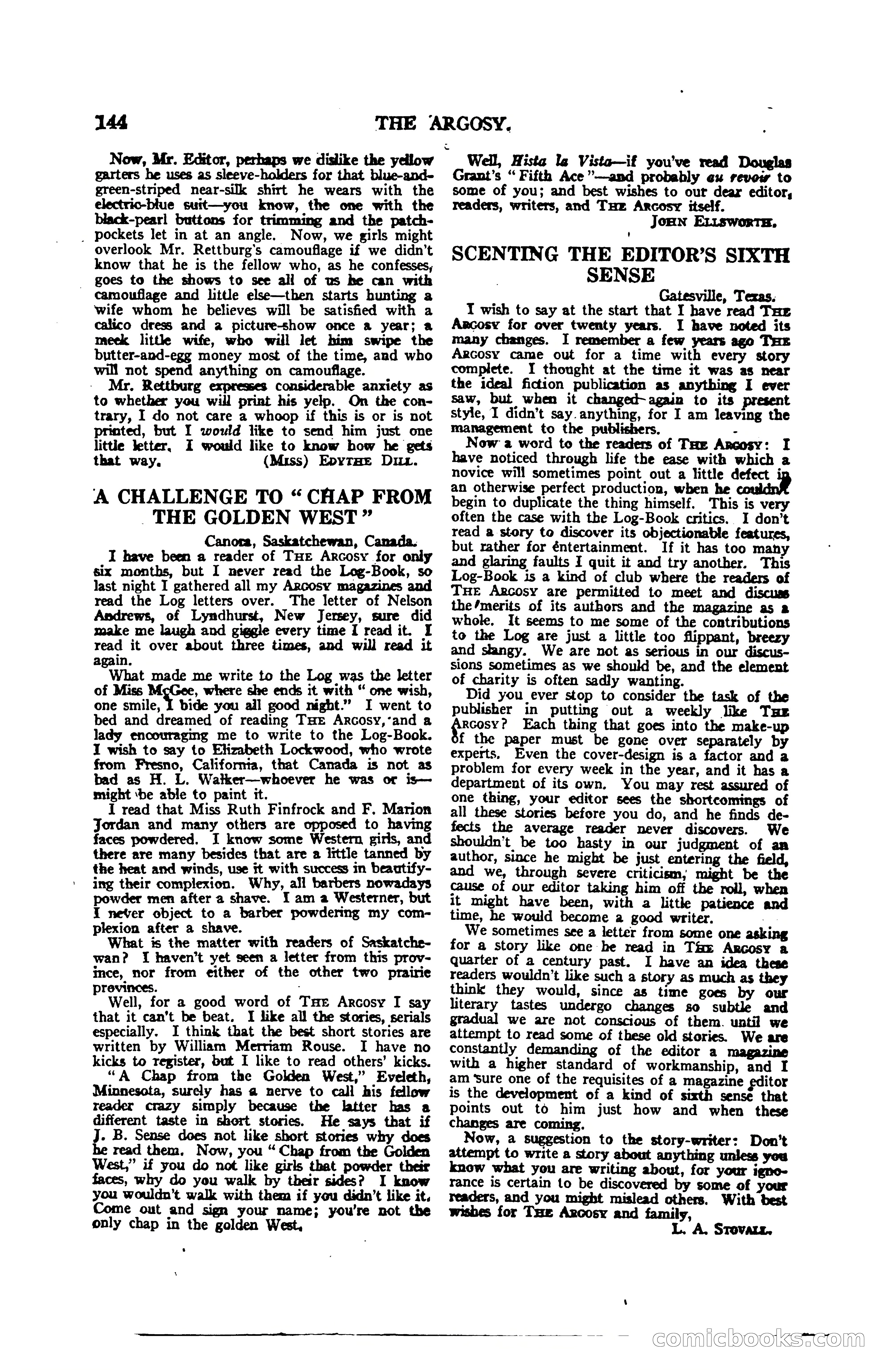
A restored page from Pulp Fiction, 1920. Page through the whole issue in the reader above.
📄 Transcribed text from this page (OCR, searchable)
Machine-transcribed from the original scan — historical spelling and the odd misread are preserved.
144 Now, Mr. Editor, perhaps we dislike the ydlow garters he uses as sleeve-holders for that blue-and- green-striped near-silk shirt he wears with the electric-biue suit—you know, the one with the biack-pearl buttons for trimming and the patch- _ pockets let in at an angle. Now, we girls might overlook Mr. Rettburg’s camouflage if we didn’t know that he is the fellow who, as he confesses, goes to the shows to see all of us he can with - camouflage and little else—then starts hunting a wife whom he believes will be satisfied with a calico dress and a picture-show once a year; a meek litth wife, who will let him swipe the butter-and-egg money most of the time, and who will not spend anything on camouflage. - Mr. Rettburg expresses considerable anxiety as to whether you will print his yelp. On the con- trary, I do not care a whoop if this is or is not printed, but I would like to send him just one litde letter, I would like to know how he gets that way. (Miss) EvyTHe Diu. A CHALLENGE TO “ CHAP FROM _THE GOLDEN WEST” Canora, Saskatchewan, Canada. I have been a reader of THe Arcosy for only six months, but I never read the Log-Book, so last night I gathered all my Arcosy magazines and read the Log letters over. The letter of Nelson Andrews, of Lyndhurst, New Jersey, sure did make me laugh and giggle every time I read it. I read it over about three times, and will read it again. What made me write to the Log was the letter of Miss M , where she ends it with “ one wish, one smile, I bide you ail good night.” I went to bed and dreamed of reading THE Arcosy,‘and a lady encouraging me to write to the Log-Book. I wish to say to Elizabeth Lockwood, who wrote from Fresno, Californta, that Canada is not as bad as H. L. Watker—whoever he was or is— might ‘be able to paint it. . I read that Miss Ruth Finfrock and F, Marion Jordan and many others are opposed to having faces powdered. I know some Western girls, and there are many besides that are a irttle tanned by the heat and winds, use it with success in beautify- ing their complexion. Why, all barbers nowadays powder men after a shave. I am a Westerner, but I never object to a barber powdering my com- plexion after a shave. What is the matter with readers of Saskatche- wan? I haven't yet seen a letter from this prov- mee, nor from either of the other two prairie previnces. Well, for a good word of THe Arcosy I say that it can’t be beat. I like all the stories, serials especially. I think that the best short stories are written by William Merriam Rouse. I have no kicks to register, but I like to read others’ kicks. “A Chap from the Golden West,” Eveleth, Minnesota, surely has a nerve to call his fellow reader crazy simply because the latter has a different taste in short stories. He says that if J. B. Sense does not like short stories why does he read them. Now, you “Chap from the Golden West,” if you do not like girls that powder their faces, why do you walk by their sides? I know you wouldn’t walk with them if you didn’t like it, Come out and sign your name; you're not the only chap in the golden West, - THE ARGOSY. Well, Hista la Vista—if you've read Douglas Grant’s “Fifth Ace”—and probably eu revoir to some of you; and best wishes to our dear editor, readers, writers, and THE Axcosy itself. JoHN ELLSworTH. SCENTING THE EDITOR’S SIXTH SENSE Gatesville, Texas. I wish to say at the start that I have read Tre for over twenty years. I have noted its many changes. I remember a few years ago THE Agcosy came out for a time with every story complete. I thought at the time it was as near the ideal fiction publication as anything I ever saw, but when it changed-again to its present style, I didn’t say. anything, for I am leaving the management to the publishers. - Now a word to the readers of THe Arcosy: I have noticed through life the ease with which a novice will sometimes point out a little defect i an otherwise perfect production, wben he begin to duplicate the thing himself. This is very often the case with the Log-Book critics. I don’t read a story to discover its objectionable features, but rather for éntertainment. If it has too many and glaring faults I quit it and try another. This Log-Book is a kind of club where the readers of THE Agcosy are permitted to meet and discuss the merits of its authors and the magazine as a whole. It seems to me some of the contributions to the Log are just a little too flippant, breezy and slangy. We are not as serious in our discus- sions sometimes as we should be, and the element of charity is often sadly wanting. Did you ever stop to consider the task of the publisher in putting out a weekly like Tue arco Each thing that goes into the make-up f the paper must be gone over separately by experts, Even the cover-design is a factor and a problem for every week in the year, and it has a department of its own. You may rest assured of one thing, your editor sees the shortcomings of all these stories before you do, and he finds de- fects the average reader never discovers. We shouldn't be too hasty in our judgment of an author, since he might be just entering the field, and we, through severe criticism, might be the cause of our editor taking him off the roll, when It might have been, with a little patience and time, he would become a good writer. = We sometimes see a letter from some one asking for a story like one he read in Tie Arcosy a Quarter of a century past. I have an idea these readers wouldn’t like such a story as much as they think they would, since as time goes by our literary tastes undergo changes so subtle and gradual we are not conscious of them. until we attempt to read some of these old stories. We are constantly demanding of the editor a i with a higher standard of workmanship, and I am ‘sure one of the requisites of a magazine gditor is the development of a kind of sixth sense that points out to him just how and when these changes are coming. Now, a suggestion to the story-writer: Don’t attempt to write a story about anything unless you know what you are writing about, for your igno- rance is certain to be discovered by some of your readers, and you might mislead others. With best wishes for Tue Arcosy and family, L. A. STovats. (eo) : CONIC NOOKKSTNEO