
Pulp Fiction, 1920 · page 24 of 160
Argosy, Vol. 120, No. 1 — page 24: what you’re looking at
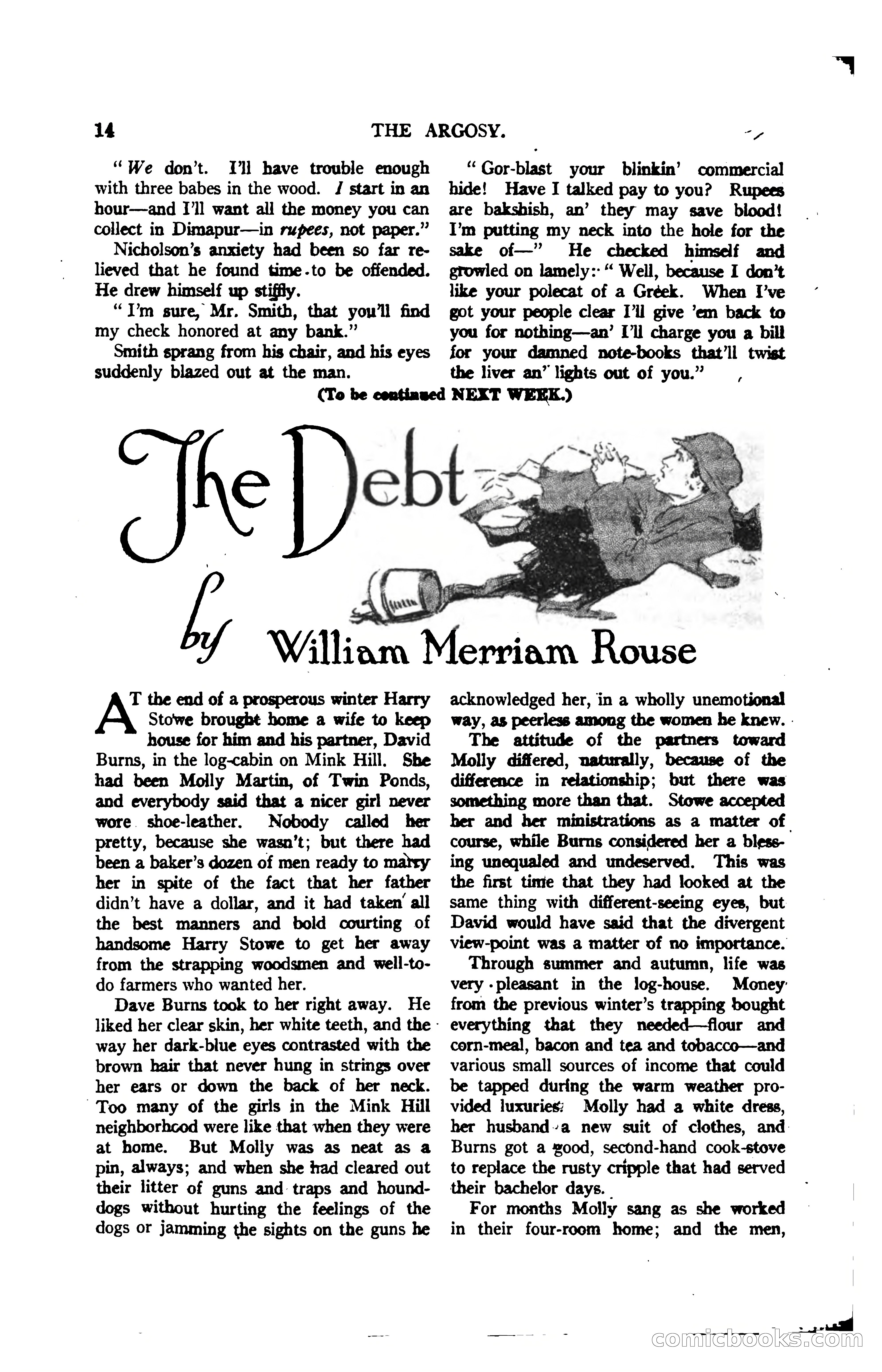
A restored page from Pulp Fiction, 1920. Page through the whole issue in the reader above.
📄 Transcribed text from this page (OCR, searchable)
Machine-transcribed from the original scan — historical spelling and the odd misread are preserved.
14 “We don’t. I'll have trouble enough with three babes in the wood. / start in an hour—and IJ’ll want all the money you can collect in Dimapur—in rupees, not paper.” Nicholson’s anxiety had been so far re- lieved that he found time.to be offended. He drew himself up stiffly. “Tm sure, Mr. Smith, that you'll find my check honored at any bank.” Smith sprang from his chair, and his eyes suddenly blazed out at the man. “Gor-blast your blinkin’ commercial hide! Have I talked pay to you? Rupees are bakshish, an’ they may save blood! I’m putting my neck into the hole for the sake of—” He checked himself and growled on lamely:: “ Well, because I don’t like your polecat of a Gréek. When I’ve got your people clear I’ll give ’em back to you for nothing—an’ I'll charge you a bill for your damned note-books that'll twist the liver an’ lights out of you.” (To be continued NEXT WEEK.) wim Merriam “Rouse T the end of a prosperous winter Harry A Stowe brought home a wife to keep house for him and his partner, David Burns, in the log-cabin on Mink Hill. She had been Molly Martin, of Twin Ponds, and everybody said that a nicer girl never wore. shoe-leather. Nobody called her pretty, because she wasn’t; but there had been a baker’s dozen of men ready to matry her in spite of the fact that her father didn’t have a dollar, and it had taken’ all the best manners and bold courting of handsome Harry Stowe to get her away from the strapping woodsmen and well-to- do farmers who wanted her. Dave Burns took to her right away. He liked her clear skin, her white teeth, and the - way her dark-blue eyes contrasted with the brown hair that never hung in strings over her ears or down the back of her neck. Too many of the girls in the Mink Hill neighborhcod were like that when they were at home. But Molly was as neat as a pin, always; and when she had cleared out their litter of guns and traps and hound- dogs without hurting the feelings of the dogs or jamming the sights on the guns he acknowledged her, in a wholly unemotional way, as peerless among the women he knew. . The attitude of the partners toward Molly differed, naturally, because of the difference in relationship; but there was something more than that. Stowe accepted her and her ministrations as a matter of course, while Burns considered her a bless- ing unequaled and undeserved. This was the first time that they had looked at the same thing with different-seeing eyes, but David would have said that the divergent view-point was a matter of no importance. Through summer and autumn, life was very -pleasant in the log-house. Money: from the previous winter’s trapping bought everything that they needed—flour and corn-meal, bacon and tea and tobacco—and various small sources of income that could be tapped during the warm weather pro- vided luxuries: Molly had a white dress, her husband-a new suit of clothes, and Burns got a good, second-hand cook-stove to replace the rusty cripple that had served their bachelor days. For months Molly sang as she worked in their four-room home; and the men, ecomircoo ___> aa” CO