
Pulp Fiction, 1920 · page 38 of 160
Argosy, Vol. 120, No. 1 — page 38: what you’re looking at
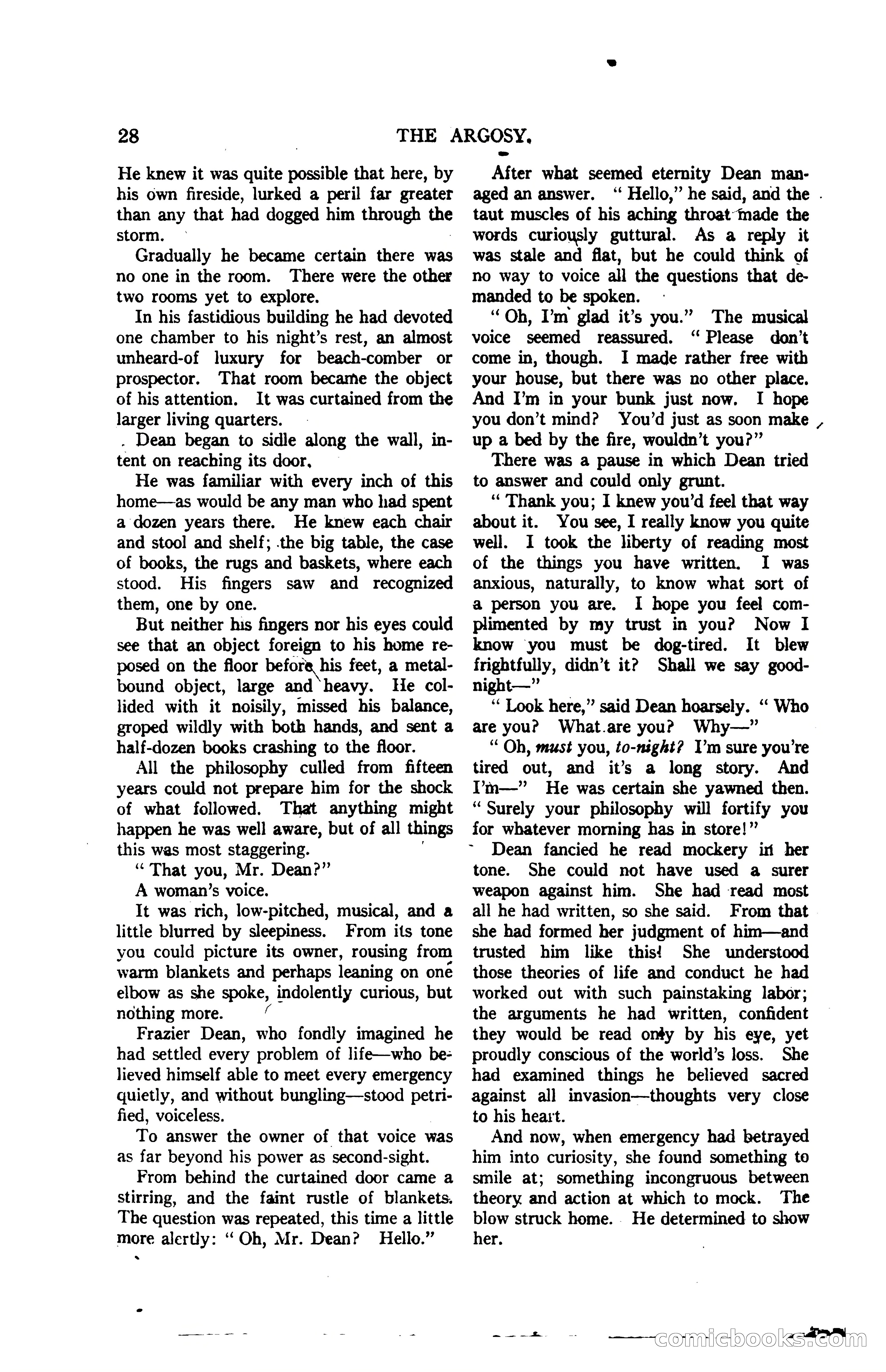
A restored page from Pulp Fiction, 1920. Page through the whole issue in the reader above.
📄 Transcribed text from this page (OCR, searchable)
Machine-transcribed from the original scan — historical spelling and the odd misread are preserved.
28 He knew it was quite possible that here, by his own fireside, lurked a peril far greater than any that had dogged him through ue storm. Gradually he became certain there was no one in the room. There were the other two rooms yet to explore. In his fastidious building he had devoted one chamber to his night’s rest, an almost unheard-of luxury for beach-comber or prospector. ‘That room became the object of his attention. It was curtained from the larger living quarters. . Dean began to sidle along the wall, in- tent on reaching its door, He was familiar with every inch of this home—as would be any man who had spent a dozen years there. He knew each chair and stool and shelf; .the big table, the case of books, the rugs and baskets, where each stood. His fingers saw and recognized them, one by one. But neither his fingers nor his eyes could see that an object foreign to his home re- posed on the floor before, his feet, a metal- bound object, large and heavy. He col- lided with it noisily, missed his balance, groped wildly with both hands, and sent a half-dozen books crashing to the floor. All the philosophy culled from fifteen years could not prepare him for the shock of what followed. That anything might happen he was well aware, but of all things this was most staggering. “That you, Mr. Dean?” A woman’s voice. It was rich, low-pitched, musical, and a little blurred by sleepiness. From its tone you could picture its owner, rousing from warm blankets and perhaps leaning on one elbow as she spoke, indolently curious, but nothing more. Frazier Dean, who fondly imagined he had settled every problem of life—who be- lieved himself able to meet every emergency quietly, and without bungling—stood peti fied, voiceless. To answer the owner of that voice was as far beyond his power as second-sight. From behind the curtained door came a Stirring, and the faint rustle of blankets. The question was repeated, this time a little more alertly: “Oh, Mr. Dean? Hello.” THE ARGOSY, After what seemed eternity Dean man- aged an answer. ‘‘ Hello,” he said, and the . taut muscles of his aching throat made the words curiously guttural. As a reply it was stale and flat, but he could think of no way to voice all the questions that de- manded to be spoken. - “Oh, I’m glad it’s you.” The musical voice seemed reassured. ‘ Please don’t come in, though. I made rather free with your house, but there was no other place. And I’m in your bunk just now. I hope you don’t mind? You’d just as soon make up a bed by the fire, wouldn’t you?” There was a pause in which Dean tried to answer and could only grunt. ‘“‘ Thank you; I knew you'd feel that way about it. You see, I really know you quite well. I took the liberty of reading most of the things you have written. I was anxious, naturally, to know what sort of a person you are. I hope you feel com- plimented by my trust in your Now I know you must be dog-tired. It blew frightfully, didn’t it? Shall we say good- night—” ‘‘ Look here,” said Dean hoarsely. ‘“‘ Who are your What.are youe Why—” “Oh, must you, to-night? I’m sure you're tired out, and it’s a long story. And I’m—” He was certain she yawned then. “Surely your philosophy will fortify you for whatever morning has in store!”’ ~ Dean fancied he read mockery in her tone. She could not have used a surer weapon against him. She had read most all he had written, so she said. From that she had formed her judgment of him—and trusted him like this! She understood those theories of life and conduct he had worked out with such painstaking labor; the arguments he had written, confident they would be read on#y by his eye, yet proudly conscious of the world’s loss. She had examined things he believed sacred against all invasion—thoughts very close to his heart. And now, when emergency had betrayed him into curiosity, she found something to smile at; something incongruous between theory and action at which to mock. The blow struck home. . He determined to show her. =~ — — &. ————-COnnEeoo@o@ SS GG (Li