
Pulp Fiction, 1920 · page 71 of 160
Argosy, Vol. 120, No. 1 — page 71: what you’re looking at
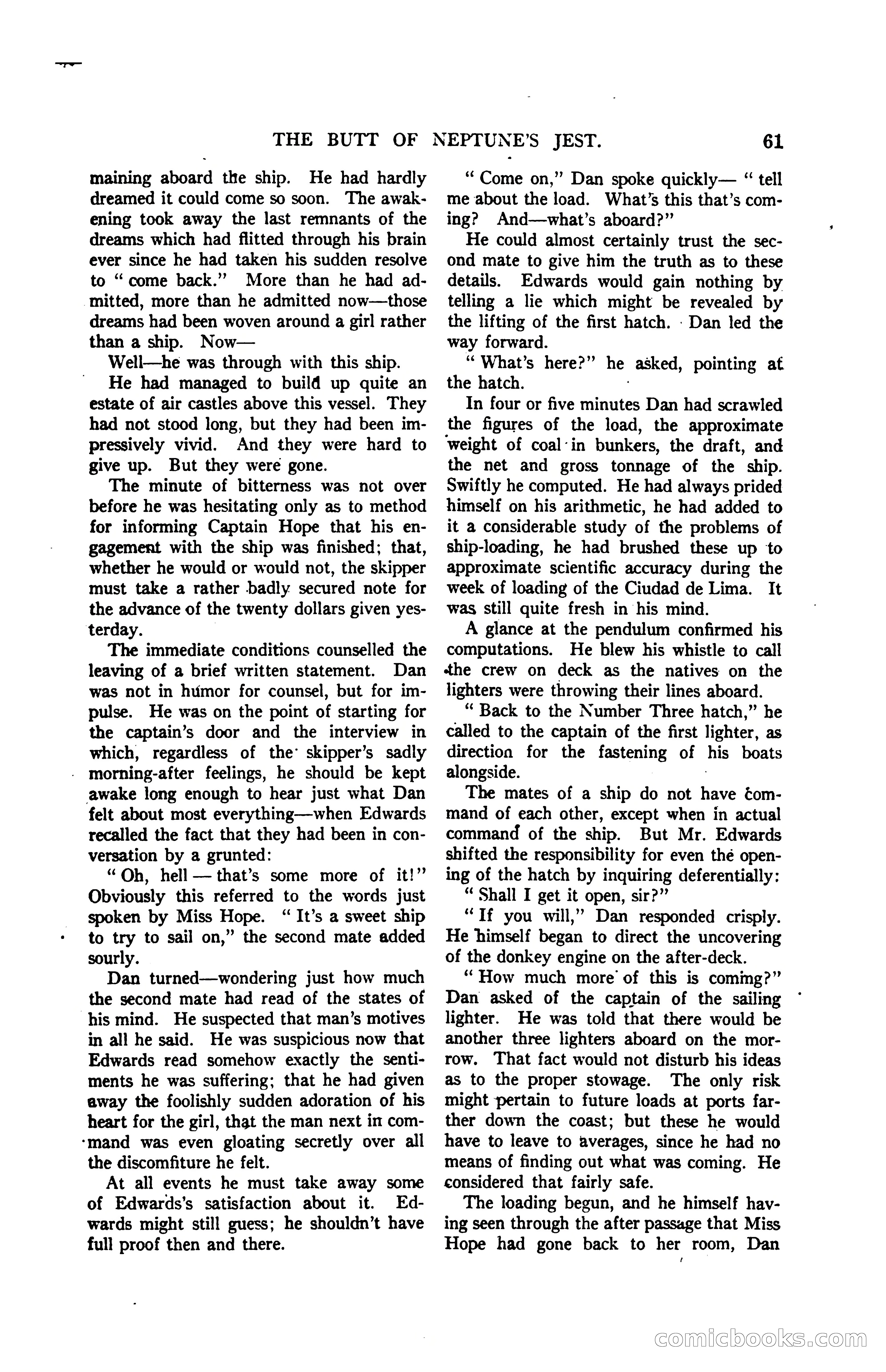
A restored page from Pulp Fiction, 1920. Page through the whole issue in the reader above.
📄 Transcribed text from this page (OCR, searchable)
Machine-transcribed from the original scan — historical spelling and the odd misread are preserved.
THE BUTT OF NEPTUNE E’S JEST. maining aboard the ship. He had hardly dreamed it could come so soon. The awak- ening took away the last remnants of the dreams which had flitted through his brain ever since he had taken his sudden resolve to “ come back.” More than he had ad- mitted, more than he admitted now—those dreams had been woven around a girl rather than a ship. Now— Well—he was through with this ship. He had managed to build up quite an estate of air castles above this vessel. They had not stood long, but they had been im- pressively vivid. And they were hard to give up. But they were gone. The minute of bitterness was not over before he was hesitating only as to method for informing Captain Hope that his en- gagement with the ship was finished; that, whether he would or would not, the skipper must take a rather badly secured note for the advance of the twenty dollars given yes- terday. The immediate conditions counselled the leaving of a brief written statement. Dan was not in himor for counsel, but for im- pulse. He was on the point of starting for the captain’s door and the interview in which, regardless of the’ skipper’s sadly - Mmorning-after feelings, he should be kept awake long enough to hear just what Dan felt about most everything—when Edwards recalled the fact that they had been in con- versation by a grunted: “Oh, hell — that’s some more of it!” Obviously this referred to the words just spoken by Miss Hope. “ It’s a sweet ship to try to sail on,” the second mate added sourly. Dan turned—wondering just how much the second mate had read of the states of his mind. He suspected that man’s motives in all he said. He was suspicious now that Edwards read somehow exactly the senti- ments he was suffering; that he had given away the foolishly sudden adoration of his heart for the girl, that the man next in com- ‘mand was even gloating secretly over all the discomfiture he felt. At all events he must take away some of Edwards’s satisfaction about it. Ed- wards might still guess; he shouldn’t have full proof then and there. 61 “¢ Come on,” Dan spoke quickly— “ tell me about the load. What’s this that’s com- ing? And—what’s aboard?” He could almost certainly trust the sec- ond mate to give him the truth as to these details. Edwards would gain nothing by telling a lie which might be revealed by the lifting of the first hatch. _ Dan led the way forward. ‘“ What’s here?” ne! asked, pointing af the hatch. In four or five minutes Dan had scrawled the figures of the load, the approximate weight of coal-in bunkers, the draft, and the net and gross tonnage of the ship. swiftly he computed. He had always prided himself on his arithmetic, he had added to it a considerable study of the problems of ship-loading, he had brushed these up to approximate scientific accuracy during the week of loading of the Ciudad de Lima. It was still quite fresh in his mind. A glance at the pendulum confirmed his computations. He blew his whistle to call tthe crew on deck as the natives on the lighters were throwing their lines aboard. ‘“‘ Back to the Number Three hatch,” he called to the captain of the first lighter, as direction for the fastening of his boats alongside. The mates of a ship do not have ¢om- mand of each other, except when in actual command of the ship. But Mr. Edwards shifted the responsibility for even thé open- ing of the hatch by inquiring deferentially: “* Shall I get it open, sir?” “If you will,” Dan responded crisply. He himself began to direct the uncovering of the donkey engine on the after-deck. ‘““How much more of this is commg?” Dan asked of the captain of the sailing lighter. He was told that there would be another three lighters aboard on the mor- row. That fact would not disturb his ideas as to the proper stowage. The only risk might pertain to future loads at ports far- ther down the coast; but these he would have to leave to averages, since he had no means of finding out what was coming. He considered that fairly safe. The loading begun, and he himself hav- ing seen through the after passage that Miss Hope had gone back to her room, Dan EO 1NOO CO