
Pulp Fiction, 1920 · page 73 of 160
Argosy, Vol. 120, No. 1 — page 73: what you’re looking at
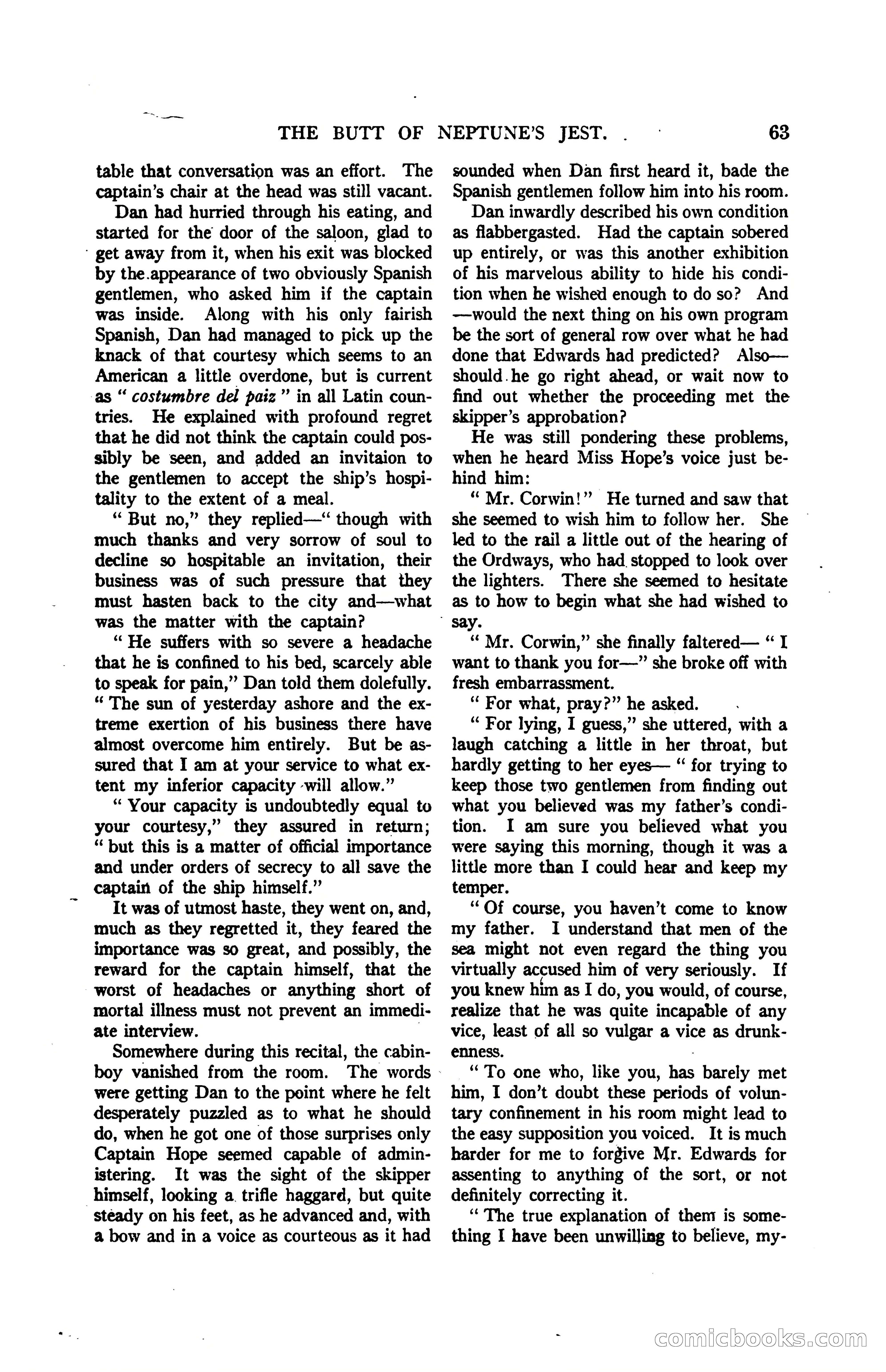
A restored page from Pulp Fiction, 1920. Page through the whole issue in the reader above.
📄 Transcribed text from this page (OCR, searchable)
Machine-transcribed from the original scan — historical spelling and the odd misread are preserved.
THE BUTT OF NEPTUNE’S JEST. table that conversation was an effort. The captain’s chair at the head was still vacant. Dan had hurried through his eating, and started for the door of the saloon, glad to ‘ get away from it, when his exit was blocked by the.appearance of two obviously Spanish gentlemen, who asked him if the captain was inside. Along with his only fairish Spanish, Dan had managed to pick up the knack of that courtesy which seems to an American a little overdone, but is current as “costumbre del paiz”’ in all Latin coun- tries. He explained with profound regret that he did not think the captain could pos- sibly be seen, and added an invitaion to the gentlemen to accept the ship’s hospi- tality to the extent of a meal. “ But no,” they replied—“ though with much thanks and very sorrow of soul to decline so hospitable an invitation, their business was of such pressure that they must hasten back to the city and—what was the matter with the captain? “He suffers with so severe a headache that he is confined to his bed, scarcely able to speak for pain,” Dan told them dolefully. “The sun of yesterday ashore and the ex- treme exertion of his business there have almost overcome him entirely. But be as- sured that I am at your service to what ex- tent my inferior capacity -will allow.” “ Your capacity is undoubtedly equal to your courtesy,” they assured in return; “but this is a matter of official importance and under orders of secrecy to all save the captain of the ship himself.” It was of utmost haste, they went on, and, much as they regretted it, they feared the importance was so great, and possibly, the reward for the captain himself, that the worst of headaches or anything short of mortal illness must not prevent an immedi- ate interview. | Somewhere during this recital, the cabin- boy vanished from the room. The words - were getting Dan to the point where he felt desperately puzzled as to what he should do, when he got one of those surprises only Captain Hope seemed capable of admin- istering. It was the sight of the skipper himself, looking a. trifle haggard, but quite steady on his feet, as he advanced and, with a bow and in a voice as courteous as it had 63 sounded when Dan first heard it, bade the Spanish gentlemen follow him into his room. Dan inwardly described his own condition as flabbergasted. Had the captain sobered up entirely, or was this another exhibition of his marvelous ability to hide his condi- tion when he wished enough to do so? And —would the next thing on his own program be the sort of general row over what he had done that Edwards had predicted? Also— should. he go right ahead, or wait now to find out whether the proceeding met the skipper’s approbation? He was still pondering these problems, when he heard Miss Hope’s voice just be- hind him: “ Mr. Corwin!” He turned and saw that she seemed to wish him to follow her. She led to the rail a little out of the hearing of the Ordways, who had stopped to look over the lighters. There she seemed to hesitate as to how to begin what she had wished to " say. “* Mr. Corwin,” she finally faltered— “ I want to thank you for—” she broke off with fresh embarrassment. “For what, pray?” he asked. “ For lying, I guess,” she uttered, with a laugh catching a little in her throat, but hardly getting to her eyes— “ for trying to keep those two gentlemen from finding out what you believed was my father’s condi- tion. I am sure you believed what you were saying this morning, though it was a little more than I could hear and keep my temper. ‘““Of course, you haven’t come to know my father. I understand that men of the sea might not even regard the thing you virtually accused him of very seriously. If you knew him as I do, you would, of course, realize that he was quite incapable of any vice, least of all so vulgar a vice as drunk- enness. “To one who, like you, has barely met him, I don’t doubt these periods of volun- tary confinement in his room might lead to the easy supposition you voiced. It is much harder for me to forgive Mr. Edwards for assenting to anything of the sort, or not definitely correcting it. “The true explanation of them is some- thing I have been unwilling to believe, my- - CoOMnlclooo@ (-) CO