
Pulp Fiction, 1920 · page 84 of 160
Argosy, Vol. 120, No. 1 — page 84: what you’re looking at
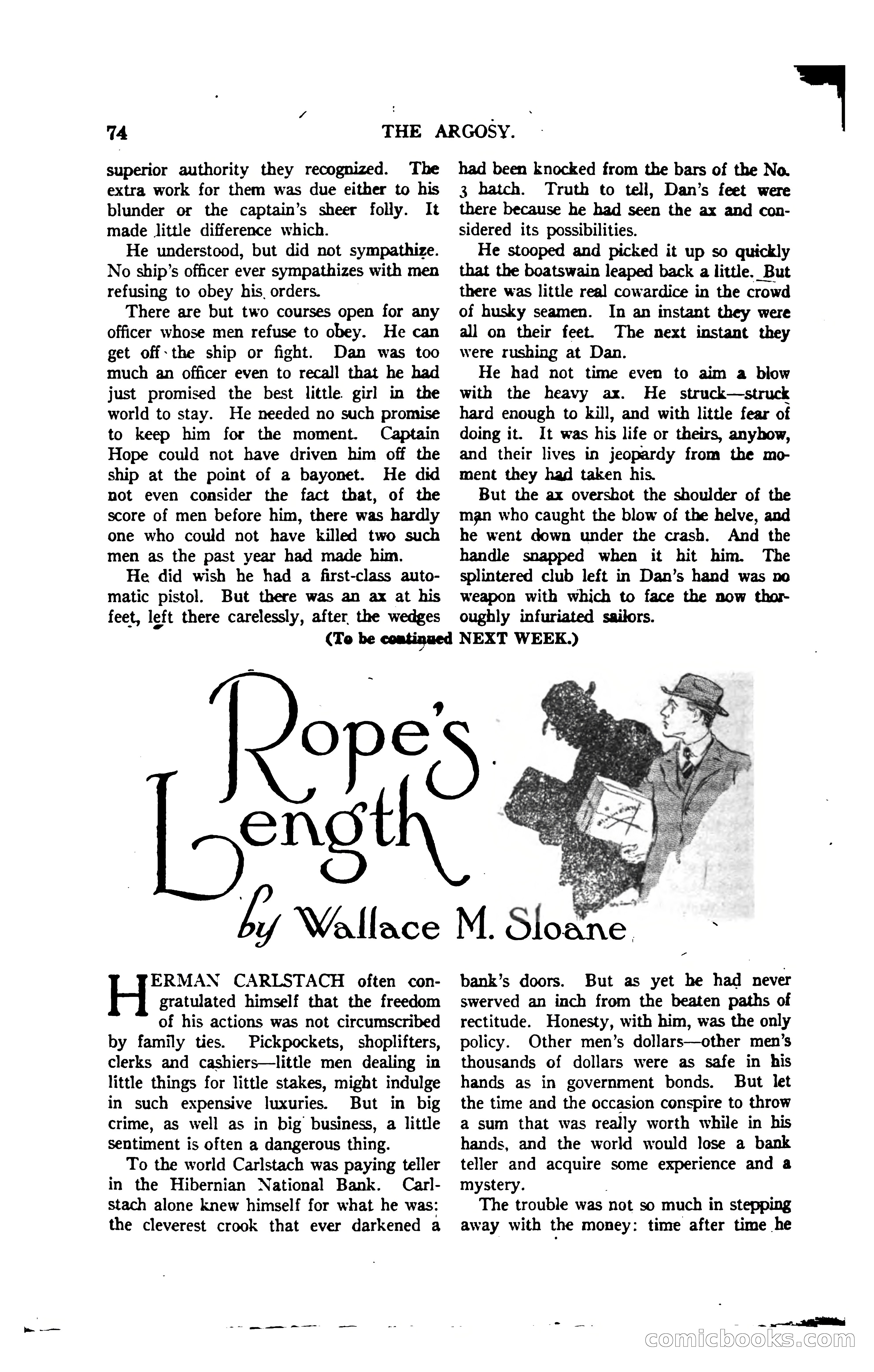
A restored page from Pulp Fiction, 1920. Page through the whole issue in the reader above.
📄 Transcribed text from this page (OCR, searchable)
Machine-transcribed from the original scan — historical spelling and the odd misread are preserved.
7 14 superior authority they recognized. The extra work for them was due either to his blunder or the captain’s sheer folly. It made little difference which. He understood, but did not sympathize. No ship’s officer ever sympathizes with men refusing to obey his. orders. | There are but two courses open for any officer whose men refuse to obey. He can get off-the ship or fight. Dan was too much an officer even to recall that he had just promised the best little. girl in the world to stay. He needed no such promise to keep him for the moment. Captain Hope could not have driven him off the ship at the point of a bayonet. He did not even consider the fact that, of the score of men before him, there was hardly one who could not have killed two such men as the past year had made him. He did wish he had a first-class auto- matic pistol. But there was an ax at his feet, left there carelessly, after, the wedges THE ARGOSY. had been knocked from the bars of the No. 3 hatch. Truth to tell, Dan’s feet were there because he had seen the ax and con- sidered its possibilities. He stooped and picked it up so quickly that the boatswain leaped back a little. But there was little real cowardice in the crowd of husky seamen. In an instant they were all on their feet. The next instant they were rushing at Dan. He had not time even to aim a blow with the heavy ax. He struck—struck hard enough to kill, and with little fear of doing it. It was his life or theirs, anyhow, and their lives in jeopardy from the mo- ment they had taken his. But the ax overshot the shoulder of the man who caught the blow of the helve, and he went down under the crash. And the handle snapped when it hit him. The splintered club left in Dan’s hand was no weapon with which to face the now thor- oughly infuriated sailors. (To be continued NEXT WEEK.) ~ ope engt hy Wallace ERMAN CARLSTACH often con- gratulated himself that the freedom of his actions was not circumscribed by family ties. Pickpockets, shoplifters, clerks and cashiers—little men dealing in little things for little stakes, might indulge in such expensive luxuries. But in big crime, as well as in big business, a little Sentiment is often a dangerous thing. To the world Carlstach was paying teller in the Hibernian National Bank. Carl- stach alone knew himself for what he was: the cleverest crook that ever darkened a ‘. ohh & RS As LS. “\ Beaks —_? M. Sloane Zz bank’s doors. But as yet he had never swerved an inch from the beaten paths of rectitude. Honesty, with him, was the only policy. Other men’s dollars—other men’s thousands of dollars were as safe in his hands as in government bonds. But let the time and the occasion conspire to throw a sum that was really worth while in his hands, and the world would lose a bank teller and acquire some experience and a mystery. The trouble was not so much in stepping away with the money: time after time he ~ 7 comicbools C@