
Pulp Fiction, 1920 · page 94 of 160
Argosy, Vol. 120, No. 1 — page 94: what you’re looking at
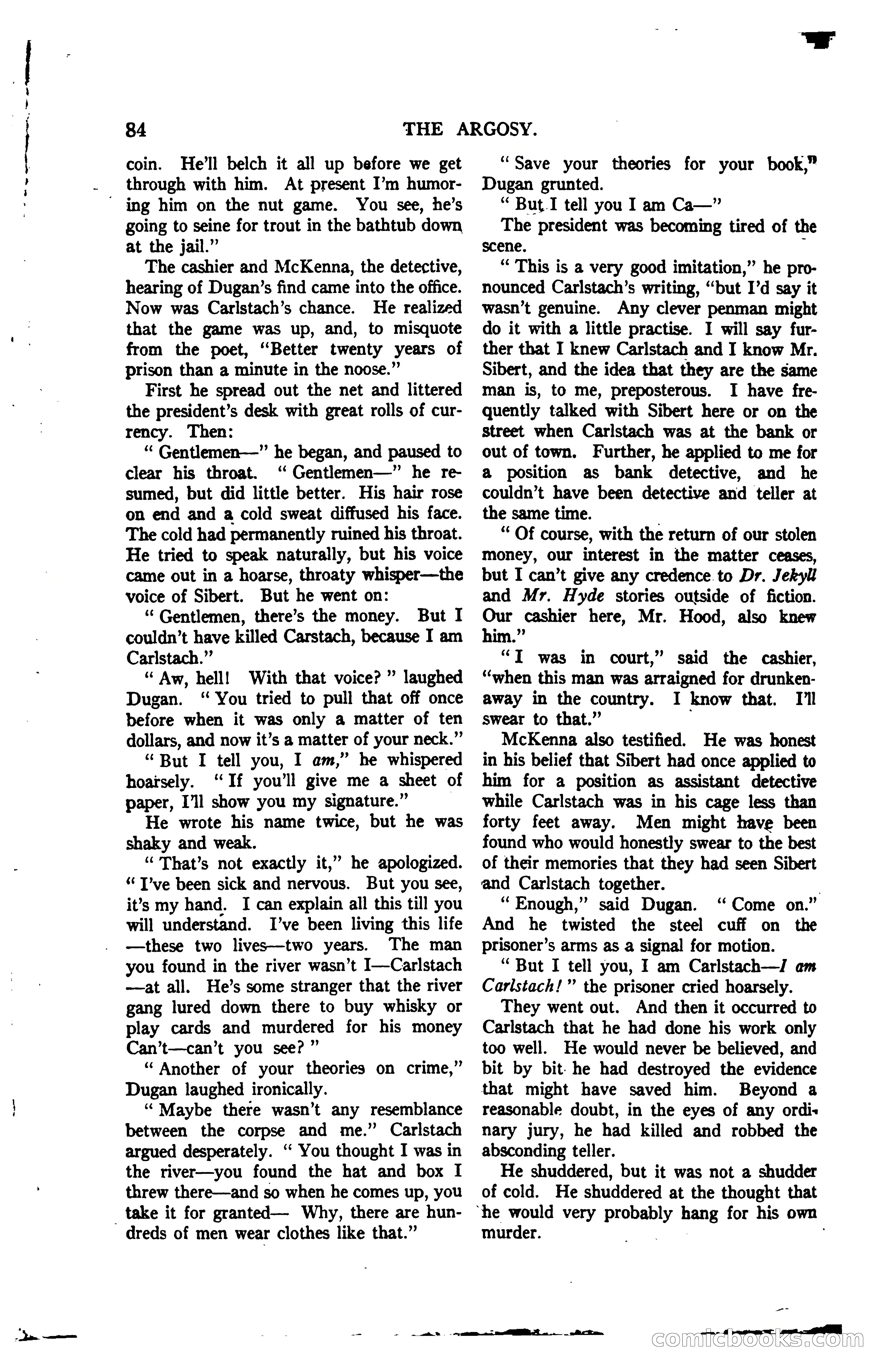
A restored page from Pulp Fiction, 1920. Page through the whole issue in the reader above.
📄 Transcribed text from this page (OCR, searchable)
Machine-transcribed from the original scan — historical spelling and the odd misread are preserved.
- CN ee. Se om AODage ' ing him on the nut game. 84 THE ARGOSY. coin. He'll belch it all up before we get through with him. At present I’m humor- You see, he’s going to seine for trout in the bathtub down at the jail.” The cashier and McKenna, the detective, hearing of Dugan’s find came into the office. Now was Carlstach’s chance. He realized that the game was up, and, to misquote from the poet, ‘Better twenty years of prison than a minute in the noose.” First he spread out the net and littered the president’s desk with great rolls of cur- rency. Then: “‘ Gentlemen—” he began, and paused to clear his throat. ‘“ Gentlemen—” he re- sumed, but did little better. His hair rose on end and a cold sweat diffused his face. The cold had permanently ruined his throat. He tried to speak naturally, but his voice came out in a hoarse, throaty whisper—the voice of Sibert. But he went on: ‘“‘ Gentlemen, there’s the money. But I couldn’t have killed Carstach, because I am Carlstach.” “ Aw, hell! With that voice? ” laughed Dugan. “ You tried to pull that off once before when it was only a matter of ten dollars, and now it’s a matter of your neck.” “But I tell you, I am,” he whispered hoarsely. ‘If you'll give me a sheet of paper, I'll show you my signature.” He wrote his name twice, but he was shaky and weak. “ That’s not exactly it,” he apologized. ‘“‘T’ve been sick and nervous. But you see, it’s my hand. I can explain all this till you will understand. I’ve been living this life —these two lives—two years. The man you found in the river wasn’t I—Carlstach —at all. He’s some stranger that the river gang lured down there to buy whisky or play cards and murdered for his money Can’t—can’t you see?” “ Another of your theories on crime,” Dugan laughed ironically. “Maybe there wasn’t any resemblance between the corpse and me.” Carlstach argued desperately. ‘‘ You thought I was in the river—you found the hat and box I threw there—and so when he comes up, you take it for granted— Why, there are hun- _ dreds of men wear clothes like that.” os ea. ee ll 7 GOMMGDOOIKsS Go ‘Save your theories for your book,” Dugan grunted. ‘ But I tell you I am Ca—” The president was becoming tired of the scene. : ‘ This is a very good imitation,” he pro- nounced Carlstach’s writing, “but I’d say it wasn’t genuine. Any clever penman might do it with a little practise. I will say fur- ther that I knew Carlstach and I know Mr. Sibert, and the idea that they are the same man is, to me, preposterous. I have fre- quently talked with Sibert here or on the street when Carlstach was at the bank or out of town. Further, he applied to me for @ position as bank detective, and he couldn’t have been detective and teller at the same time. | “ Of course, with the return of our stolen money, our interest in the matter ceases, but I can’t give any credence.to Dr. Jekyll and Mr. Hyde stories outside of fiction. Our cashier here, Mr. Hood, also knew him.”’ “YT was in court,” said the cashier, “when this man was arraigned for drunken- away in the country. I know that. I'll swear to that.” McKenna also testified. He was honest in his belief that Sibert had once applied to him for a position as assistant detective while Carlstach was in his cage less than forty feet away. Men might have been found who would honestly swear to the best of their memories that they had seen Sibert and Carlstach together. “Enough,” said Dugan. And he twisted the steel cuff on the prisoner’s arms as a signal for motion. “But I tell you, I am Carlstach—ZJ am Carlstach!”’ the prisoner cried hoarsely. They went out. And then it occurred to Carlstach that he had done his work only too well. He would never be believed, and bit by bit- he had destroyed the evidence that might have saved him. Beyond a reasonable doubt, in the eyes of any ordi+ nary jury, he had killed and robbed the absconding teller. He shuddered, but it was not a shudder of cold. He shuddered at the thought that ‘he would very probably hang for his own murder. —_ “Come on.”