
Pulp Fiction, 1920 · page 127 of 208
Argosy All-Story Weekly — "The Purple Limited" — page 127: what you’re looking at
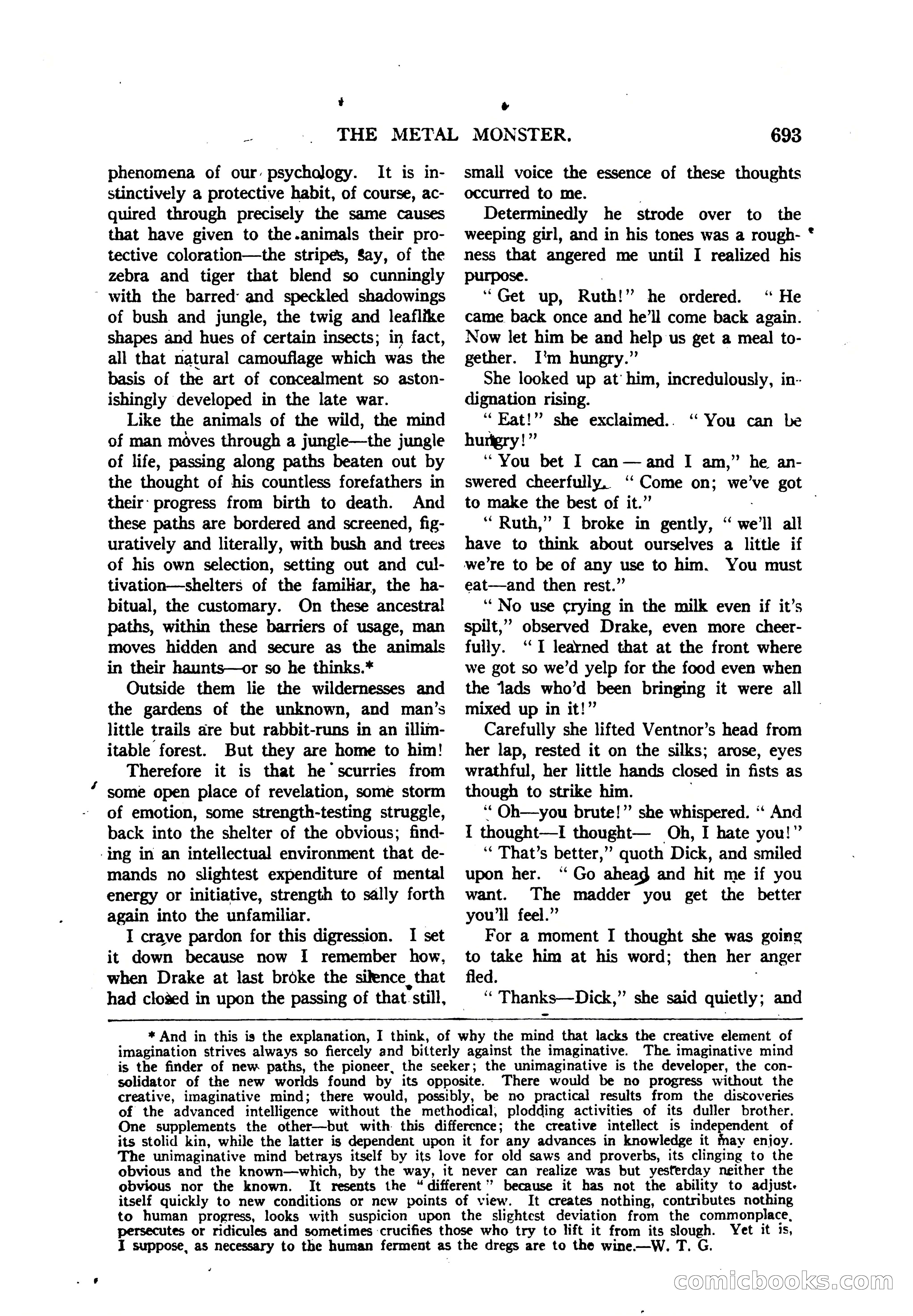
A restored page from Pulp Fiction, 1920. Page through the whole issue in the reader above.
📄 Transcribed text from this page (OCR, searchable)
Machine-transcribed from the original scan — historical spelling and the odd misread are preserved.
t - °, THE phenomena of our psychology. It is in- stinctively a protective habit, of course, ac- quired through precisely the same causes that have given to the.animals their pro- tective coloration—the stripes, Say, of the zebra and tiger that blend so cunningly ’ with the barred: and speckled shadowings of bush and jungle, the twig and leaflike shapes and hues of certain insects; in fact, all that natural camouflage which was the basis of the art of concealment so aston- ishingly developed in the late war. Like the animals of the wild, the mind of man moves through a jungle—the jungle of life, passing along paths beaten out by the thought of his countless forefathers in their: progress from birth to death. And these paths are bordered and screened, fig- uratively and literally, with bush and trees of his own selection, setting out and cul- tivation—shelters of the familar, the ha- bitual, the customary. On these ancestral paths, within these barriers of usage, man moves hidden and secure as the animals in their haunts—or so he thinks.* Outside them lie the wildernesses and the gardens of the unknown, and man’s little trails are but rabbit-runs in an illim- itable forest. But they are home to him! Therefore it is that he scurries from some open place of revelation, some storm of emotion, some strength-testing struggle, back into the shelter of the obvious; find- -ing in an intellectual environment that de- mands no slightest expenditure of mental energy or initiative, strength to sally forth again into the unfamiliar. I crave pardon for this digression. I set it down because now I remember how, when Drake at last broke the silence that had closed in upon the passing of that. still, METAL + MONSTER, 693 small voice the essence of these thoughts occurred to me. . Determinedly he strode over to the weeping girl, and in his tones was a rough- ness that angered me until I realized his purpose. ‘Get up, Ruth! ” he ordered. “ He came back once and he’ll come back again. Now let him be and help us get a meal to- gether. I'm hungry.” She looked up at’ him, incredulously, in-. dignation rising. “Eat!” she exclaimed.. hurigry!”’ ‘You bet I can — and I am,” he an- “You can be swered cheerfully, ‘‘ Come on; we’ve got to make the best of it.” “Ruth,” I broke in gently, “ we'll all have to think about ourselves a little if we're to be of any use to him. You must eat—and then rest.” ‘““No use crying in the milk even if it’s spilt,’ observed Drake, even more cheer- fully. ‘I learned that at the front where we got so we’d yelp for the food even when the lads who’d been bringing it were all mixed up in it!” Carefully she lifted Ventnor’s head from her lap, rested it on the silks; arose, eves wrathful, her little hands closed in fists as though to strike him. ‘“ Oh—you brute!” she whispered. “‘ And I thought—I thought— Oh, I hate you!” ‘“‘ That’s better,” quoth Dick, and smiled upon her. “Go aheag and hit me if you want. The madder you get the better you'll feel.” For a moment I thought she was going to take him at his word; then her anger fled. * And in this is the explanation, I think, of why the mind that lacks the creative element of imagination strives always so fiercely and bitterly against the imaginative. The imaginative mind is the finder of new paths, the pioneer, the seeker; the unimaginative is the developer, the con- solidator of the new worlds found by its opposite. There would be no progress without the creative, imaginative mind; there would, possibly, be no practical results from the discoveries of the advanced intelligence without the methodical, plodding activities of its duller brother. One supplements the other—but with. this difference; the creative intellect is independent. of its stolid kin, while the latter is dependent upon it for any advances in knowledge it may enjoy. The unimaginative mind betrays itself by its love for old saws and proverbs, its clinging to the obvious and the known—which, by the way, it never can realize was but yesterday neither the obvious nor the known. itself quickly to new conditions or new points of view. It resents the “different because it has not the ability to adjust. It creates nothing, contributes nothing to human progress, looks with suspicion upon the slightest deviation from the Ma ns persecutes or ridicules and sometimes -crucifies those who try to lift it from its slough. Yet it is I suppose, as necessary to the human ferment as the dregs are to the wine —W. T. G. ‘é Thanks— Dick, ”? she said quietly; and mG 6)(0)©) (C(O) S (C(O)