
Pulp Fiction, 1920 · page 140 of 208
Argosy All-Story Weekly — "The Purple Limited" — page 140: what you’re looking at
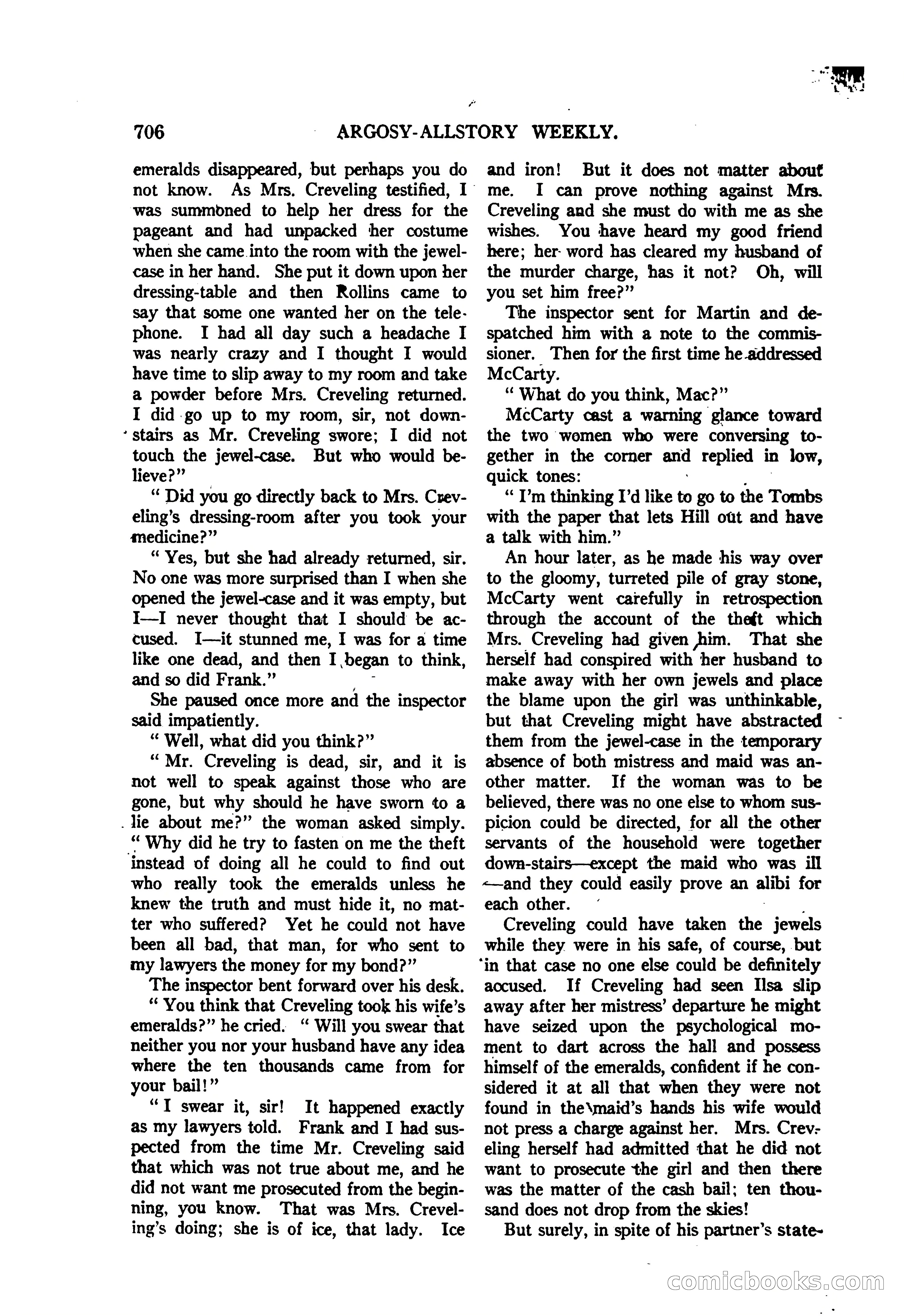
A restored page from Pulp Fiction, 1920. Page through the whole issue in the reader above.
📄 Transcribed text from this page (OCR, searchable)
Machine-transcribed from the original scan — historical spelling and the odd misread are preserved.
Fad ARGOSY-ALLSTORY WEEKLY. 706 emeralds disappeared, but perhaps you do not know. As Mrs. Creveling testified, I ‘was summoned to help her dress for the pageant and had unpacked her costume when she came into the room with the jewel- case in her hand. She put it down upon her dressing-table and then Rollins came to say that some one wanted her on the tele- phone. I had all day such a headache I was nearly crazy and I thought I would have time to slip away to my room and take a powder before Mrs. Creveling returned. I did go up to my room, sir, not down- ‘stairs as Mr. Creveling swore; I did not touch the jewel-case. But who would be- lieve?” “ Did you go directly back to Mrs. Crev- eling’s dressing-room after you took your amedicine?”’ “Yes, but she had already returned, sir. No one was more surprised than I when she opened the jewel-case and it was empty, but I—TI never thought that I should be ac- cused. I—#it stunned me, I was for a time like one dead, and then T began to think, and so did F rank. ” She paused once more and the inspector said impatiently. “Well, what did you think?” “Mr. Creveling is dead, sir, and it is not well to speak against those who are gone, but why should he have sworn to a _lie about me?” the woman asked simply. “Why did he try to fasten on me the theft instead of doing all he could to find out who really took the emeralds unless he knew the truth and must hide it, no mat- ter who suffered? Yet he could not have been all bad, that man, for who sent to my lawyers the money for my bond?” The inspector bent forward over his desk. “You think that Creveling took his wife’s emeralds?” he cried. “ Will you swear that neither you nor your husband have any idea where the ten thousands came from for your bail!” “T swear it, sir! It happened exactly as my lawyers told. Frank and I had sus- pected from the time Mr. Creveling said that which was not true about me, and he did not want me prosecuted from the begin- ning, you know. That was Mrs. Crevel- ing’s doing; she is of ice, that lady. Ice and iron! But it does not matter about me. I can prove nothing against Mrs. Creveling and she must do with me as she wishes. You ‘have heard my good friend here; her- word has cleared my husband of the murder charge, has it not? Oh, will you set him free?”’ The inspector sent for Martin and de- spatched him with a note to the commis- sioner. Then for the first time he addressed McCarty. “What do you think, Mac?” McCarty cast a warning glance toward the two women who were conversing to- gether in the corner and replied in low, quick tones: “ T’m thinking I'd like to go to the Tombs with the paper that lets Hill oat and have a talk with him.” An hour later, as he made his way over to the gloomy, turreted pile of gray stone, McCarty went carefully in retrospection through the account of the theft which Mrs. Creveling had given him. That she herself had conspired with her husband to make away with her own jewels and place the blame upon the girl was unthinkable, re 6 but that Creveling might have abstracted - them from the jewel-case in the temporary absence of both mistress and maid was an- other matter. If the woman was to be believed, there was no one else to whom sus- picion could be directed, for all the other servants of the household were together down-stairs—except the maid who was ill <—and they could easily prove an anbh for each other. Creveling could have taken the jewels while they were in his safe, of course, but ‘in that case no one else could be definitely accused. If Creveling had seen Ilsa slip away after her mistress’ departure he might have seized upon the psychological mo- ment to dart across the hall and possess himself of the emeralds, confident if he con- sidered it at all that when they were not found in the\maid’s hands his wife would not press a charge against her. Mrs. Crev- eling herself had admitted that he did not want to prosecute the girl and then there was the matter of the cash bail; ten thou- sand does not drop from the skies! But surely, in spite of his partner’s state~- nn) OO) (C(O) A S. (C(O)