
Pulp Fiction, 1920 · page 32 of 208
Argosy All-Story Weekly — "The Purple Limited" — page 32: what you’re looking at
A restored page from Pulp Fiction, 1920. Page through the whole issue in the reader above.
📄 Transcribed text from this page (OCR, searchable)
Machine-transcribed from the original scan — historical spelling and the odd misread are preserved.
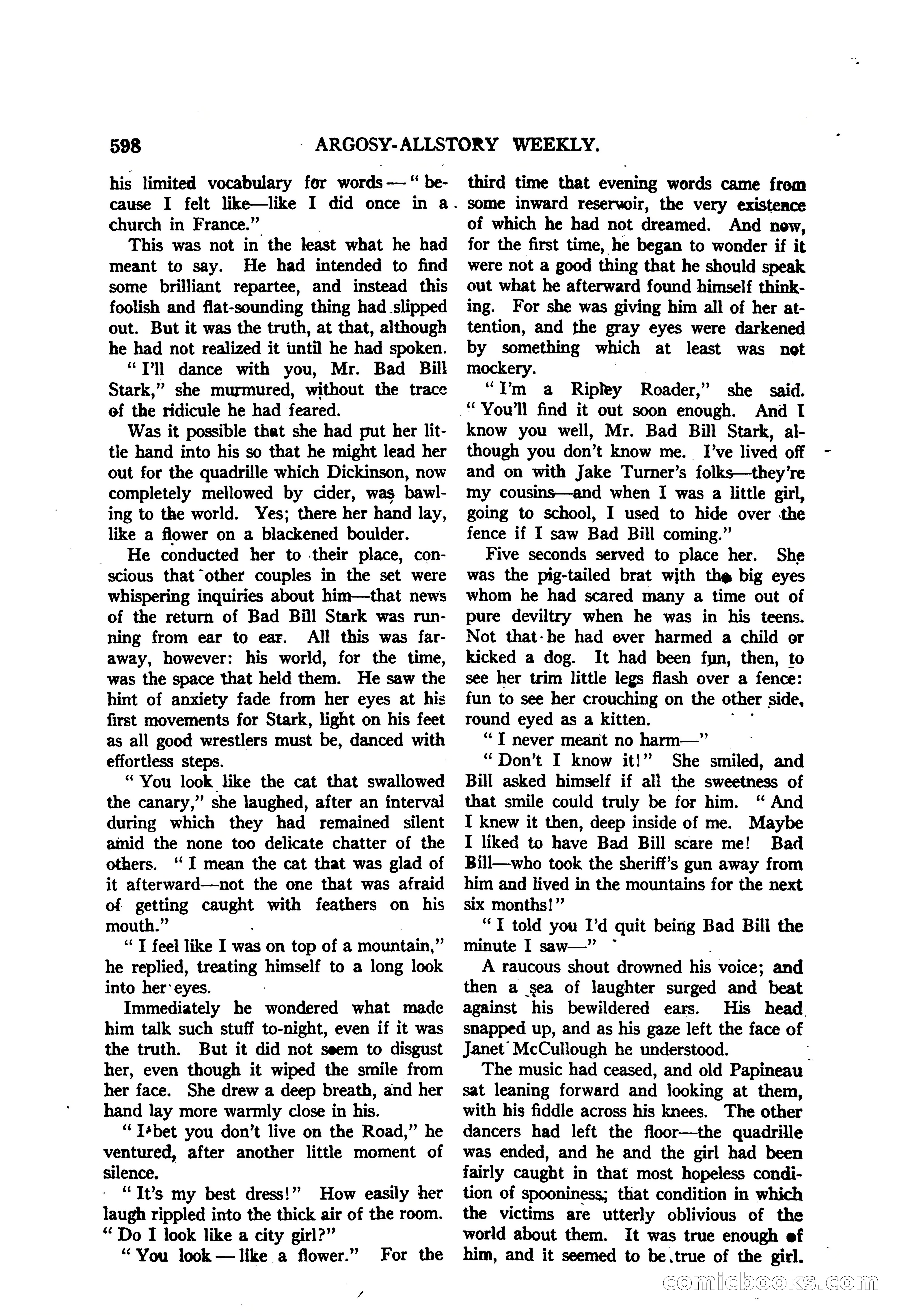
598 his limited vocabulary for words — “ be- cause I felt like—like I did once in a. church in France.” This was not in the least what he had meant to say. He had intended to find some brilliant repartee, and instead this foolish and flat-sounding thing had slipped out. But it was the truth, at that, although he had not realized it until he had spoken. “Pll dance with you, Mr. Bad Bill Stark,” she murmured, without the trace of the ridicule he had feared. Was it possible that she had put her lit- tle hand into his so that he might lead her out for the quadrille which Dickinson, now completely mellowed by cider, was bawl- ing to the world. Yes; there her hand lay, like a flower on a blackened boulder. _ He conducted her to their place, con- scious that “other couples in the set were whispering inquiries about him—that news of the return of Bad Bill Stark was run- ning from ear to ear. All this was far- away, however: his world, for the time, was the space that held them. He saw the hint of anxiety fade from her eyes at his first movements for Stark, light on his feet as all good wrestlers must be, danced wath effortless steps. “You look like the cat that swallowed the canary,” she laughed, after an interval during which they had remained silent amid the none too delicate chatter of the others. ‘‘I mean the cat that was glad of it afterward—not the one that was afraid of. getting caught with feathers on his mouth.” “ T feel like I was on top of a mountain,” he replied, treating himself to a long look into her eyes. Immediately he wondered what made him talk such stuff to-night, even if it was the truth. But it did not seem to disgust her, even though it wiped the smile from her face. She drew a deep breath, and her hand lay more warmly close in his. “‘I¢bet you don’t live on the Road,” he ventured, after another little moment of silence. “It’s my best dress!”’ How easily her laugh rippled into the thick air of the room. “Do I look like a city girl?” “You look — like a flower.” For the 7 - ARGOSY-ALLSTORY WEEKLY. third time that evening words came ftom some inward reserwoir, the very existence of which he had not dreamed. And new, for the first time, he began to wonder if it were not a good thing that he should speak out what he afterward found himself think- ing. For she was giving him all of her at- tention, and the gray eyes were darkened by something which at least was not mockery “Tm a Ripley Roader,” she said. “You'll find it out soon enough. And I know you well, Mr. Bad Bill Stark, al- though you don’t know me. I’ve lived off and on with Jake Turner’s folks—they’re my cousins—and when I was a little girl, going to school, I used to hide over the fence if I saw Bad Bill coming.” Five seconds served to place her. She was the pig-tailed brat with the big eyes whom he had scared many a time out of pure deviltry when he was in his teens. Not that-he had ever harmed a child er kicked a dog. It had been fyn, then, to see her trim little legs flash over a fence: fun to see her crouching on the other side, round eyed as a kitten. “T never meant no harm—’”’ “Don’t I know it!” She smiled, and Bill asked himself if all the sweetness of that smile could truly be for him. “ And I knew it then, deep inside of me. Maybe I liked to have Bad Bill scare me! Bad Bill—-who took the sheriff’s gun away from him and lived in the mountains for the next six months!” “IT told you I’d quit being Bad Bill the minute I saw—” ~ A raucous shout drowned his voice; and then a sea of laughter surged and beat against his bewildered ears. Janet McCullough he understood. The music had ceased, and old Papineau ~ sat leaning forward and looking at them, with his fiddle across his knees. The other dancers had left the floor—the quadrille was ended, and he and the girl had been fairly caught in that most hopeless condi- tion of spooniness; that condition in which the victims are utterly oblivious of the world about them. It was true enough ef him, and it seemed to be.true of the girl. connuicle OO S His head. snapped up, and as his gaze left the face of Conn