
Pulp Fiction, 1920 · page 53 of 208
Argosy All-Story Weekly — "The Purple Limited" — page 53: what you’re looking at
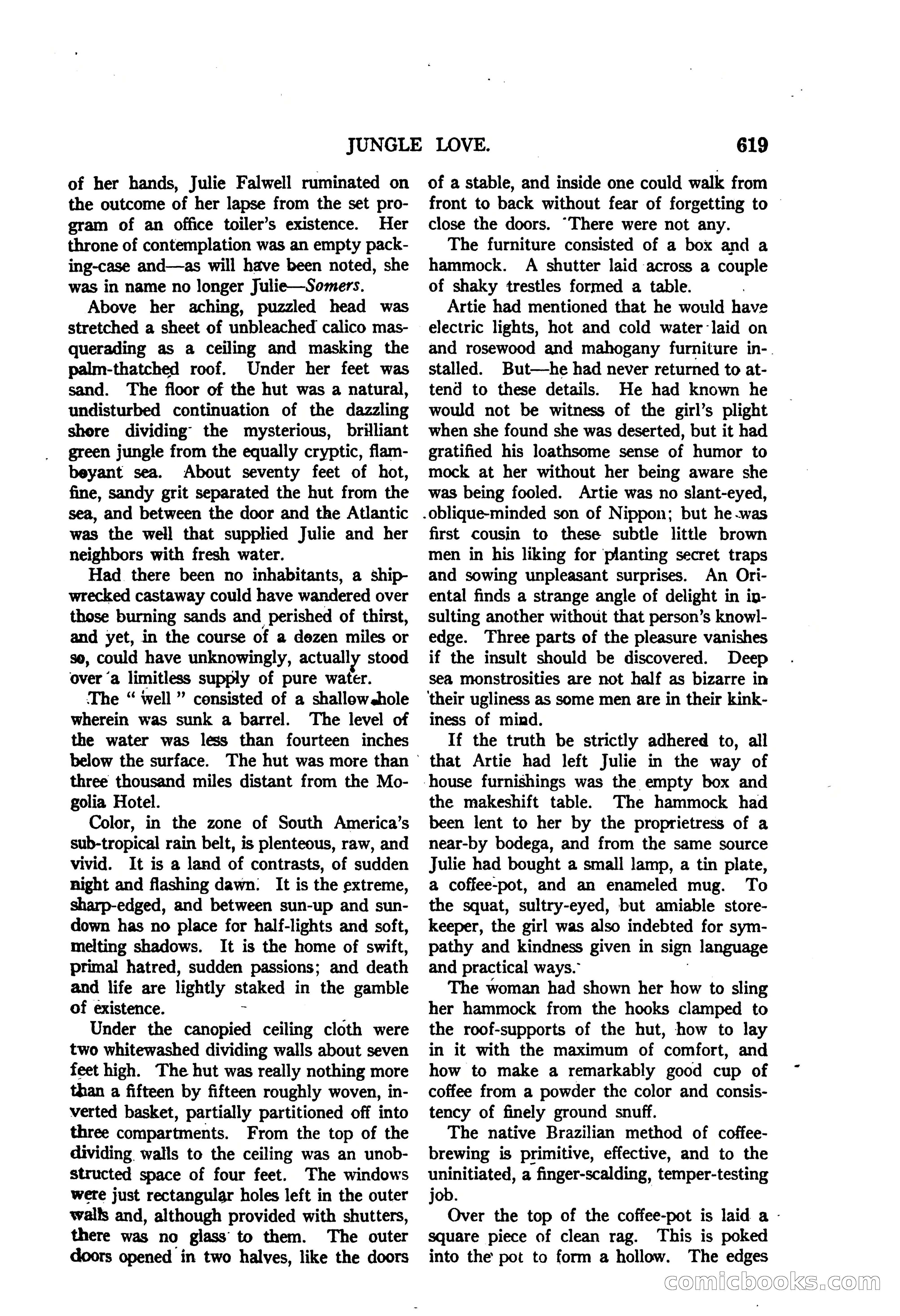
A restored page from Pulp Fiction, 1920. Page through the whole issue in the reader above.
📄 Transcribed text from this page (OCR, searchable)
Machine-transcribed from the original scan — historical spelling and the odd misread are preserved.
JUNGLE LOVE. of her hands, Julie Falwell ruminated on the outcome of her lapse from the set pro- gram of an office toiler’s existence. Her throne of contemplation was an empty pack- ing-case and—as will have been noted, she was in name no longer Julie—Somers. Above her aching, puzzled head was stretched a sheet of unbleached calico mas- querading as a ceiling and masking the palm-thatched roof. Under her feet was sand. The floor of the hut was a natural, undisturbed continuation of the dazzling shore dividing the mysterious, brilliant green jungle from the equally cryptic, flam- beyant sea. About seventy feet of hot, fine, sandy grit separated the hut from the sea, and between the door and the Atlantic was the well that supplied Julie and her neighbors with fresh water. Had there been no inhabitants, a ship- wrecked castaway could have wandered over those burning sands and perished of thirst, and yet, in the course of a dezen miles or so, could have unknowingly, actually stood over ‘a limitless supply of pure water. The “ well ” consisted of a shallowshole wherein was sunk a barrel. The level of the water was less than fourteen inches below the surface. three thousand miles distant from the Mo- golia Hotel. Color, in the zone of South America’s sub-tropical rain belt, is plenteous, raw, and vivid. It is a land of contrasts, of sudden hight and flashing dawn: It is the extreme, sharp-edged, and between sun-up and sun- down has no place for half-lights and soft, melting shadows. It is the home of swift, primal hatred, sudden passions; and death and life are lightly staked in the gamble of existence. Under the canopied ceiling cloth were two whitewashed dividing walls about seven feet high. The hut was really nothing more than a fifteen by fifteen roughly woven, in- verted basket, partially partitioned off into three compartments. From the top of the dividing walls to the ceiling was an unob- structed space of four feet. The windows were just rectangular holes left in the outer walls and, although provided with shutters, there was no glass to them. The outer doors opened in two halves, like the doors The hut was more than | 619 of a stable, and inside one could walk from front to back without fear of forgetting to — close the doors. “There were not any. The furniture consisted of a box and a hammock. A shutter laid across a couple of shaky trestles formed a table. Artie had mentioned that he would have electric lights, hot and cold water laid on and rosewood and mahogany furniture in-. stalled. But—he had never returned to at- tend to these details. He had known he would not be witness of the girl’s plight when she found she was deserted, but it had gratified his loathsome sense of humor to mock at her without her being aware she was being fooled. Artie was no slant-eyed, -oblique-minded son of Nippon; but he -was first cousin to these subtle little brown men in his liking for planting secret traps and sowing unpleasant surprises. An Ori- ental finds a strange angle of delight in in- sulting another without that person’s know!]- edge. Three parts of the pleasure vanishes if the insult should be discovered. Deep sea monstrosities are not half as bizarre in ‘their ugliness as some men are in their kink- Iness of mind. If the truth be strictly adhered to, all that Artie had left Julie in the way of ‘house furnishings was the empty box and the makeshift table. The hammock had been lent to her by the proprietress of a near-by bodega, and from the same source Julie had bought a small lamp, a tin plate, a coffee-pot, and an enameled mug. To the squat, sultry-eyed, but amiable store- keeper, the girl was also indebted for sym- pathy and kindness given in sign language and practical ways.” The woman had shown her how to sling her hammock from the hooks clamped to the roof-supports of the hut, how to lay in it with the maximum of comfort, and how to make a remarkably good cup of coffee from a powder the color and consis- tency of finely ground snuff. The native Brazilian method of coffee- brewing is primitive, effective, and to the uninitiated, a finger-scalding, temper-testing job. Over the top of the coffee-pot is laid a - square piece of clean rag. This is poked into the pot to form a hollow. The edges CONMUC CO NOOK