
Pulp Fiction, 1920 · page 60 of 208
Argosy All-Story Weekly — "The Purple Limited" — page 60: what you’re looking at
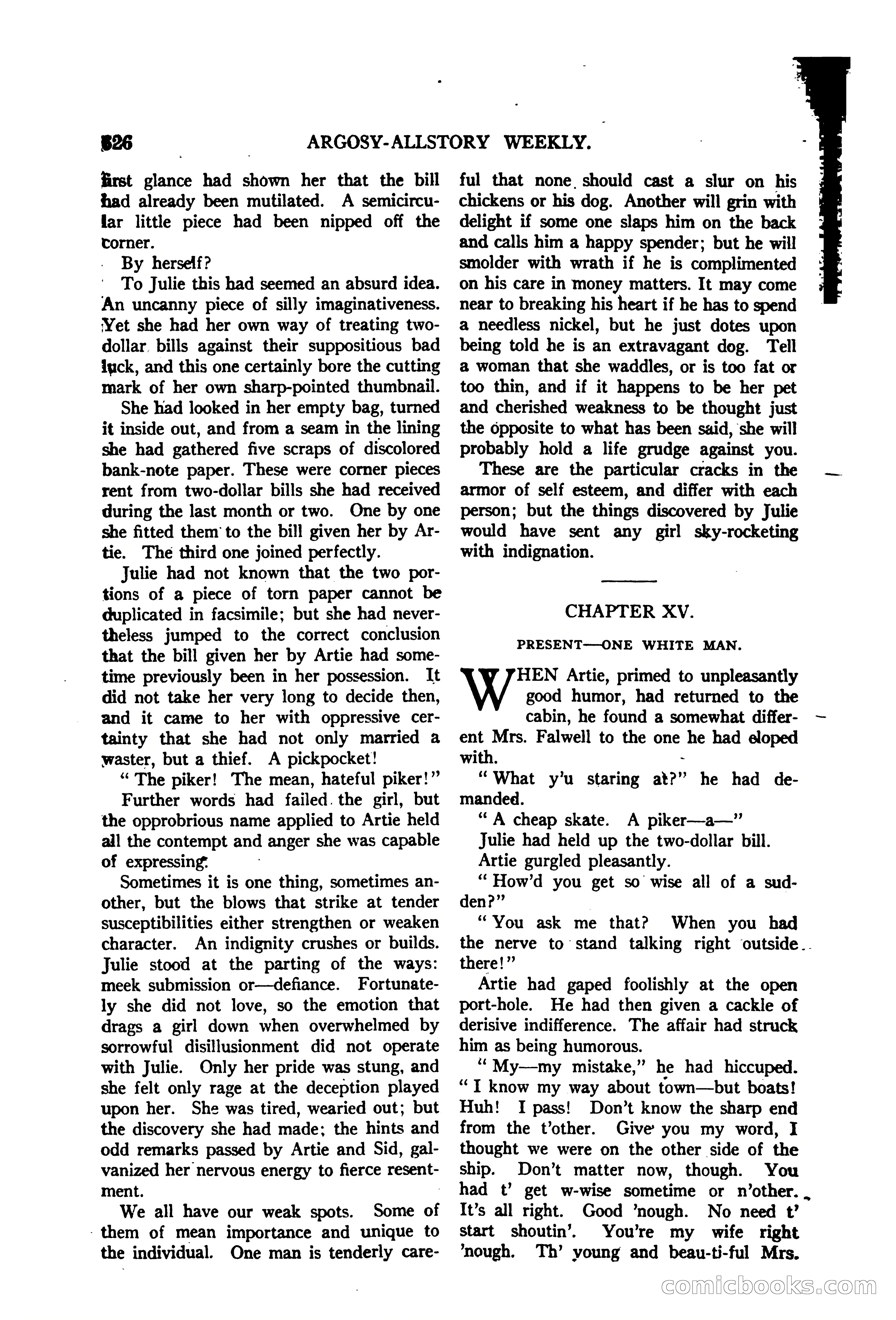
A restored page from Pulp Fiction, 1920. Page through the whole issue in the reader above.
📄 Transcribed text from this page (OCR, searchable)
Machine-transcribed from the original scan — historical spelling and the odd misread are preserved.
626 first glance had shown her that the bill had already been mutilated. A semicircu- far little piece had been nipped off the corner. By herself? To Julie this had seemed an absurd idea. An uncanny piece of silly imaginativeness. Yet she had her own way of treating two- dollar. bills against their suppositious bad Juck, and this one certainly bore the cutting mark of her own sharp-pointed thumbnail. She had looked in her empty bag, turned it inside out, and from a seam in the lining she had gathered five scraps of discolored bank-note paper. These were corner pieces rent from two-dollar bills she had received during the last month or two. One by one she fitted them’ to the bill given her by Ar- tie. The third one joined perfectly. Julie had not known that the two por- tions of a piece of torn paper cannot be duplicated in facsimile; but she had never- theless jumped to the correct conclusion that the bill given her by Artie had some- time previously been in her possession. It did not take her very long to decide then, and it came to her with oppressive cer- tainty that she had not only married a waster, but a thief. A pickpocket! “The piker! The mean, hateful piker!” Further words had failed. the girl, but the opprobrious name applied to Artie held ail the contempt and anger she was capable of expressing. Sometimes it is one thing, sometimes an- other, but the blows that strike at tender susceptibilities either strengthen or weaken character. An indignity crushes or builds. Julie stood at the parting of the ways: meek submission or—defiance. Fortunate- ly she did not love, so the emotion that drags a girl down when overwhelmed by sorrowful disillusionment did not operate with Julie. Only her pride was stung, and she felt only rage at the deception played upon her. She was tired, wearied out; but the discovery she had made; the hints and odd remarks passed by Artie and Sid, gal- vanized her nervous energy to fierce resent- ment. We all have our weak spots. Some of - them of mean importance and unique to the individual. One man is tenderly care- ARGOSY-ALLSTORY WEEKLY. ful that none. should cast a slur on his chickens or his dog. Another will grin with delight if some one slaps him on the back and calls him a happy spender; but he will smolder with wrath if he is complimented on his care in money matters. It may come near to breaking his heart if he has to spend a needless nickel, but he just dotes upon being told he is an extravagant dog. Tell a woman that she waddles, or is too fat or too thin, and if it happens to be her pet and cherished weakness to be thought just the opposite to what has been said, she will probably hold a life grudge against you. These are the particular cracks in the armor of self esteem, and differ with each person; but the things discovered by Julie would have sent any girl sky-rocketing with indignation. | CHAPTER XV. PRESENT—ONE WHITE MAN. HEN Artie, primed to unpleasantly good humor, had returned to the cabin, he found a somewhat differ- ent Mrs. Falwell to the one he had eloped with. : “What y’u staring at?” he had de- manded. ‘“‘A cheap skate. A piker—a—”’ Julie had held up the two-dollar bill. Artie gurgled pleasantly. ““How’d you get so wise all of a sud- den?” “You ask me that? When you had the nerve to stand talking right outside... there!” Artie had gaped foolishly at the open port-hole. He had then given a cackle of derisive indifference. The affair had struck him as being humorous. ‘““My—my mistake,” he had hiccuped. “TI know my way about town—but boats! Huh! I pass! Don’t know the sharp end from the t’other. Give you my word, I thought we were on the other side of the ship. Don’t matter now, though. You had t’ get w-wise sometime or n/’other. It’s all right. Good ’nough. No need t’ start shoutin’. You’re my wife right ‘nough. Th’ voung and beau-ti-ful Mrs. COMICLOO S CO