
Pulp Fiction, 1921 · page 105 of 146
Argosy All-Story Weekly, February 5, 1921 — page 105: what you’re looking at
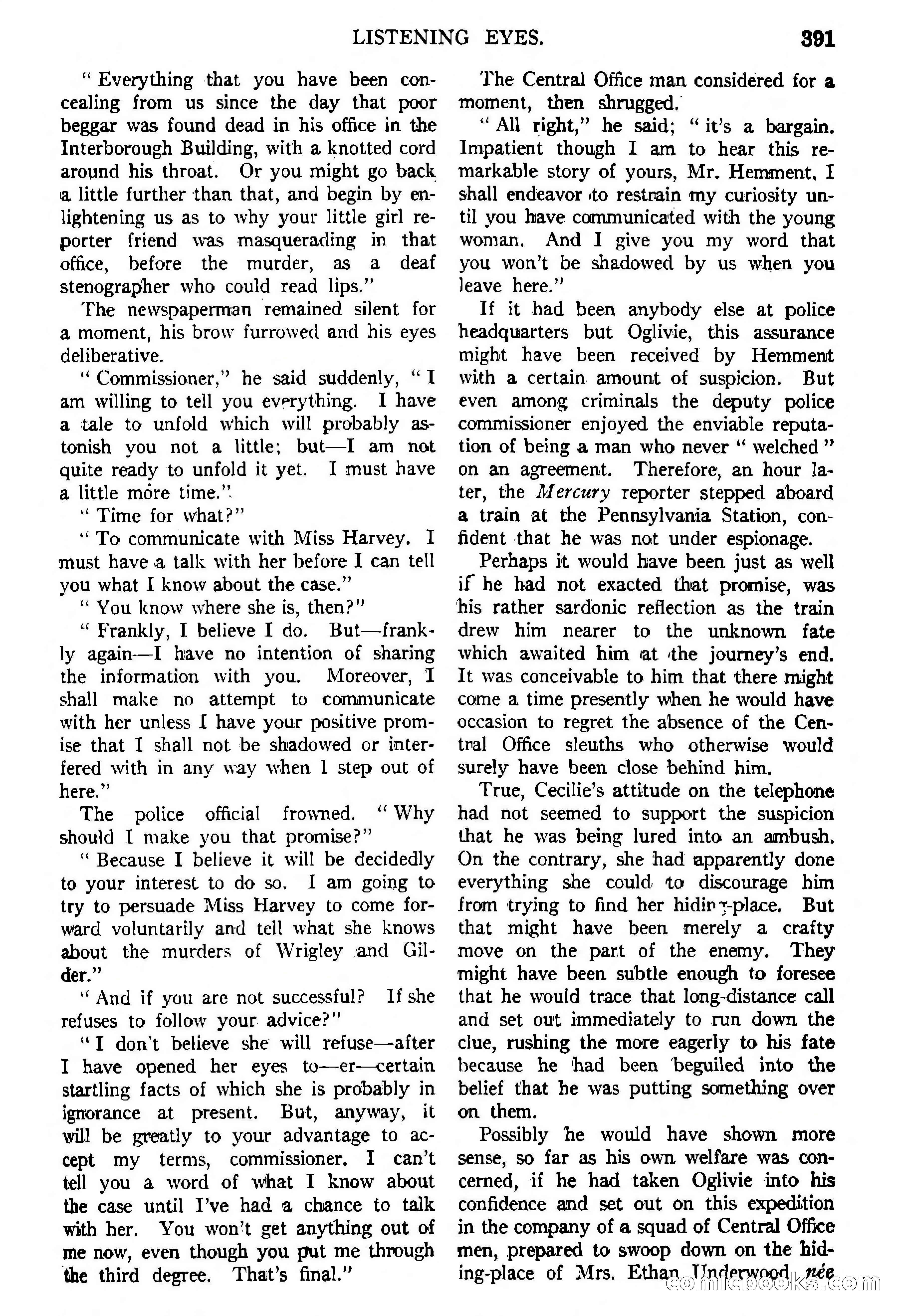
A restored page from Pulp Fiction, 1921. Page through the whole issue in the reader above.
📄 Transcribed text from this page (OCR, searchable)
Machine-transcribed from the original scan — historical spelling and the odd misread are preserved.
LISTENING EYES. ‘““ Everything that you have been con- cealing from us since the day that poor beggar was found dead in his office in the Interborough Building, with a knotted cord around his throat. Or you might go back a little further than that, and begin by en- lightening us as to why your little girl re- porter friend was masquerading in that office, before the murder, as a deaf stenographer who could read lips.” The newspaperman remained silent for a moment, his brow furrowed and his eyes deliberative. “Commissioner,” he said suddenly, “I am willing to tell you everything. I have a tale to unfold which will probably as- tonish vou not a little; but—I am not quite ready to unfold it yet. J must have a little more time.” “Time for what?” ‘“To communicate with Miss Harvey. I must have a talk with her before I can tell you what I know about the case.” ‘You know where she is, then?” ‘Frankly, I believe I do. But—frank- ly again—I have no intention of sharing the information with you. Moreover, I shall make no attempt to communicate with her unless I have your positive prom- ise that I shall not be shadowed or inter- fered with in any way when | step out of here.” The police official frowned. should I make you that promise?” ‘Because I believe it will be decidedly to your interest to do so. I am going to try to persuade Miss Harvey to come for- ward voluntarily and tell what she knows about the murders of Wrigley and Gil- der.” “ And if you are not successful? refuses to follow your. advice?” “T don't believe she will refuse—after I have opened her eyes to—er—certain startling facts of which she is probably in ignorance at present. But, anyway, it will be greatly to your advantage to ac- cept my terms, commissioner. I can’t tell you a word of what I know about the case until I’ve had a chance to talk with her. You won’t get anything out of me now, even though you put me through the third degree. That’s final.” If she 391 The Central Office man considered for a moment, then shrugged. ‘All right,” he said; “ it’s a bargain. Impatient though I am to hear this re- markable story of yours, Mr. Hemment, I shall endeavor :to restrain my curiosity un- til you have communicated with the young woman, And I give you my word that you won’t be shadowed by us when you Jeave here.” If it had been anybody else at police headquarters but Oglivie, this assurance might have been received by Hemment with a certain amount of suspicion. But even among criminals the deputy police commissioner enjoyed the enviable reputa- tion of being a man who never ‘‘ welched ” on an agreement. Therefore, an hour la- ter, the Mercury reporter stepped aboard a train at the Pennsylvania Station, con- fident that he was not under espionage. Perhaps it would have been just as well if he had not exacted that promise, was his rather sardonic reflection as the train drew him nearer to the unknown fate which awaited him at ‘the journey’s end. It was conceivable to him that there might come a time presently when he would have occasion to regret the absence of the Cen- tral Office sleuths who otherwise would surely have been close behind him. True, Cecilie’s attitude on the telephone had not seemed to support the suspicion that he was being lured into an ambush. On the contrary, she had apparently done everything she could to discourage him from trying to find her hidiry-place, But that might have been merely a crafty move on the part of the enemy. They might have been subtle enough to foresee that he would trace that long-distance call and set out immediately to run down the clue, rushing the more eagerly to his fate because he ‘had been ‘beguiled into the belief that he was putting something over on them. Possibly he would have shown more sense, so far as his own welfare was con- cerned, if he had taken Oglivie into his confidence and set out on this expedition in the company of a squad of Central Office men, prepared to swoop down on the hid- 4 ing-place of Mrs. Ethan Underwood) née.