
Pulp Fiction, 1921 · page 107 of 146
Argosy All-Story Weekly, February 5, 1921 — page 107: what you’re looking at
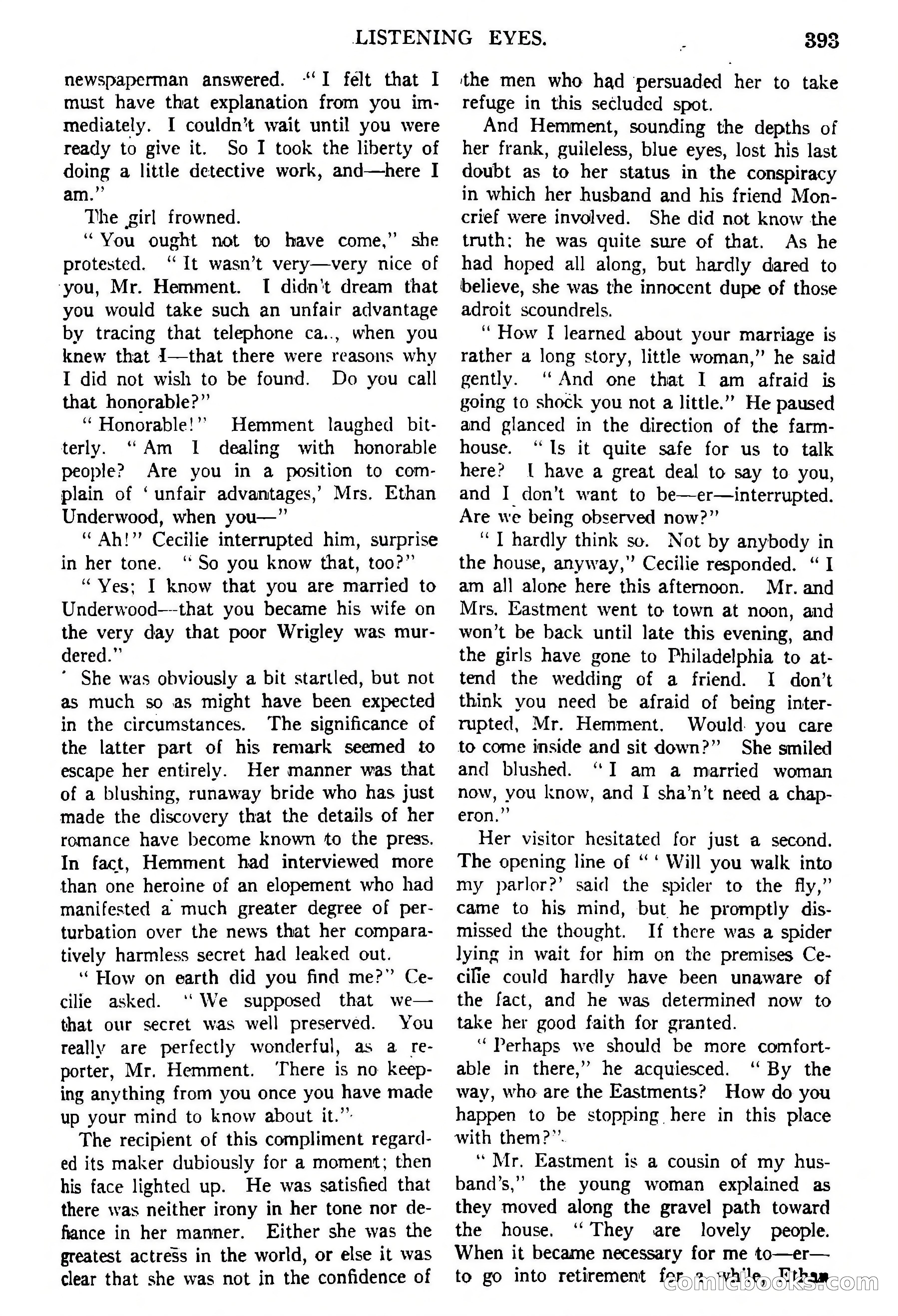
A restored page from Pulp Fiction, 1921. Page through the whole issue in the reader above.
📄 Transcribed text from this page (OCR, searchable)
Machine-transcribed from the original scan — historical spelling and the odd misread are preserved.
LISTENING EVES. . 398 newspaperman answered. “‘I felt that I must have that explanation from you im- mediately. I couldn’t wait until you were ready to give it. So I took the liberty of doing a little detective work, and—here I am.” The girl frowned. “You ought not to have come,” she protested. “ It wasn’t very—very nice of ‘you, Mr. Hemment. I didn't dream that you would take such an unfair advantage by tracing that telephone ca.., when you knew that J—that there were reasons why I did not wish to be found. Do you call that honorable?”’ ‘“ Honorable!’* Hemment laughed bit- terly. “Am 1 dealing with honorable people? Are you in a position to com- plain of ‘ unfair advantages,’ Mrs. Ethan Underwood, when you—”’ ‘ Ah!’’ Cecilie interrupted him, surprise in her tone. ‘ So you know that, too?” “Yes; I know that you are married to Underwood—-that you became his wife on the very day that poor Wrigley was mur- dered.” " She was obviously a bit startled, but not as much so as might have been expected in the circumstances. The significance of the latter part of his remark seemed to escape her entirely. Her manner was that of a blushing, runaway bride who has just made the discovery that the details of her romance have become known to the press. In fact, Hemment had interviewed more than one heroine of an elopement who had manifested a much greater degree of per- turbation over the news that her compara- tively harmless secret had leaked out. ‘How on earth did you find me?” Ce- cilie asked. ‘‘ We supposed that we— that our secret was well preserved. You really are perfectly wonderful, as a re- porter, Mr. Hemment. There is no keep- ing anything from you once you have made up your mind to know about it.” The recipient of this compliment regard- ed its maker dubiously for a moment; then his face lighted up. He was satisfied that there was neither irony in her tone nor de- fiance in her manner. Either she was the greatest actress in the world, or else it was clear that she was not in the confidence of ithe men who had persuaded her to take refuge in this secluded spot. And Hemment, sounding the depths of her frank, guileless, blue eyes, lost his last doubt as to her status in the conspiracy in which her husband and his friend Mon- crief were involved. She did not know the truth: he was quite sure of that. As he had hoped all along, but hardly dared to believe, she was the innocent dupe of those adroit scoundrels. ‘“ How I learned about your marriage is rather a long story, little woman,’”’ he said gently. ‘And one that I am afraid is going to shock you not a little.” He paused and glanced in the direction of the farm- house. “Is it quite safe for us to talk here? I have a great deal to say to you, and I don’t want to be—er—interrupted. Are we being observed now?” “ T hardly think so. Not by anybody in the house, anyway,” Cecilie responded. “I am al] alone here this afternoon. Mr. and Mrs. Eastment went to town at noon, and won’t be back until late this evening, and the girls have gone to Philadelphia to at- tend the wedding of a friend. I don’t think you need be afraid of being inter- rupted, Mr. Hemment. Would: you care to come inside and sit down?” She smiled and blushed. “I am a married woman now, you know, and I sha’n’t need a chap- eron,”’ Her visitor hesitated for just a second. The opening line of “‘ Will you walk into my parlor?’ said the spider to the fly,” came to his mind, but he promptly dis- missed the thought. If there was a spider lying in wait for him on the premises Ce- cilie could hardly have been unaware of the fact, and he was determined now to take her good faith for granted. ‘““Perhaps we should be more comfort- able in there,” he acquiesced. ‘‘ By the way, who are the Eastments? How do you happen to be stopping here in this place with them?”. ‘“Mr. Eastment is a cousin of my hus- band’s,’’ the young woman explained as they moved along the gravel path toward the house. ‘‘ They are lovely people. When it became necessary for me to—er— to go into retirement fer2-:vhile, Mthames inn