
Pulp Fiction, 1921 · page 111 of 146
Argosy All-Story Weekly, February 5, 1921 — page 111: what you’re looking at
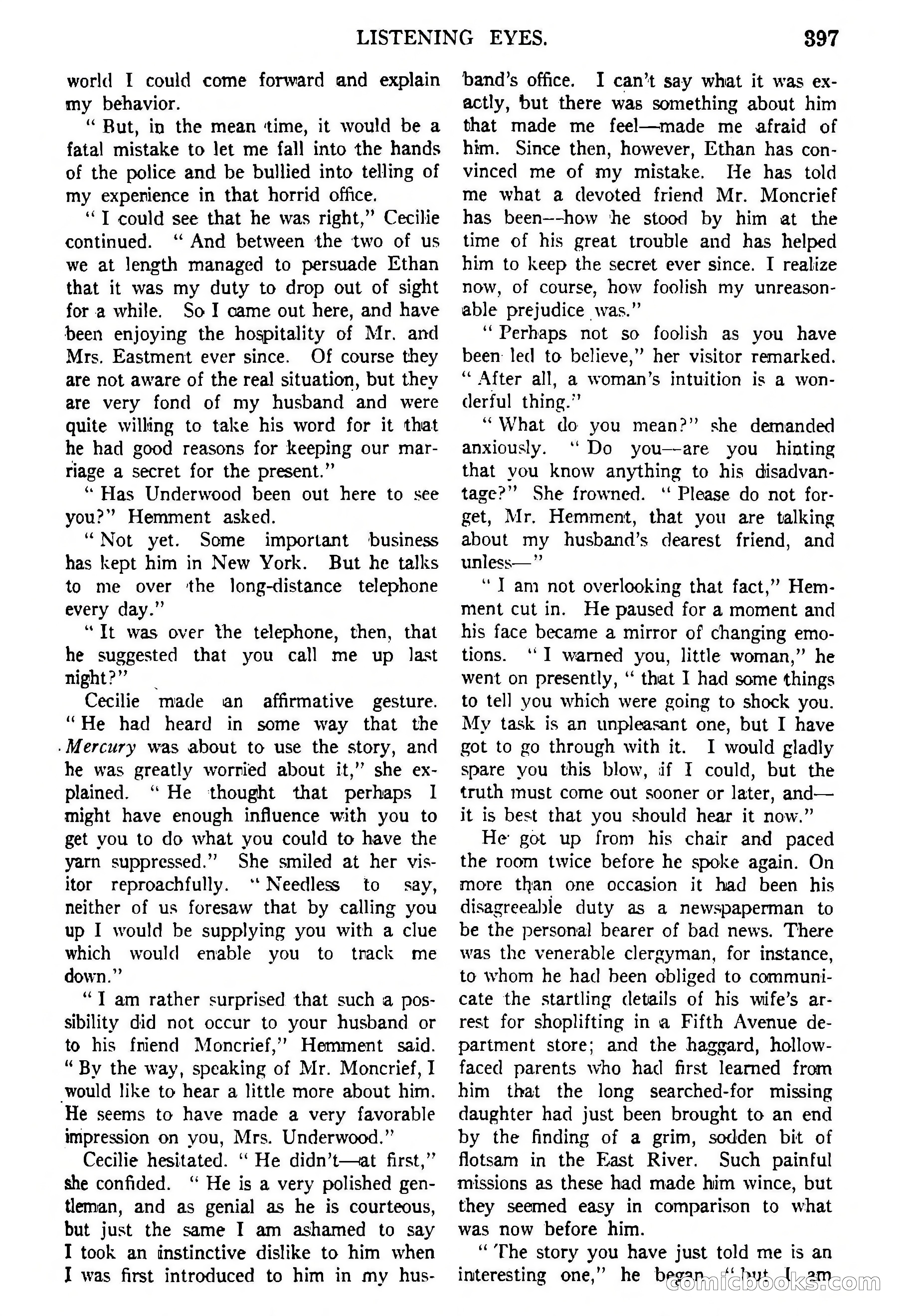
A restored page from Pulp Fiction, 1921. Page through the whole issue in the reader above.
📄 Transcribed text from this page (OCR, searchable)
Machine-transcribed from the original scan — historical spelling and the odd misread are preserved.
LISTENING EYES, $97 world I could come forward and explain my behavior. ‘“ But, in the mean time, it would be a fatal mistake to let me fall into the hands of the police and be bullied into telling of my experience in that horrid office. ‘“T could see that he was right,” Cecilie continued. ‘‘ And between the two of us we at length managed to persuade Ethan that it was my duty to drop out of sight for a while. So J came out here, and have been enjoying the hospitality of Mr. and Mrs. Eastment ever since. Of course they are not aware of the real situation, but they are very fond of my husband and were quite willing to take his word for it that he had good reasons for keeping our mar- riage a secret for the present.” “ Has Underwood been out here to see you?’ Hemment asked. ‘“Not yet. Some important business has kept him in New York. But he talks to me over ‘the long-distance telephone every day.” “Tt was over the telephone, then, that he suggested that you call me up last night?” Cecilie made an affirmative gesture. ‘“He had heard in some way that the . Mercury was about to use the story, and he was greatly worried about it,” she ex- plained. ‘“ He thought that perhaps I might have enough influence with you to get vou to do what you could to have the yarn suppressed.” She smiled at her vis- iter reproachfully. ‘‘ Needless to say, neither of us foresaw that by calling you up I would be supplying you with a clue which would enable you to track me down.” “TI am rather surprised that such a pos- sibility did not occur to your husband or to his fmend Moncrief,’’ Hemment said. “ By the way, speaking of Mr. Moncrief, I would like to hear a little more about him. He seems to have made a very favorable impression on you, Mrs. Underwood.” Cecilie hesitated. ‘“‘ He didn’t—at first,”’ she confided. ‘ He is a very polished gen- tleman, and as genial as he is courteous, but just the same I am ashamed to say I took an instinctive dislike to him when J was first introduced to him in my hus- band’s office. I can’t say what it was ex- actly, but there was something about him that made me feel—made me afraid of him. Since then, however, Ethan has con- vinced me of my mistake. He has told me what a devoted friend Mr. Moncrief has been—-how the stood by him at the time of his great trouble and has helped him to keep the secret ever since. I realize now, of course, how foolish my unreason- able prejudice was.” ‘Perhaps not so foolish as you have been: ledl to believe,” her visitor remarked. ‘““ After all, a woman’s intuition is a won- derful thing.” “What do you mean?” she demanded anxiously. ‘‘ Do you—are you hinting that vou know anything to his disadvan- tage?”’ She frowned. ‘‘ Please do not for- get, Mr. Hemment, that you are talking about my husband’s dearest friend, and unless—”’ ‘“ T am not overlooking that fact,’’ Hem- ment cut in. He paused for a moment and his face became a mirror of changing emo- tions. ‘I warned you, little woman,” he went on presently, ‘‘ that I had some things to tell you which were going to shock you. My task is an unpleasant one, but I have got to go through with it. I would gladly spare you this blow, if I could, but the truth must come out sooner or later, and— it is best that you should hear it now.” He got up from his chair and paced the room twice before he spoke again. On more than one occasion it had been his disagreeable duty as a newspaperman to be the personal bearer of bad news. There was the venerable clergyman, for instance, to whom he had been obliged to communi- cate the startling cletails of his wife’s ar- rest for shoplifting in a Fifth Avenue de- partment store; and the haggard, hollow- faced parents who had first learned from him that the long searched-for missing daughter had just been brought to an end by the finding of a grim, sodden bit of flotsam in the East River. Such painful missions as these had made him wince, but they seemed easy in comparison to what was now before him. “The story you have just told me is an interesting one,” he began. ¢-but lamas im