
Pulp Fiction, 1921 · page 113 of 146
Argosy All-Story Weekly, February 5, 1921 — page 113: what you’re looking at
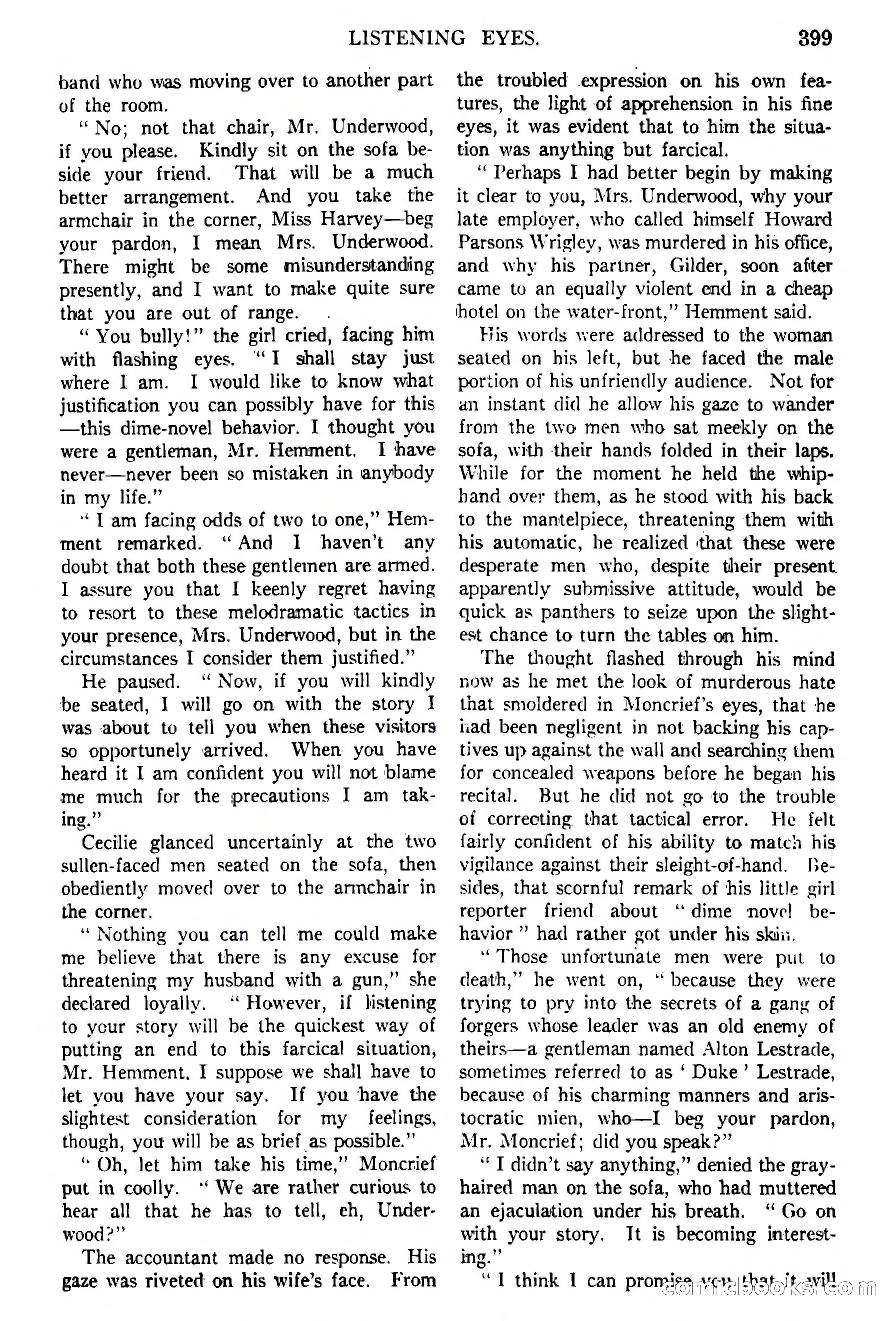
A restored page from Pulp Fiction, 1921. Page through the whole issue in the reader above.
📄 Transcribed text from this page (OCR, searchable)
Machine-transcribed from the original scan — historical spelling and the odd misread are preserved.
LISTENING EYES. band who was moving over to another part of the room. “No; not that chair, Mr. Underwood, if you please. Kindly sit on the sofa be- side your friend. That will be a much better arrangement. And you take the armchair in the corner, Miss Harvey—beg your pardon, I mean Mrs. Underwood. There might be some misunderstanding presently, and I want to make quite sure that you are out of range. . “Vou bully!” the girl cried, facing him with flashing eyes. “I shall stay just where I am. I would like to know what justification you can possibly have for this —this dime-novel behavior. I thought you were a gentleman, Mr. Hemment. I have never—never been so mistaken in anybody in my life.” “Tam facing odds of two to one,” Hem- ment remarked. “And I haven’t any doubt that both these gentlemen are armed. I assure you that I keenly regret having to resort to these melodramatic tactics in your presence, Mrs. Underwood, but in the circumstances I consider them justified.” He paused. ‘‘ Now, if you will kindly be seated, I will go on with the story I was about to tell you when these visitors so opportunely arrived. When you have heard it I am confident you will not blame me much for the precautions J am tak- ing.” Cecilie glanced uncertainly at the two sullen-faced men seated on the sofa, then obediently moved over to the armchair in the corner. ‘“Nothing vou can tell me could make me believe that there is any excuse for threatening my husband with a gun,” she declared loyally. “‘ However, if listening to your story will be the quickest way of putting an end to this farcical situation, Mr. Hemment, I suppose we shall have to let you have your say. If you have the slightest consideration for my _ feelings, though, you will be as brief_as possible.” “Qh, let him take his time,” Moncrief put in coolly. ‘‘ We are rather curious to hear all that he has to tell, eh, Under- wood?”’ The accountant made no response. His gaze was riveted on his wife’s face. From 399 the troubled expression on his own fea- tures, the light of apprehension in his fine eyes, it was evident that to him the situa- tion was anything but farcical. “Perhaps I had better begin by making it clear to you, Mrs. Underwood, why your late employer, who called himself Howard Parsons Wrigley, was murdered in his office, and why his partner, Gilder, soon after came to an equally violent end in a cheap hotel on the water-front,” Hemment said. Fiis words were addressed to the woman seated on his left, but he faced the male portion of his unfriendly audience. Not for an instant did he allow his gaze to wander from the two men who sat meekly on the sofa, with their hands folded in their laps. While for the moment he held the whip- hand over them, as he stood with his back to the mantelpiece, threatening them with his automatic, he realized ‘that these were desperate men who, despite their present. apparently submissive attitude, would be quick as panthers to seize upon the slight- est chance to turn the tables on him. The thought flashed through his mind now as he met the look of murderous hate that smoldered in Moncrief’s eyes, that he tad been negligent in not backing his cap- tives up against the wall and searching them for concealed weapons before he began his recital. But he did not go to the trouble oi correcting that tactical error. He felt fairly confident of his ability to match his vigilance against their sleight-of-hand. Be- sides, that scornful remark of his little girl reporter friend about ‘‘ dime nove! be- havior ” had rather got under his skiis. ‘Those unfortunate men were put to death,” he went on, ‘‘ because they were trying to pry into the secrets of a gang of forgers whose leader was an old enemy of theirs—a gentleman named Alton Lestrade, sometimes referred to as ‘ Duke’ Lestrade, because of his charming manners and aris- tocratic mien, who—I beg your pardon, Mr. Moncrief; did you speak?” ‘‘T didn’t say anything,” denied the gray- haired man on the sofa, who had muttered an ejaculation under his breath. ‘“ Go on with your story. It is becoming interest- ing.” “7 think 1 can promise weve Rafolkavllo