
Pulp Fiction, 1921 · page 144 of 146
Argosy All-Story Weekly, February 5, 1921 — page 144: what you’re looking at
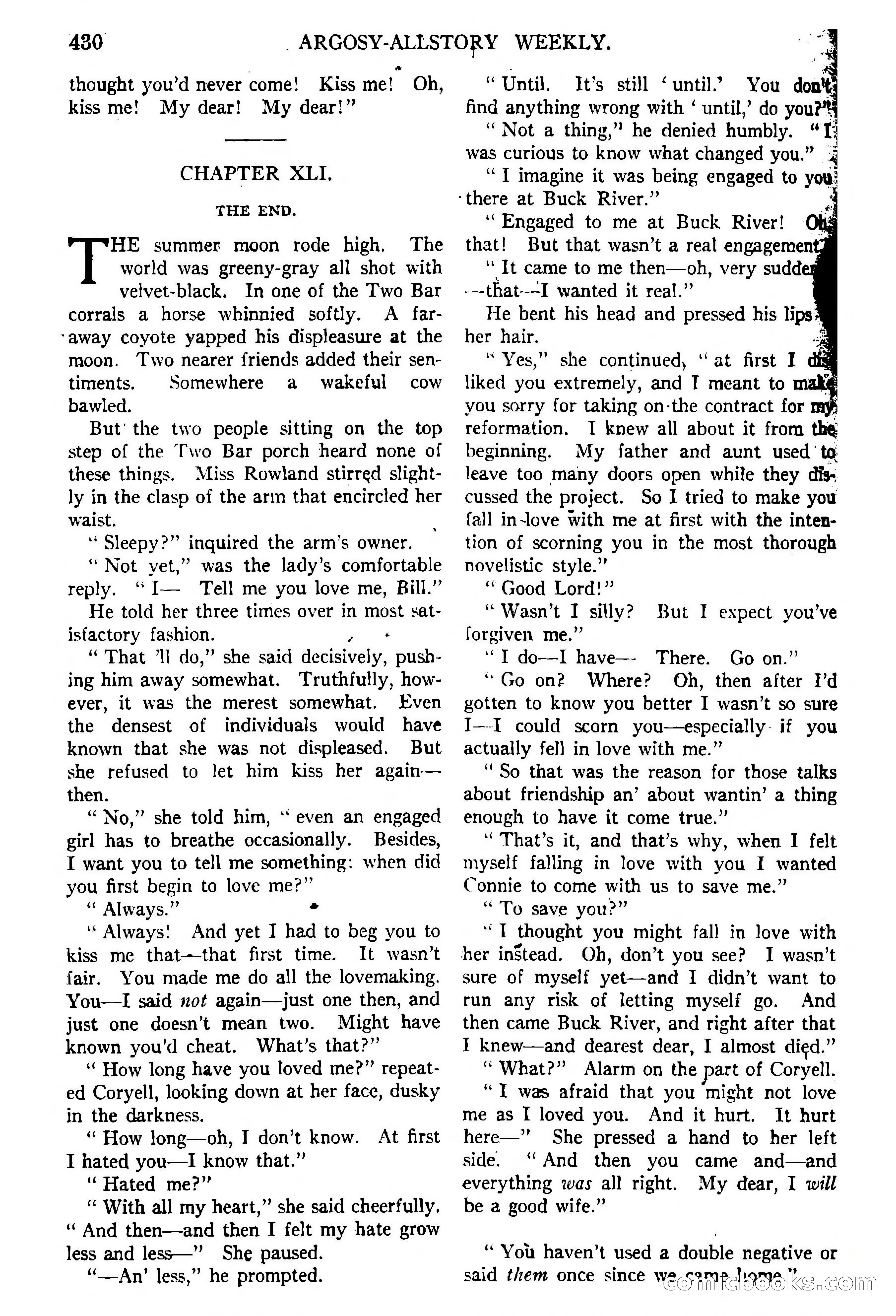
A restored page from Pulp Fiction, 1921. Page through the whole issue in the reader above.
📄 Transcribed text from this page (OCR, searchable)
Machine-transcribed from the original scan — historical spelling and the odd misread are preserved.
430 thought you’d never come! Kiss me! Oh, kiss me! My dear! My dear!” CHAPTER XLI. THE END. HE summer moon rode high. The world was greeny-gray all shot with velvet-black. In one of the Two Bar corrals a horse whinnied softly. A far- ‘away coyote yapped his displeasure at the moon. Two nearer friends added their sen- timents. Somewhere a_ wakeful cow bawled. But’ the two people sitting on the top step of the Two Bar porch heard none of these things. Miss Rowland stirred slight- ly in the clasp of the arm that encircled her waist. ‘‘ Sleepy?” inquired the arm’s owner. ‘Not vet,” was the lady’s comfortable reply. ‘‘I— Tell me you love me, Bill.” He told her three times over in most sat- isfactory fashion. “That ‘ll do,” she said doalsindly,, push- ing him away somewhat. Truthfully, how- ever, it was the merest somewhat. Even the densest of individuals would have known that she was not displeased. But she refused to let him kiss her again— then. “No,” she told him, ‘‘ even an engaged girl has to breathe occasionally. Besides, I want you to tell me something: when did you first begin to love me?”’ ‘ Always.” = ‘‘Always! And yet I had to beg you to kiss me that—that first time. It wasn’t fair. You made me do all the lovemaking. You—I said of again—just one then, and just one doesn’t mean two. Might have known you'd cheat. What’s that?” “ How long have you loved me?”’ repeat- ed Coryell, looking down at her face, dusky in the darkness. ‘How long—oh, I don’t know. At first I hated you—I know that.”’ ‘Hated me?’”’ “ With all my heart,”’ she said cheerfully. “ And then—and then I felt my hate grow less and less—” She paused. ‘An’ less,” he prompted. _ARGOSY-ALLSTORY WEEKLY. ‘there at Buck River.” her inStead. Oh, don’t you see? “Until. It’s still ‘until You don't find anything wrong with ‘ until,’ do you? ‘Not a thing,” he denied humbly. a & was curious to know what changed you.” 4 “T imagine it was being engaged to you! “Engaged to me at Buck River! -Obg that! But that wasn’t a real engagementZ “It came to me then—oh, very suddeg ---that--I wanted it real.” | He bent his head and pressed his lips? her hair. “ae “ Yes,” she continued, ‘at first I iia liked you extremely, and T meant to maké you sorry for taking on-the contract for my reformation. I knew all about it from the beginning. My father and aunt used ‘to: leave too many doors open while they dix cussed the project. So I tried to make you fall inlove with me at first with the inten- tion of scorning you in the most thorough novelistic style.”’ ‘Good Lord!” ‘“ Wasn’t I silly? forgiven me.” ‘“T do—I have—- There. Go on.” ‘Go on? Where? Oh, then after I'd gotten to know you better I wasn’t so sure J—-I could scorn you—especially: if you actually fell in love with me.” ‘So that was the reason for those talks about friendship an’ about wantin’ a thing enough to have it come true.” ‘ That’s it, and that’s why, when I felt myself falling in love with you I wanted Connie to come with us to save me.” “To save you?” | “ T thought you might fall in love with I wasn’t sure of myself yet—and I didn’t want to run any risk of letting myself go. And then came Buck River, and right after that } knew—and dearest dear, I almost died.” “What?” Alarm on the part of Coryell. “I was afraid that you might not love me as I loved you. And it hurt. It hurt here—”’ She pressed a hand to her left side. ‘“‘And then you came and—and everything was all right. My dear, I will be a good wife.” But I expect you’ve “You haven’t used a double negative or said them once since wa carrchasaices CO