
Pulp Fiction, 1921 · page 146 of 146
Argosy All-Story Weekly, February 5, 1921 — page 146: what you’re looking at
A restored page from Pulp Fiction, 1921. Page through the whole issue in the reader above.
📄 Transcribed text from this page (OCR, searchable)
Machine-transcribed from the original scan — historical spelling and the odd misread are preserved.
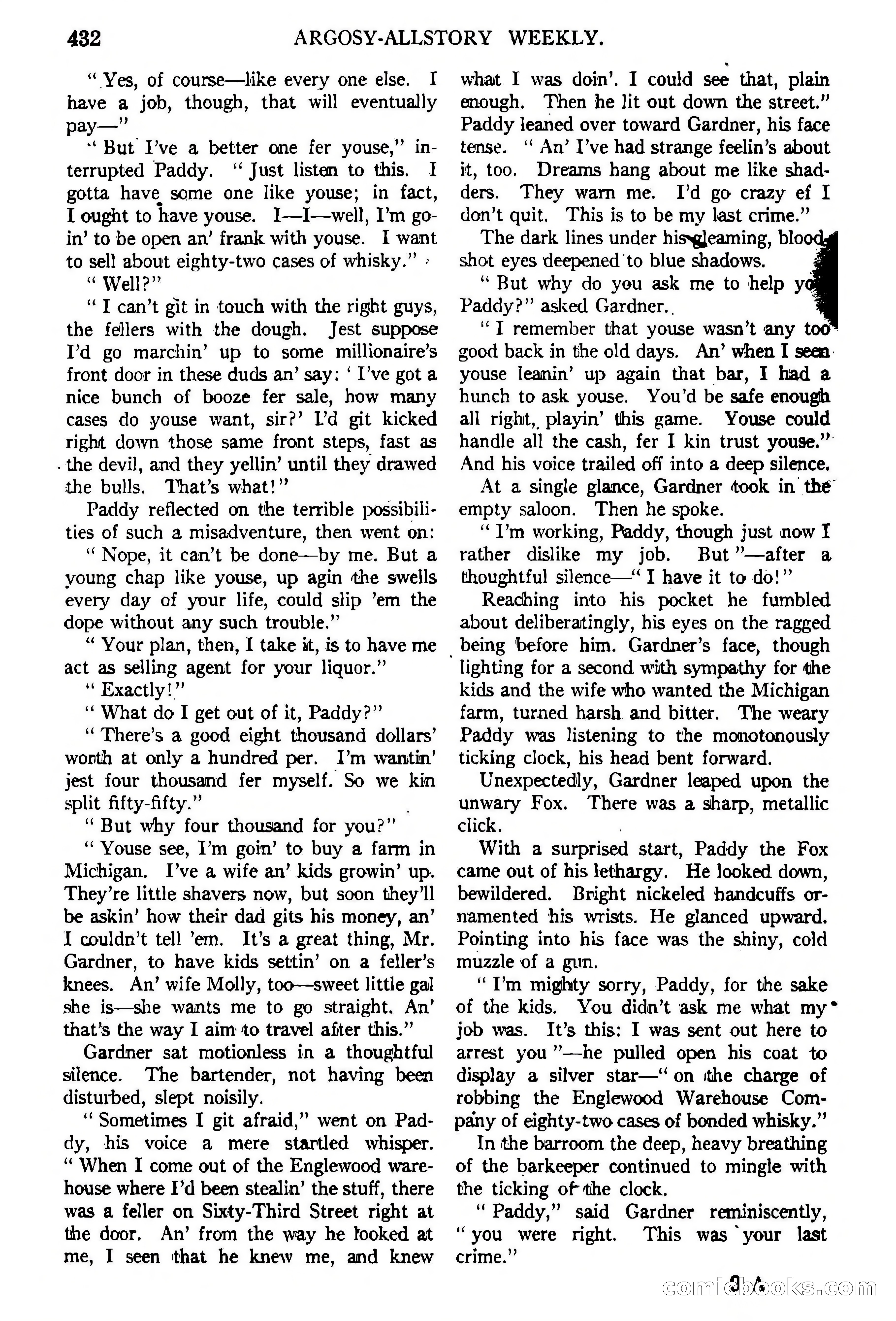
432 “Yes, of course—like every one else. I have a job, though, that will eventually pay—” ‘But I’ve a better one fer youse,” in- terrupted Paddy. “ Just listen to this. I gotta have some one like youse; in fact, I ought to have youse. I—I—well, I’m go- in’ to be open an’ frank with youse. I want to sell about eighty-two cases of whisky.” » “Well?” “T can’t git in touch with the right guys, the fellers with the dough. Jest suppose I’d go marchin’ up to some millionaire’s front door in these duds an’ say: ‘ I’ve gota nice bunch of booze fer sale, how many cases do youse want, sir?’ I'd git kicked right down those same front steps, fast as . the devil, and they yellin’ until they drawed the bulls. That’s what!” Paddy reflected on the terrible possibili- ties of such a misadventure, then went on: ‘Nope, it can’t be done—by me. But a young chap like youse, up agin the swells every day of your life, could slip ’em the dope without any such trouble.” “ Your plan, then, I take it, is to have me act as selling agent for your liquor.” ‘“ Exactly!” ‘What do I get out of it, Paddy?” ‘“There’s a good eight thousand dollars’ worth at only a hundred per. I’m wantin’ jest four thousand fer myself. So we kin split fifty-fifty.” ‘But why four thousand for you?” ‘“'Youse see, I’m goin’ to buy a farm in Michigan. I’ve a wife an’ kids growin’ up. They’re little shavers now, but soon they'll be askin’ how their dad gits his money, an’ IT couldn’t tell ’em. It’s a great thing, Mr. Gardner, to have kids settin’ on a feller’s knees. An’ wife Molly, too—sweet little gal she is—she wants me to go straight. An’ that’s the way I aim: to travel after this.” Gardner sat motionless in a thoughtful silence. The bartender, not having been disturbed, slept noisily. ‘‘ Sometimes I git afraid,” went on Pad- dy, his voice a mere startled whisper. ‘When I come out of the Englewood ware- house where I’d been stealin’ the stuff, there was a feller on Sixty-Third Street right at the door. An’ from the way he looked at me, I seen that he knew me, and knew ARGOSY-ALLSTORY WEEKLY. what I was doin’. I could see that, plain enough. Then he lit out down the street.” Paddy leaned over toward Gardner, his face tense. ‘‘ An’ I’ve had strange feelin’s about it, too. Dreams hang about me like shad- ders. They warn me. I’d go crazy ef I don’t quit. This is to be my last crime.” The dark lines under hisygjeaming, blood, shot eyes deepened ‘to blue shadows. “But why do you ask me to help ya Paddy?” asked Gardner... i ‘“T remember that youse wasn’t any too" good back in the old days. An’ when I seen: youse leanin’ up again that bar, I had a hunch to ask youse. You’d be safe enough all right, playin’ this game. Youse could handle all the cash, fer I kin trust youse.” And his voice trailed off into a deep silence. At a single glance, Gardner took in the empty saloon. Then he spoke. ‘“[’m working, Paddy, though just now I rather dislike my job. But’—after a thoughtful silence—“ I have it to do!” Reaching into his pocket he fumbled about deliberatingly, his eyes on the ragged _being before him. Gardner’s face, though lighting for a second with sympathy for the kids and the wife who wanted the Michigan farm, turned harsh and bitter. The weary Paddy was listening to the monotonously ticking clock, his head bent forward. Unexpectedly, Gardner leaped upon the unwary Fox. There was a sharp, metallic click. , With a surprised start, Paddy the Fox came out of his lethargy. He looked down, bewildered. Bright nickeled handcuffs or- namented his wrists. He glanced upward. Pointing into his face was the shiny, cold muzzle of a gun. ‘I’m mighty sorry, Paddy, for the sake of the kids. job was. It’s this: I was sent out here to arrest you ”’—he pulled open his coat to display a silver star—‘‘ on ithe charge of robbing the Englewood Warehouse Com- pany of eighty-two cases of bonded whisky.” In the barroom the deep, heavy breathing of the barkeeper continued to mingle with the ticking of the clock. ‘“ Paddy,” said Gardner reminiscently, “you were right. This was your last crime.” oA) COMI .oOKS.CO You didn’t ask me what my°