
Pulp Fiction, 1921 · page 53 of 146
Argosy All-Story Weekly, February 5, 1921 — page 53: what you’re looking at
A restored page from Pulp Fiction, 1921. Page through the whole issue in the reader above.
📄 Transcribed text from this page (OCR, searchable)
Machine-transcribed from the original scan — historical spelling and the odd misread are preserved.
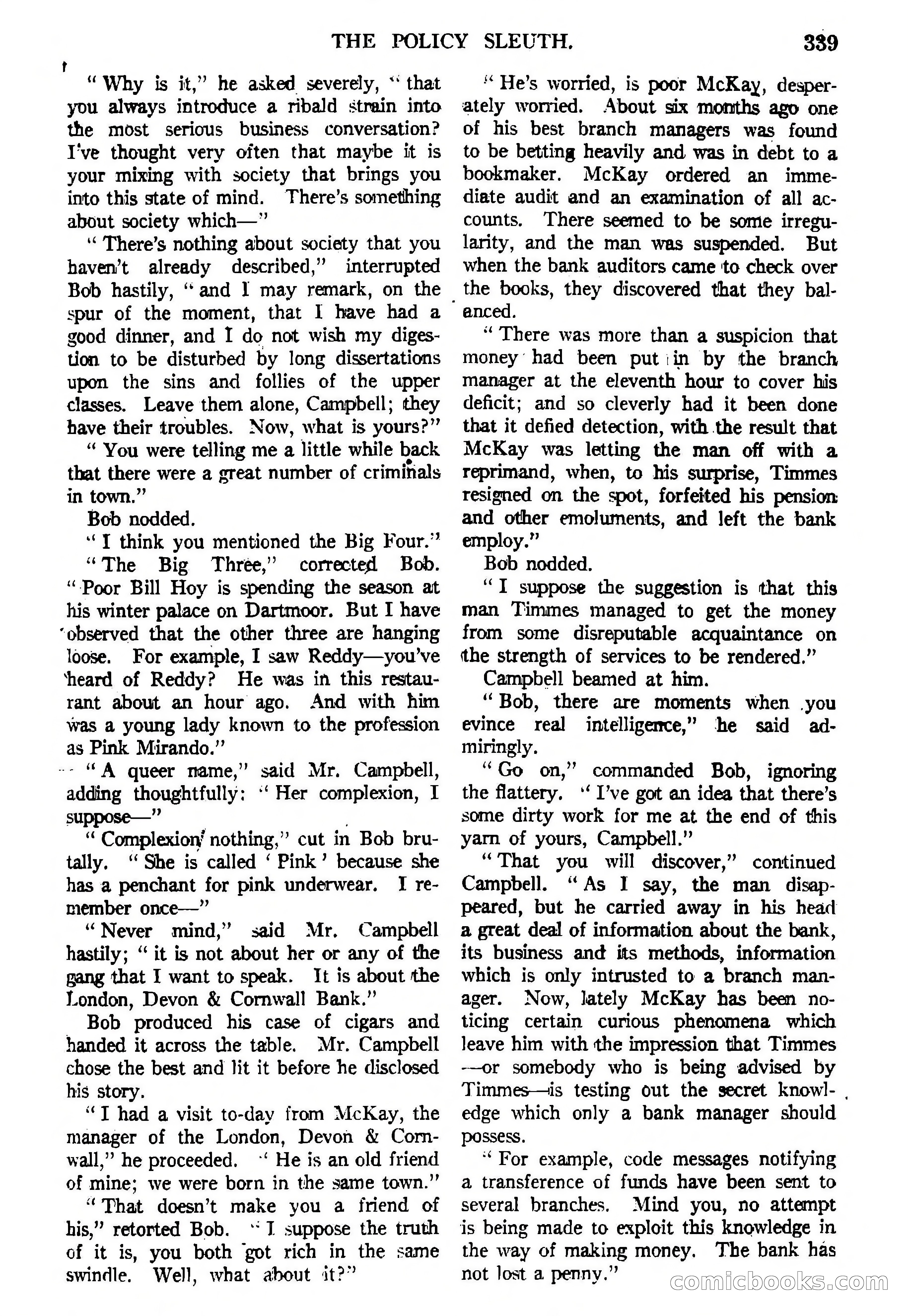
THE POLICY SLEUTH. t “Why is it,” he asked severely, ‘‘ that you always introduce a ribald strain into the most serious business conversation? I’ve thought very often that maybe it is your mixing with society that brings you into this state of mind. There’s something about society which—”’ ‘“ There’s nothing about society that you baven’t already described,” interrupted Bob hastily, ‘“‘and I may remark, on the spur of the moment, that I have had a good dinner, and I do not wish my diges- tion to be disturbed by long dissertations upon the sins and follies of the upper classes. Leave them alone, Campbell; they have their troubles. Now, what is yours?” “ You were telling me a little while back that there were a great number of criminals in town.”’ Bob nodded. ‘‘T think you mentioned the Big Four.” “The Big Three,” corrected Bob. ‘Poor Bill Hoy is spending the season at his winter palace on Dartmoor. But I have ‘observed that the other three are hanging loose. For example, I saw Reddy—you’ve ‘heard of Reddy? He was in this restau- rant about an hour ago. And with him was a young lady known to the profession as Pink Mirando.” - “ A queer mame,” said Mr. Campbell, adding thoughtfully: “‘ Her complexion, I su ) “ Complexion’ nothing,” cut in Bob bru- tally. ‘She is called ‘ Pink’ because she has a penchant for pink underwear. I re- member once—” “Never mind,” said Mr, Campbell hastily; ‘it is not about her or any of the gang that I want to speak. It is about the London, Devon & Cornwall Bank.” Bob produced his case of cigars and handed it across the table. Mr. Campbell chose the best and lit it before he disclosed his story. “T had a visit to-day from McKay, the manager of the London, Devon & Corm- wall,” he proceeded. ~‘ He is an old friend of mine; we were born in the same town.”’ “That doesn’t make you a friend of his,” retorted Bob. ‘J suppose the truth of it is, you both got rich in the same swindle. Well, what about it?” 309 ‘“ He’s worried, is poor McKay, desper- ately worried. About six months ago one of his best branch managers was found to be betting heavily and was in debt to a bookmaker. McKay ordered an imme- diate audit and an examination of all ac- counts. There seemed to be some irregu- larity, and the man was suspended. But when the bank auditors came ‘to check over the books, they discovered that they bal- " anced. ‘There was more than a suspicion that money’ had been putiin by the branch manager at the eleventh hour to cover his deficit; and so cleverly had it been done that it defied detection, with the result that McKay was letting the man off with a reprimand, when, to his surprise, Timmes resigned on the spot, forfeited his pension and other emoluments, and left the bank employ.” Bob nodded. ‘I suppose the suggestion is that this man Timmes managed to get the money from some disreputable acquaintance on the strength of services to be rendered.” Campbell beamed at him. “Bob, there are moments when you evince real intelligermce,” he said ad- miringly. ‘Go on,’ commanded Bob, ignoring the flattery. ‘‘ I’ve got an idea that there’s some dirty work for me at the end of this yarn of yours, Campbell.” “That you will discover,” continued Campbell. ‘As I say, the man disap- peared, but he carried away in his head a great deal of information about the bank, its business and its methods, information which is only intrusted to a branch man- ager. Now, lately McKay has been no- ticing certain curious phenomena which Jeave him with the impression that Timmes -—or somebody who is being advised by Timmes—is testing out the secret knowl- . edge which only a bank manager should possess. ‘For example, code messages notifying a transference of funds have been sent to several branches. Mind you, no attempt is being made to exploit this knowledge in the way of making money. The bank has not lost a penny.” cOmicbhooks.c©