
Pulp Fiction, 1921 · page 6 of 146
Argosy All-Story Weekly, February 5, 1921 — page 6: what you’re looking at
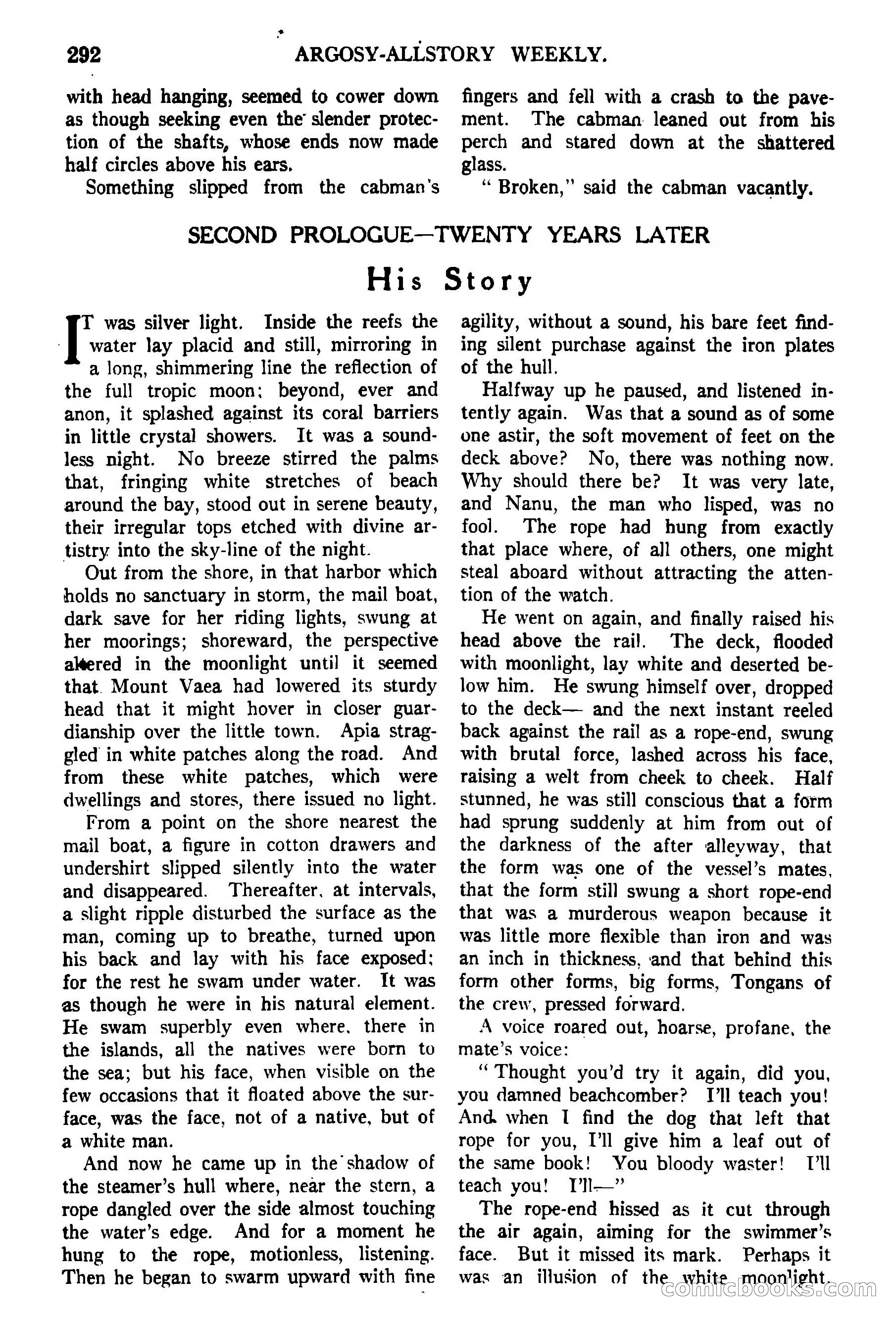
A restored page from Pulp Fiction, 1921. Page through the whole issue in the reader above.
📄 Transcribed text from this page (OCR, searchable)
Machine-transcribed from the original scan — historical spelling and the odd misread are preserved.
e 292 with head hanging, seemed to cower down as though seeking even the’ slender protec- tion of the shafts, whose ends now made half circles above his ears. Something slipped from the cabman's ARGOSY-ALLSTORY WEEKLY. fingers and fell with a crash to the pave- ment. The cabman. leaned out from his perch and stared down at the shattered glass. “ Broken,”’ said the cabman vacantly. SECOND PROLOGUE—TWENTY YEARS LATER His Story T was silver light. Inside the reefs the water lay placid and still, mirroring in a long, shimmering line the reflection of the full tropic moon: beyond, ever and anon, it splashed against its coral barriers in little crystal showers. It was a sound- less night. No breeze stirred the palms that, fringing white stretches of beach around the bay, stood out in serene beauty, their irregular tops etched with divine ar- tistry into the sky-line of the night. Out from the shore, in that harbor which holds no sanctuary in storm, the mail boat, dark save for her riding lights, swung at her moorings; shoreward, the perspective altered in the moonlight until it seemed that. Mount Vaea had lowered its sturdy head that it might hover in closer guar- dianship over the little town. Apia strag- gled in white patches along the road. And from these white patches, which were dwellings and stores, there issued no light. From a point on the shore nearest the mail boat, a figure in cotton drawers and undershirt slipped silently into the water and disappeared. Thereafter. at intervals, a slight ripple disturbed the surface as the man, coming up to breathe, turned upon his back and lay with his face exposed: for the rest he swam under water. It was as though he were in his natural element. He swam superbly even where. there in the islands, all the natives were born to the sea; but his face, when visible on the few occasions that it floated above the sur- face, was the face, not of a native, but of a white man. And now he came up in the shadow of the steamer’s hull where, near the stern, a rope dangled over the side almost touching the water’s edge. And for a moment he hung to the rope, motionless, listening. Then he began to swarm upward with fine agility, without a sound, his bare feet find- ing silent purchase against the iron plates of the hull. Halfway up he paused, and listened in- tently again. Was that a sound as of some one astir, the soft movement of feet on the deck above? No, there was nothing now. Why should there be? It was very late, and Nanu, the man who lisped, was no fool. The rope had hung from exactly that place where, of all others, one might steal aboard without attracting the atten- tion of the watch. He went on again, and finally raised his head above the rail. The deck, flooded with moonlight, lay white and deserted be- low him. He swung himself over, dropped to the deck— and the next instant reeled back against the rail as a rope-end, swung with brutal force, lashed across his face, raising a welt from cheek to cheek. Half stunned, he was still conscious that a form had sprung suddenly at him from out of the darkness of the after alleyway, that the form was one of the vessel’s mates, that the form still swung a short rope-end that was a murderous weapon because it was little more flexible than iron and was an inch in thickness, and that behind this form other forms, big forms, Tongans of the crew, pressed forward. A voice roared out, hoarse, profane, the mate’s voice: ‘Thought you’d try it again, did you, you damned beachcomber? I'll teach you! And. when I find the dog that left that rope for you, I’ll give him a leaf out of the same book! You bloody waster! T’ll teach you! [’l—” The rope-end hissed as it cut through the air again, aiming for the swimmer’s face. But it missed its mark. Perhaps it was an illusion of the. white moonlight...