
Pulp Fiction, 1921 · page 91 of 146
Argosy All-Story Weekly, February 5, 1921 — page 91: what you’re looking at
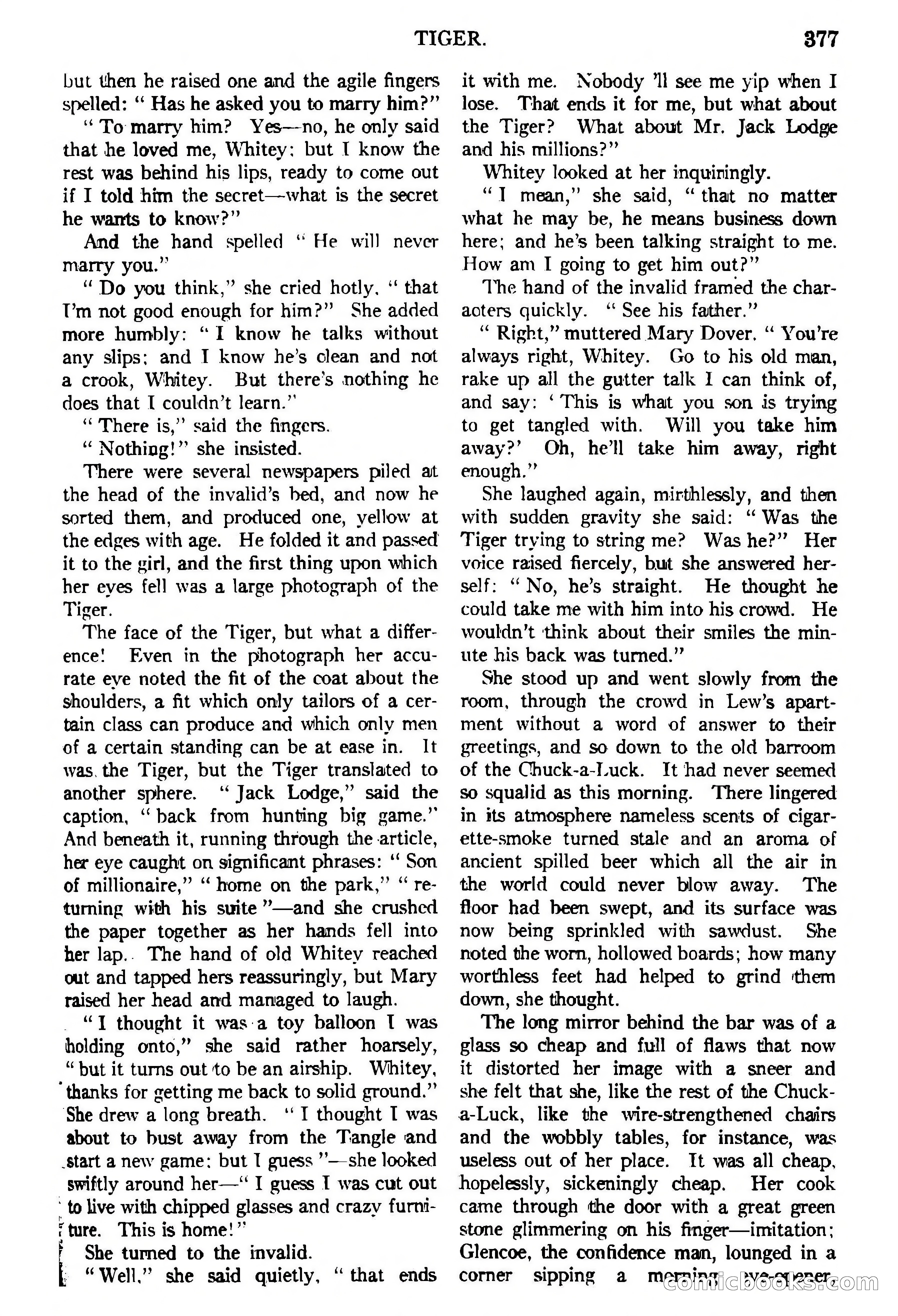
A restored page from Pulp Fiction, 1921. Page through the whole issue in the reader above.
📄 Transcribed text from this page (OCR, searchable)
Machine-transcribed from the original scan — historical spelling and the odd misread are preserved.
TIGER. but then he raised one and the agile fingers spelled: ‘ Has he asked you to marry him?e”’ “To marry him? Yes—no, he only said that he loved me, Whitey: but I know the rest was behind his lips, ready to come out if I told him the secret—what is the secret he wants to know?” And the hand spelled ‘“ He wil] never marry you.” “Do you think,” she cried hotly, ‘‘ that Tm not good enough for him?” She added more humbly: “I know he talks without any slips; and I know he’s clean and not a crook, Whitey. But there’s nothing he does that [ couldn’t learn.”’ ‘There is,” said the fingers. ‘“ Nothing!” she insisted. There were several newspapers piled at the head of the invalid’s bed, and now he sorted them, and produced one, vellow at the edges with age. He folded it and passed it to the girl, and the first thing upon which her eves fell was a large photograph of the Tiger. The face of the Tiger, but what a differ- ence! Even in the photograph her accu- rate eve noted the fit of the coat about the shoulders, a fit which only tailors of a cer- tain class can produce and which only men of a certain standing can be at ease in. It was. the Tiger, but the Tiger translated to another sphere. ‘‘ Jack Lodge,” said the caption, “back from hunting big game.” And beneath it, running through the article, her eye caught on significant phrases: ‘‘ Son of millionaire,” ‘‘ home on the park,” “ re- turning with his suite ”’—and she crushed the paper together as her hands fell into her lap.. The hand of old Whitey reached out and tapped hers reassuringly, but Mary raised her head and managed to laugh. “T thought it was:a toy balloon T was holding onto,” she said rather hoarsely, “but it turns out to be an airship. Whitey, ‘thanks for getting me back to solid ground.” She drew a long breath. ‘‘ I thought T was about to bust away from the Tangle and Start a new game: but T guess ’’—she looked swiftly around her—‘ I guess I was cut out to live with chipped glasses and crazy furni- ‘ture. This is home!” She turned to the invalid. . “Well.” she said quietly, “that ends 377 it with me. Nobody ‘ll see me yip when I lose. That ends it for me, but what about the Tiger? What about Mr. Jack Lodge and his millions?” Whitey looked at her inquiringly. ‘“T mean,” she said, “ that no matter what he may be, he means business down here; and he’s been talking straight to me. How am I going to get him out?” The hand of the invalid framed the char- aoters quickly. ‘ See his father.” “ Right,” muttered Mary Dover, ‘“ You're always right, Whitey. Go to his old man, rake up all the gutter talk I can think of, and say: ‘ This is what you son is trying to get tangled with. Will you take him away?’ Oh, he’ll take him away, right enough.” She laughed again, mirthlessly, and then with sudden gravity she said: “‘ Was the Tiger trying to string me? Was he?” Her voice raised fiercely, but she answered her- self: “ No, he’s straight. He thought he could take me with him into his crowd. He wouldn’t think about their smiles the min- ute his back was turned.’ She stood up and went slowly from the room, through the crowd in Lew’s apart- ment without a word of answer to their greetings, and so down to the old barroom of the Chuck-a-Luck. It had never seemed so squalid as this morning. There lingered in its atmosphere nameless scents of cigar- ette-smoke turned stale and an aroma of ancient spilled beer which all the air in the world could never blow away. The floor had been swept, and its surface was now being sprinkled with sawdust. She noted the worn, hollowed boards; how many worthless feet had helped to grind ‘them down, she thought. The long mirror behind the bar was of a glass so cheap and full of flaws that now It distorted her image with a sneer and she felt that she, like the rest of the Chuck- a-Luck, like the wire-strengthened chairs and the wobbly tables, for instance, was useless out of her place. It was all cheap, hopelessly, sickeningly cheap. Her cook came through the door with a great green stone glimmering on his finger—imitation; Glencoe, the confidence man, lounged in a corner sipping a merning: )ecteReteo