
Pulp Fiction, 1922 · page 113 of 178
Argosy All-Story Weekly, February 4, 1922 — page 113: what you’re looking at
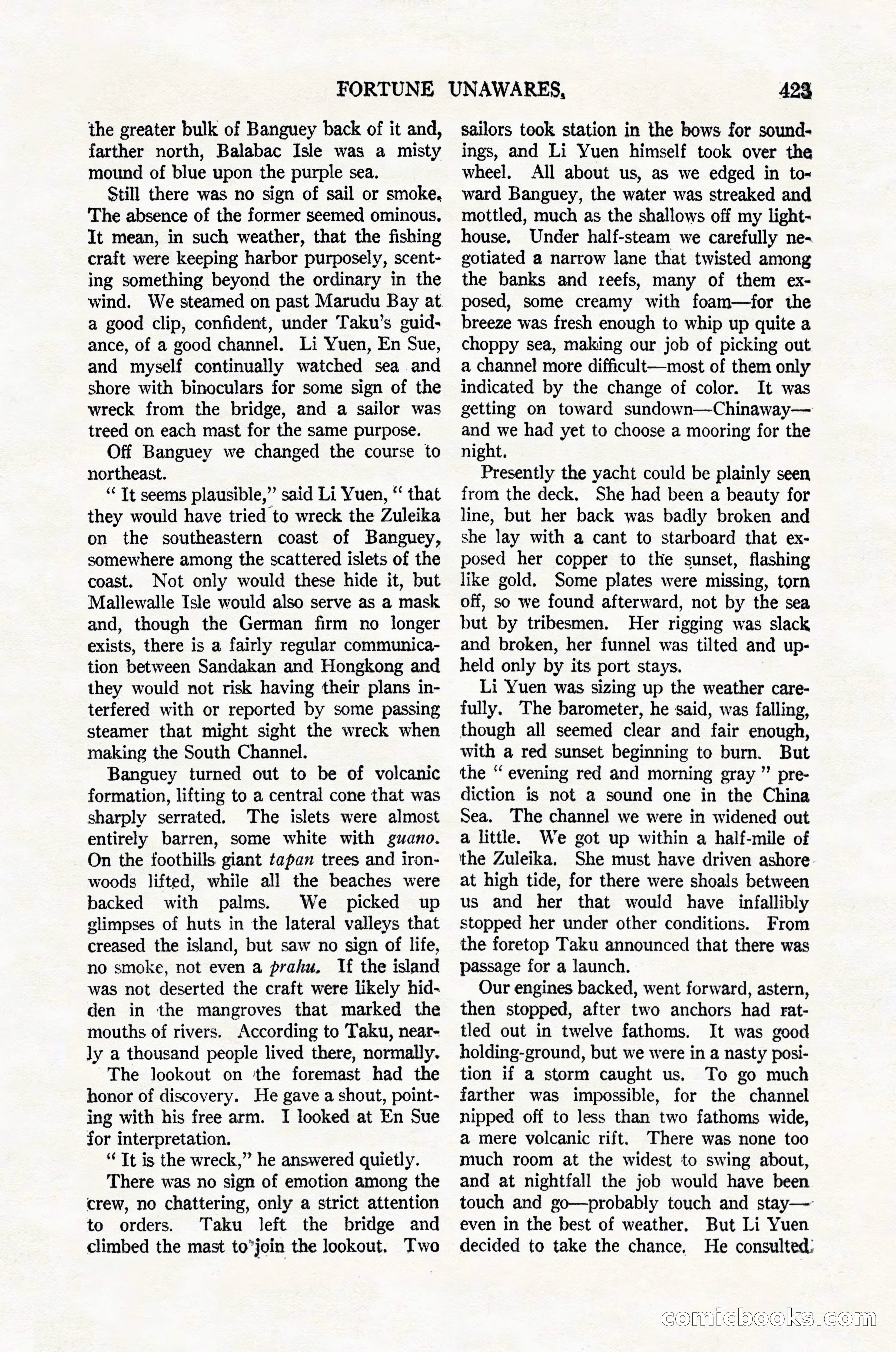
A restored page from Pulp Fiction, 1922. Page through the whole issue in the reader above.
📄 Transcribed text from this page (OCR, searchable)
Machine-transcribed from the original scan — historical spelling and the odd misread are preserved.
FORTUNE UNAWARES, the greater bulk of Banguey back of it and, farther north, Balabac Isle was a misty mound of blue upon the purple sea. Still there was no sign of sail or smoke. The absence of the former seemed ominous, It mean, in such weather, that the fishing craft were keeping harbor purposely, scent- ing something beyond the ordinary in the wind. We steamed on past Marudu Bay at a good clip, confident, under Taku’s guid- ance, of a good channel. Li Yuen, En Sue, and myself continually watched sea and shore with binoculars for some sign of the wreck from the bridge, and a sailor was treed on each mast for the same purpose. Off Banguey we changed the course to northeast. “ Tt seems plausible,” said Li Yuen, “ that they would have tried to wreck the Zuleika on the southeastern coast of Banguey, somewhere among the scattered islets of the coast. Not only would these hide it, but Mallewalle Isle would also serve as a mask and, though the German firm no longer exists, there is a fairly regular communica- tion between Sandakan and Hongkong and they would not risk having their plans in- terfered with or reported by some passing steamer that might sight the wreck when making the South Channel. Banguey turned out to be of volcanic formation, lifting to a central cone that was sharply serrated. The islets were almost entirely barren, some white with guano. On the foothills giant tapan trees and iron- woods lifted, while all the beaches were backed with palms. We picked up glimpses of huts in the lateral valleys that creased the island, but saw no sign of life, no smoke, not even a prahu, If the island was not deserted the craft were likely hid- den in the mangroves that marked the mouths of rivers. According to Taku, near- ly a thousand people lived there, normally. The lookout on the foremast had the honor of discovery. He gave a shout, point- ing with his free arm. I looked at En Sue for interpretation. ‘Tt is the wreck,” he answered quietly. There was no sign of emotion among the crew, no chattering, only a strict attention to orders. Taku left the bridge and climbed the mast to’join the lookout. Two 423 sailors took station in the bows for sound- ings, and Li Yuen himself took over the wheel, All about us, as we edged in to< ward Banguey, the water was streaked and mottled, much as the shallows off my light- house, Under half-steam we carefully ne- gotiated a narrow lane that twisted among the banks and reefs, many of them ex- posed, some creamy with foam—for the breeze was fresh enough to whip up quite a choppy sea, making our job of picking out a channel more difficult—most of them only indicated by the change of color. It was getting on toward sundown—Chinaway— and we had yet to choose a mooring for the night, Presently the yacht could be plainly seen from the deck. She had been a beauty for line, but her back was badly broken and she lay with a cant to starboard that ex- posed her copper to the sunset, flashing like gold. Some plates were missing, torn off, so we found afterward, not by the sea but by tribesmen. Her rigging was slack and broken, her funnel was tilted and up- held only by its port stays. Li Yuen was sizing up the weather care- fully. The barometer, he said, was falling, though all seemed clear and fair enough, with a red sunset beginning to burn. But the “ evening red and morning gray ” pre- diction is not a sound one in the China Sea. The channel we were in widened out a little. We got up within a half-mile of the Zuleika. She must have driven ashore. at high tide, for there were shoals between us and her that would have _infallibly stopped her under other conditions. From the foretop Taku announced that there was passage for a launch. Our engines backed, went forward, astern, then stopped, after two anchors had ,rat- tled out in twelve fathoms. It was good holding-ground, but we were in a nasty posi- tion if a storm caught us. To go much farther was impossible, for the channel nipped off to less than two fathoms wide, a mere volcanic rift. There was none too much room at the widest to swing about, and at nightfall the job would have been touch and go—probably touch and stay— even in the best of weather. But Li Yuen decided to take the chance, He consulted: COmiCbooks.Gonm