
Pulp Fiction, 1922 · page 124 of 178
Argosy All-Story Weekly, February 4, 1922 — page 124: what you’re looking at
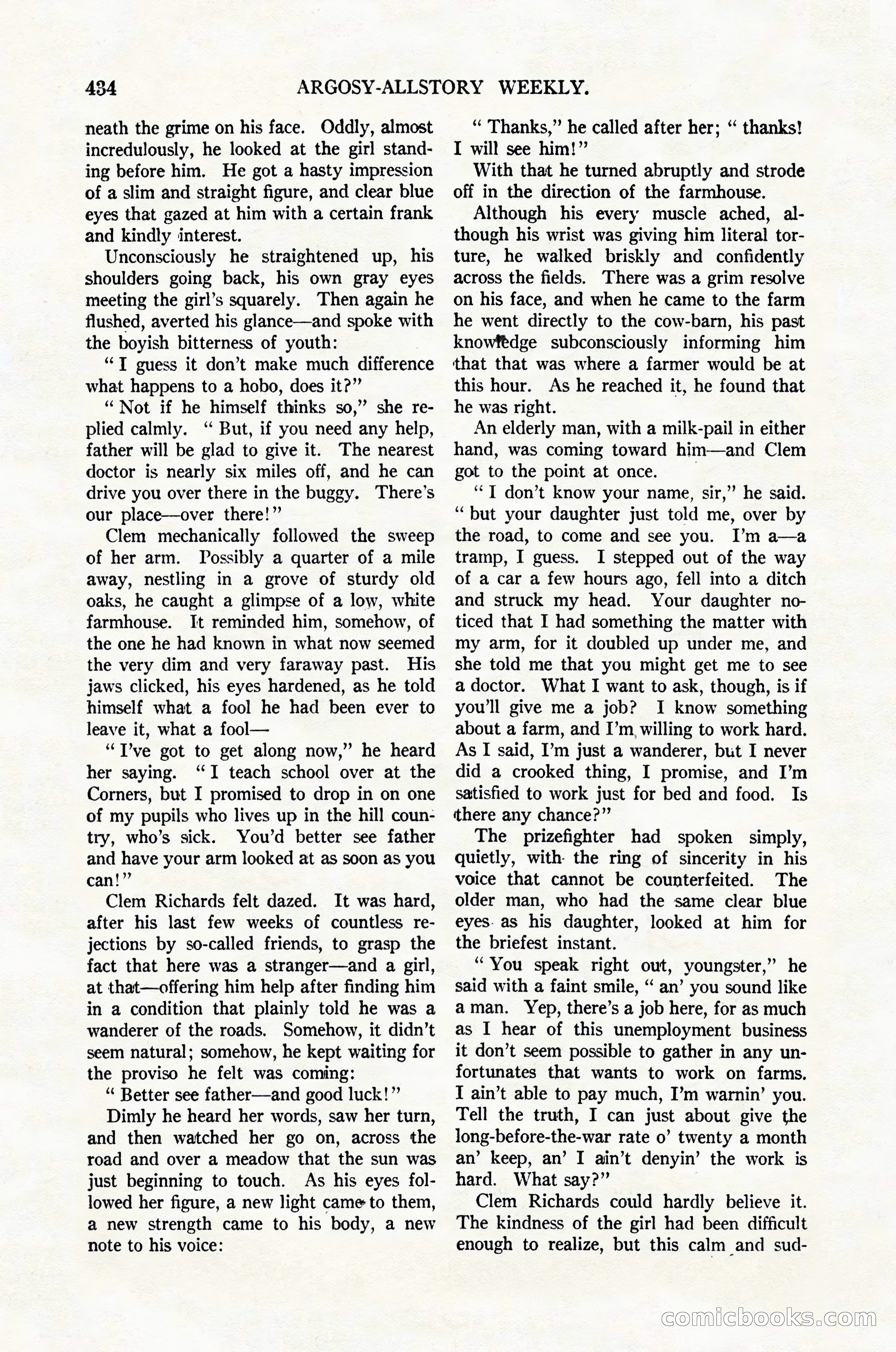
A restored page from Pulp Fiction, 1922. Page through the whole issue in the reader above.
📄 Transcribed text from this page (OCR, searchable)
Machine-transcribed from the original scan — historical spelling and the odd misread are preserved.
434 neath the grime on his face. Oddly, almost incredulously, he looked at the girl stand- ing before him. He got a hasty impression of a slim and straight figure, and clear blue eyes that gazed at him with a certain frank and kindly interest. Unconsciously he straightened up, his shoulders going back, his own gray eyes meeting the girl’s squarely. Then again he flushed, averted his glance—and spoke with the boyish bitterness of youth: “TI guess it don’t make much difference what happens to a hobo, does it?” “Not if he himself thinks so,” she re- plied calmly. ‘“ But, if you need any help, father will be glad to give it. The nearest doctor is nearly six miles off, and he can drive you over there in the buggy. There’s our place—over there!” Clem mechanically followed the sweep of her arm. Possibly a quarter of a mile away, nestling in a grove of sturdy old oaks, he caught a glimpse of a low, white farmhouse. It reminded him, somehow, of the one he had known in what now seemed the very dim and very faraway past. His jaws clicked, his eyes hardened, as he told himself what a fool he had been ever to leave it, what a fool— “T’ve got to get along now,” he heard her saying. “I teach school over at the Corners, but I promised to drop in on one of my pupils who lives up in the hill coun- try, who’s sick. You’d better see father and have your arm looked at as soon as you can!” Clem Richards felt dazed. It was hard, after his last few weeks of countless re- jections by so-called friends, to grasp the fact that here was a stranger—and a girl, at that—offering him help after finding him in a condition that plainly told he was a wanderer of the roads. Somehow, it didn’t seem natural; somehow, he kept waiting for the proviso he felt was coming: “ Better see father—and good luck!” Dimly he heard her words, saw her turn, and then watched her go on, across the road and over a meadow that the sun was just beginning to touch. As his eyes fol- lowed her figure, a new light came to them, a new strength came to his body, a new note to his voice: ARGOSY-ALLSTORY WEEKLY. “ Thanks,” he called after her; “ thanks! I will see him!” With that he turned abruptly and strode off in the direction of the farmhouse. Although his every muscle ached, al- though his wrist was giving him literal tor- ture, he walked briskly and confidently across the fields. There was a grim resolve on his face, and when he came to the farm he went directly to the cow-barn, his past knowfédge subconsciously informing him that that was where a farmer would be at this hour. As he reached it, he found that he was right. An elderly man, with a milk-pail in either hand, was coming toward him—and Clem got to the point at once. __ ‘I don’t know your name, sir,” he said. “put your daughter just told me, over by the road, to come and see you. I’m a—a tramp, I guess. I stepped out of the way of a car a few hours ago, fell into a ditch and struck my head. Your daughter no- ticed that I had something the matter with my arm, for it doubled up under me, and she told me that you might get me to see a doctor. What I want to ask, though, is if you'll give me a job? I know something about a farm, and I’m willing to work hard. As I said, I’m just a wanderer, but I never did a crooked thing, I promise, and I’m satisfied to work just for bed and food. Is there any chance?” The prizefighter had spoken simply, quietly, with. the ring of sincerity in his voice that cannot be counterfeited. The older man, who had the same clear blue eyes. as his daughter, looked at him for the briefest instant. “You speak right out, youngster,” he said with a faint smile, ‘an’ you sound like aman. Yep, there’s a job here, for as much as I hear of this unemployment business it don’t seem possible to gather in any un- fortunates that wants to work on farms. I ain’t able to pay much, I’m warnin’ you. Tell the truth, I can just about give the long-before-the-war rate o’ twenty a month an’ keep, an’ I ain’t denyin’ the work is hard. What say?” Clem Richards could hardly believe it. The kindness of the girl had been difficult enough to realize, but this calm and sud- COmMiCMoolks.Gom