
Pulp Fiction, 1922 · page 127 of 178
Argosy All-Story Weekly, February 4, 1922 — page 127: what you’re looking at
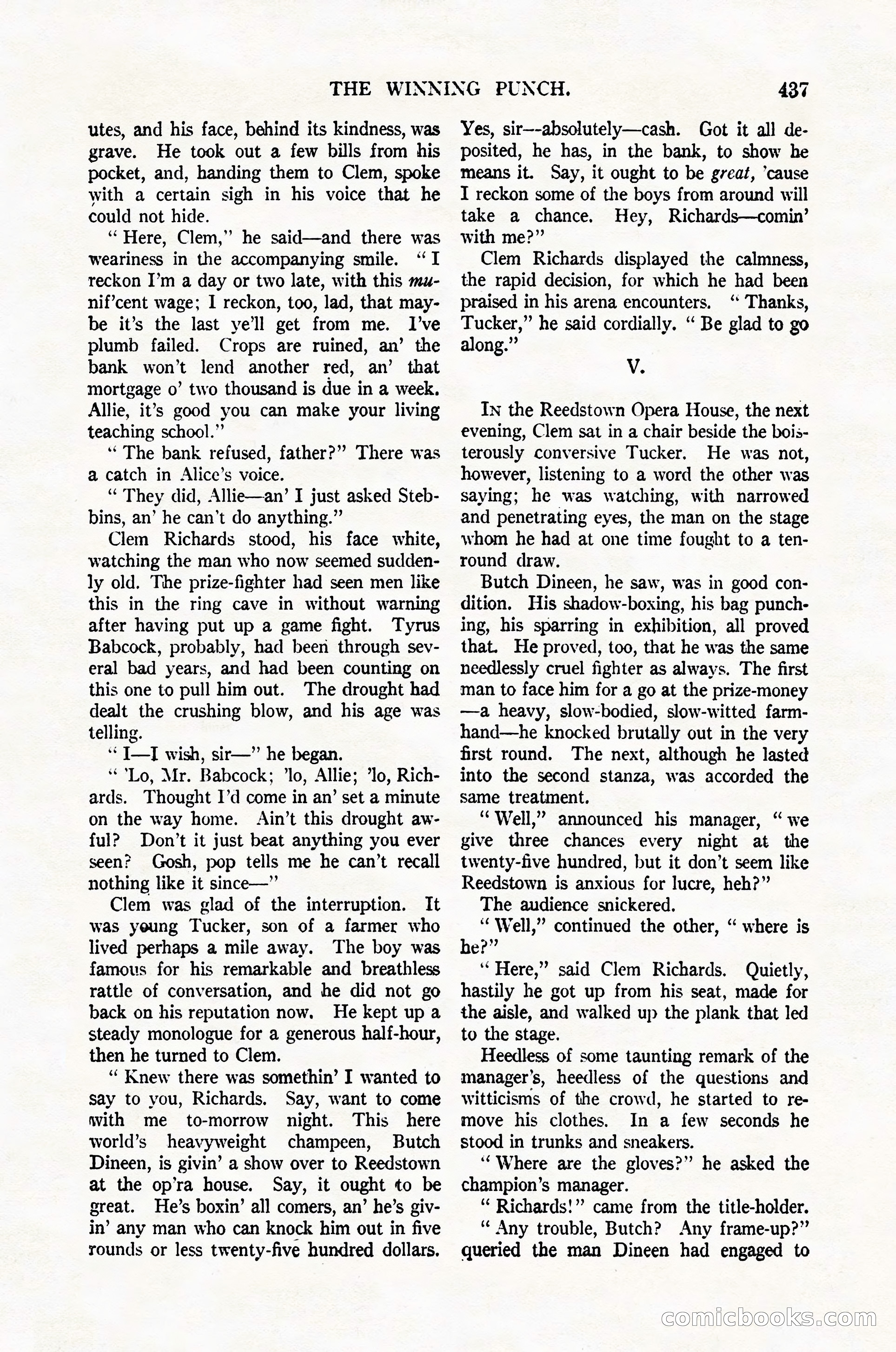
A restored page from Pulp Fiction, 1922. Page through the whole issue in the reader above.
📄 Transcribed text from this page (OCR, searchable)
Machine-transcribed from the original scan — historical spelling and the odd misread are preserved.
THE WINNING PUNCH. utes, and his face, behind its kindness, was grave. He took out a few bills from his pocket, and, handing them to Clem, spoke with a certain sigh in his voice that he could not hide. ‘“‘ Here, Clem,” he said—and there was weariness in the accompanying smile. “I reckon I’m a day or two late, with this mu- nif’cent wage; 1 reckon, too, lad, that may- be it’s the last ye'll get from me. I’ve plumb failed. Crops are ruined, an’ the bank won’t lend another red, an’ that mortgage o’ two thousand is due in a week, Allie, it’s good you can make your living teaching school.”’ ‘The bank refused, father?” There was a catch in Alice’s voice. “ They did, Allie—an’ I just asked Steb- bins, an’ he can’t do anything.” Clem Richards stood, his face white, watching the man who now seemed sudden- ly old. The prize-fighter had seen men like this in the ring cave in without warning after having put up a game fight. Tyrus Babcock, probably, had been through sev- eral bad years, and had been counting on this one to pull him out. The drought had dealt the crushing blow, and his age was telling. ‘‘ [—] wish, sir—”’ he began. ‘Lo, Mr. Babcock; ’lo, Allie; *lo, Rich- ards. Thought I’d come in an’ set a minute on the way home. Ain’t this drought aw- ful? Don’t it just beat anything you ever seen? Gosh, pop tells me he can’t recall nothing like it since—” Clem was glad of the interruption. It was young Tucker, son of a farmer who lived perhaps a mile away. The boy was famous for his remarkable and breathless rattle of conversation, and he did not go back on his reputation now. He kept up a steady monologue for a generous half-hour, then he turned to Clem. ‘Knew there was somethin’ I wanted to say to vou, Richards, Say, want to come With me to-morrow night. This here world’s heavyweight champeen, Butch Dineen, is givin’ a show over to Reedstown at the op’ra house. Say, it ought to be great. He’s boxin’ all comers, an’ he’s giv- in’ any man who can knock him out in five rounds or less twenty-five hundred dollars. 437 Yes, sir—-absolutely—cash. Got it all de- posited, he has, in the bank, to show he means it. Say, it ought to be great, ’cause I reckon some of the boys from around will take a chance. Hey, Richards—comin’ with me?” Clem Richards displayed the calmness, the rapid decision, for which he had been praised in his arena encounters. “ Thanks, Tucker,” he said cordially. “ Be glad to go along.” V. In the Reedstown Opera House, the next evening, Clem sat in a chair beside the bois- terously conversive Tucker. He was not, however, listening to a word the other was saying; he was watching, with narrowed and penetrating eyes, the man on the stage whom he had at one time fought to a ten- round draw. Butch Dineen, he saw, was in good con- dition. His shadow-boxing, his bag punch- ing, his sparring in exhibition, all proved that. He proved, too, that he was the same needlessly cruel fighter as always. The first man to face him for a go at the prize-money —a heavy, slow-bodied, slow-witted farm- hand—he knocked brutally out in the very first round. The next, although he lasted into the second stanza, was accorded the same treatment. ‘* Well,” announced his manager, “we give three chances every night at the twenty-five hundred, but it don’t seem like Reedstown is anxious for lucre, heh?” The audience snickered. ‘ Well,” continued the other, “ where is he?” ‘“ Here,”’ said Clem Richards. Quietly, hastily he got up from his seat, made for the aisle, and walked up the plank that led to the stage. Heedless of some taunting remark of the manager’s, heedless of the questions and witticisms of the crowd, he started to re- move his clothes. In a few seconds he stood in trunks and sneakers. ‘Where are the gloves?” he asked the champion’s manager. ‘“ Richards!” came from the title-holder. ‘* Any trouble, Butch? Any frame-up?” queried the man Dineen had engaged to COmiclbooks.Gonmn