
Pulp Fiction, 1922 · page 167 of 178
Argosy All-Story Weekly, February 4, 1922 — page 167: what you’re looking at
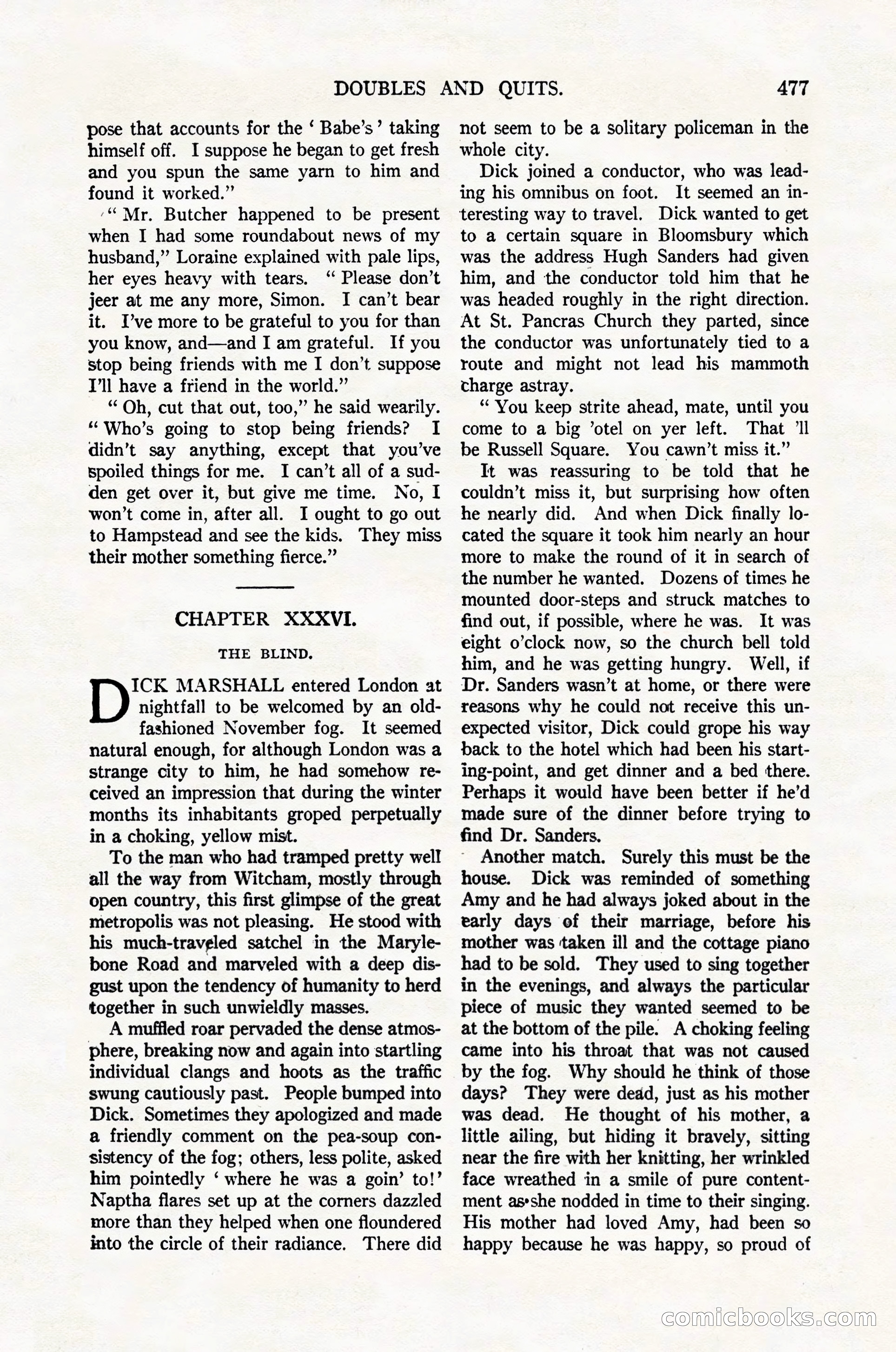
A restored page from Pulp Fiction, 1922. Page through the whole issue in the reader above.
📄 Transcribed text from this page (OCR, searchable)
Machine-transcribed from the original scan — historical spelling and the odd misread are preserved.
DOUBLES AND QUITS. pose that accounts for the ‘ Babe’s’ taking himself off. I suppose he began to get fresh and you spun the same yarn to him and found it worked.” ‘“ Mr. Butcher happened to be present when I had some roundabout news of my husband,” Loraine explained with pale lips, her eyes heavy with tears. ‘“‘ Please don’t jeer at me any more, Simon. I can’t bear it. I’ve more to be grateful to you for than you know, and—and I am grateful. If you stop being friends with me I don’t suppose I'll have a friend in the world.” “Oh, cut that out, too,” he said wearily. ““Who’s going to stop being friends? I didn’t say anything, except that you’ve spoiled things for me. I can’t all of a sud- den get over it, but give me time. No, I won’t come in, after all. I ought to go out to Hampstead and see the kids. They miss their mother something fierce.” CHAPTER XXXVI. THE BLIND. ICK MARSHALL entered London at nightfall to be welcomed by an old- fashioned November fog. It seemed natural enough, for although London was a strange city to him, he had somehow re- ceived an impression that during the winter months its inhabitants groped perpetually in a choking, yellow mist. To the man who had tramped pretty well all the way from Witcham, mostly through open country, this first glimpse of the great metropolis was not pleasing. He stood with his much-traveled satchel in the Maryle- bone Road and marveled with a deep dis- gust upon the tendency of humanity to herd together in such unwieldly masses. A muffled roar pervaded the dense atmos- phere, breaking now and again into startling individual clangs and hoots as the traffic swung cautiously past. People bumped into Dick. Sometimes they apologized and made a friendly comment on the pea-soup con- sistency of the fog; others, less polite, asked him pointedly ‘ where he was a goin’ to!’ Naptha flares set up at the corners dazzled more than they helped when one floundered into the circle of their radiance. There did ATT not seem to be a Solitary policeman in the whole city. Dick joined a conductor, who was lead- ing his omnibus on foot. It seemed an in- teresting way to travel. Dick wanted to get to a certain square in Bloomsbury which was the address Hugh Sanders had given him, and the conductor told him that he was headed roughly in the right direction. At St. Pancras Church they parted, since the conductor was unfortunately tied to a route and might not lead his mammoth charge astray. ‘You keep strite ahead, mate, until you come to a big ’otel on yer left. That ‘ll be Russell Square. You cawn’t miss it.” It was reassuring to be told that he couldn’t miss it, but surprising how often he nearly did. And when Dick finally lo- cated the square it took him nearly an hour more to make the round of it in search of the number he wanted. Dozens of times he mounted door-steps and struck matches to find out, if possible, where he was. It was eight o’clock now, so the church bell told him, and he was getting hungry. Well, if Dr. Sanders wasn’t at home, or there were reasons why he could not receive this un- expected visitor, Dick could grope his way back to the hotel which had been his start- ing-point, and get dinner and a bed there. Perhaps it would have been better if he’d made sure of the dinner before trying to find Dr. Sanders. ’ Another match. Surely this must be the house. Dick was reminded of something Amy and he had always joked about in the early days of their marriage, before his mother was taken ill and the cottage piano had to be sold. They used to sing together in the evenings, and always the particular piece of music they wanted seemed to be at the bottom of the pile. A choking feeling came into his throat that was not caused by the fog. Why should he think of those days? They were dead, just as his mother was dead. He thought of his mother, a little ailing, but hiding it bravely, sitting near the fire with her knitting, her wrinkled face wreathed in a smile of pure content- ment as*she nodded in time to their singing. His mother had loved Amy, had been so happy because he was happy, so proud of COmicClbooks.Gom