
Pulp Fiction, 1922 · page 17 of 178
Argosy All-Story Weekly, February 4, 1922 — page 17: what you’re looking at
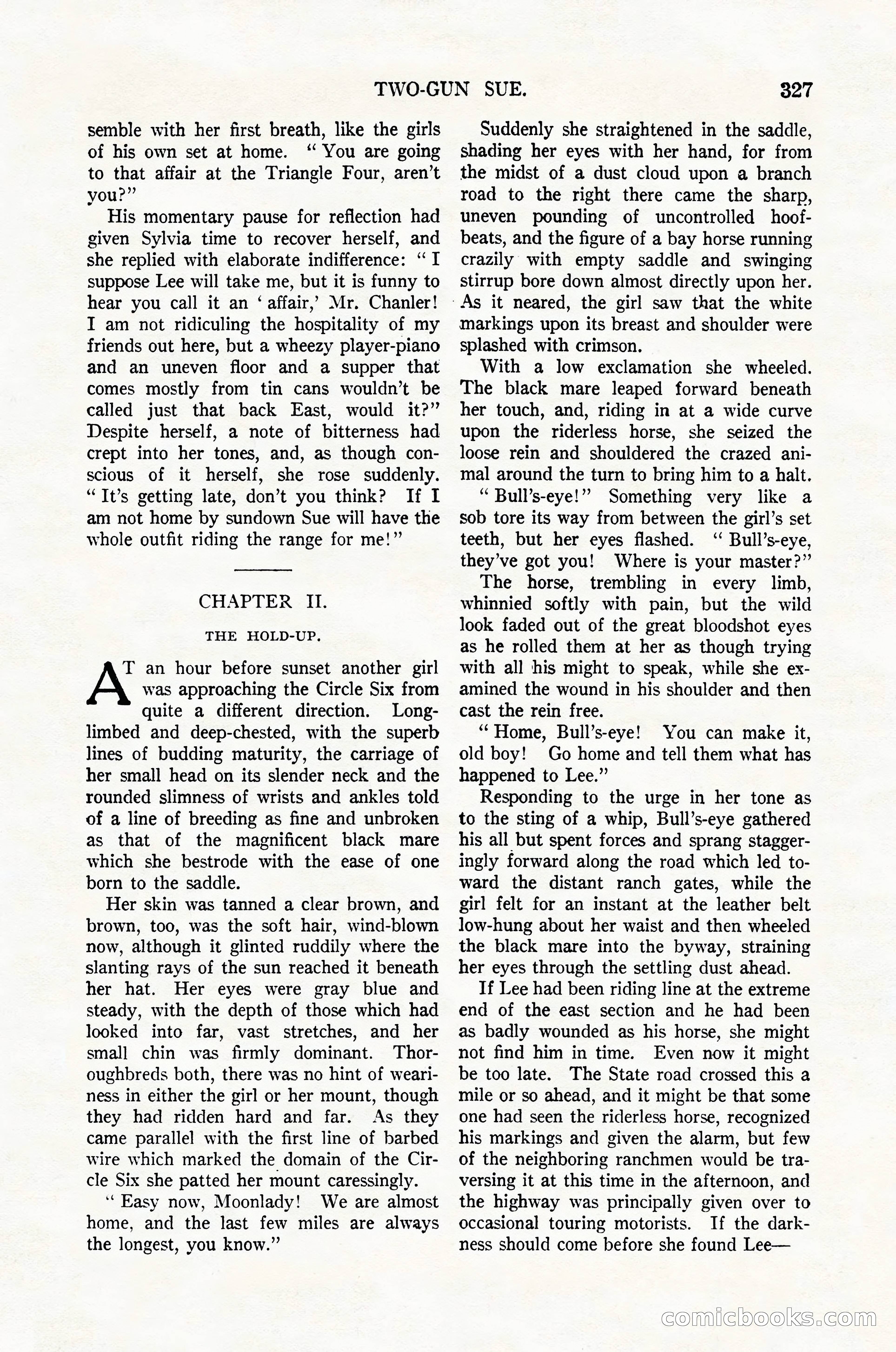
A restored page from Pulp Fiction, 1922. Page through the whole issue in the reader above.
📄 Transcribed text from this page (OCR, searchable)
Machine-transcribed from the original scan — historical spelling and the odd misread are preserved.
TWO-GUN SUE. semble with her first breath, like the girls of his own set at home. ‘ You are going to that affair at the Triangle Four, aren’t your” His momentary pause for reflection had given Sylvia time to recover herself, and she replied with elaborate indifference: ‘I suppose Lee will take me, but it is funny to hear you call it an ‘ affair,’ Mr. Chanler! I am not ridiculing the hospitality of my friends out here, but a wheezy player-piano and an uneven floor and a supper that comes mostly from tin cans wouldn’t be called just that back East, would it?” Despite herself, a note of bitterness had crept into her tones, and, as though con- scious of it herself, she rose suddenly. “It’s getting late, don’t you think? If I am not home by sundown Sue will have the whole outfit riding the range for me!”’ CHAPTER II. THE HOLD-UP. T an hour before sunset another girl was approaching the Circle Six from quite a different direction. Long- limbed and deep-chested, with the superb lines of budding maturity, the carriage of her small head on its slender neck and the rounded slimness of wrists and ankles told of a line of breeding as fine and unbroken as that of the magnificent black mare which she bestrode with the ease of one born to the saddle. Her skin was tanned a clear brown, and brown, too, was the soft hair, wind-blown now, although it glinted ruddily where the slanting rays of the sun reached it beneath her hat. Her eyes were gray blue and steady, with the depth of those which had looked into far, vast stretches, and her small chin was firmly dominant. Thor- oughbreds both, there was no hint of weari- ness in either the girl or her mount, though they had ridden hard and far. As they came parallel with the first line of barbed wire which marked the domain of the Cir- cle Six she patted her mount caressingly. ‘“ Easy now, Moonlady! We are almost home, and the last few miles are always the longest, you know.” 327 Suddenly she straightened in the saddle, shading her eyes with her hand, for from the midst of a dust cloud upon a branch road to the right there came the sharp, uneven pounding of uncontrolled hoof- beats, and the figure of a bay horse running crazily with empty saddle and swinging stirrup bore down almost directly upon her. As it neared, the girl saw that the white markings upon its breast and shoulder were splashed with crimson. With a low exclamation she wheeled. The black mare leaped forward beneath her touch, and, riding in at a wide curve upon the riderless horse, she seized the loose rein and shouldered the crazed ani- mal around the turn to bring him to a halt. “ Bull’s-eye!” Something very like a sob tore its way from between the girl’s set teeth, but her eyes flashed. ‘‘ Bull’s-eye, they’ve got you! Where is your master?” The horse, trembling in every limb, whinnied softly with pain, but the wild look faded out of the great bloodshot eyes as he rolled them at her as though trying with all his might to speak, while she ex- amined the wound in his shoulder and then cast the rein free. ‘* Home, Bull’s-eye! You can make it, old boy! Go home and tell them what has happened to Lee.” Responding to the urge in her tone as to the sting of a whip, Bull’s-eye gathered his all but spent forces and sprang stagger- ingly forward along the road which led to- ward the distant ranch gates, while the girl felt for an instant at the leather belt low-hung about her waist and then wheeled the black mare into the byway, straining her eyes through the settling dust ahead. If Lee had been riding line at the extreme end of the east section and he had been as badly wounded as his horse, she might not find him in time. Even now it might be too late. The State road crossed this a mile or so ahead, and it might be that some one had seen the riderless horse, recognized his markings and given the alarm, but few of the neighboring ranchmen would be tra- versing it at this time in the afternoon, and the highway was principally given over to occasional touring motorists. If the dark- ness should come before she found Lee— COmiclbooks.Gonn