
Pulp Fiction, 1922 · page 48 of 178
Argosy All-Story Weekly, February 4, 1922 — page 48: what you’re looking at
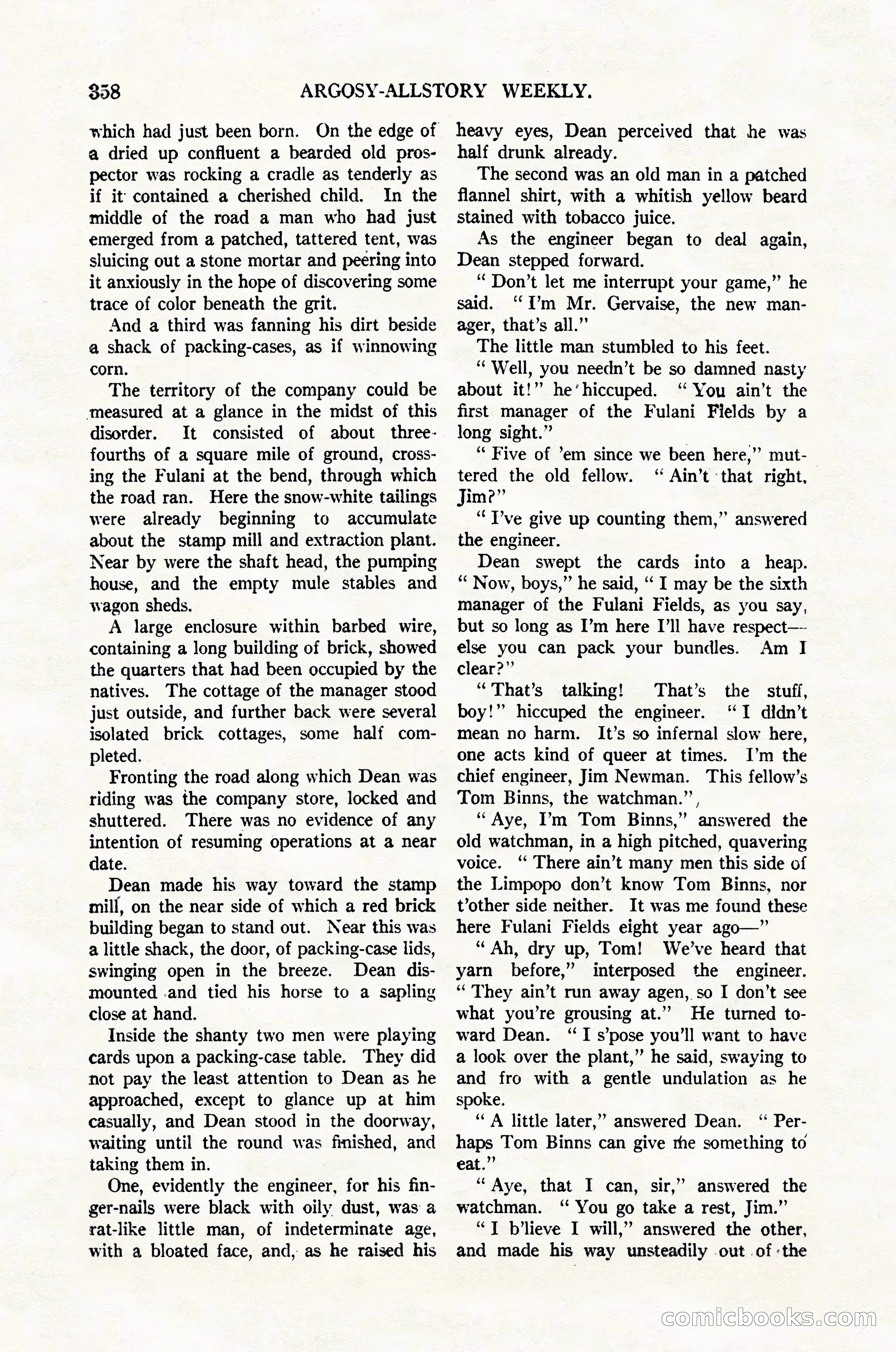
A restored page from Pulp Fiction, 1922. Page through the whole issue in the reader above.
📄 Transcribed text from this page (OCR, searchable)
Machine-transcribed from the original scan — historical spelling and the odd misread are preserved.
358 which had just been born. On the edge of a dried up confluent a bearded old pros- pector was rocking a cradle as tenderly as if it contained a cherished child. In the middle of the road a man who had just emerged from a patched, tattered tent, was sluicing out a stone mortar and peering into it anxiously in the hope of discovering some trace of color beneath the grit. And a third was fanning his dirt beside a shack of packing-cases, as if winnowing corn. The territory of the company could be measured at a glance in the midst of this disorder. It consisted of about three- fourths of a square mile of ground, cross- ing the Fulani at the bend, through which the road ran. Here the snow-white tailings were already beginning to accumulate about the stamp mill and extraction plant. Near by were the shaft head, the pumping house, and the empty mule stables and wagon sheds. A large enclosure within barbed wire, containing a long building of brick, showed the quarters that had been occupied by the natives. The cottage of the manager stood just outside, and further back were several isolated brick cottages, some half com- pleted. Fronting the road along which Dean was riding was the company store, locked and shuttered. There was no evidence of any intention of resuming operations at a near date. Dean made his way toward the stamp mill, on the near side of which a red brick building began to stand out. Near this was a little shack, the door, of packing-case lids, swinging open in the breeze. Dean dis- mounted .and tied his horse to a sapling close at hand. Inside the shanty two men were playing cards upon a packing-case table. They did not pay the least attention to Dean as he approached, except to glance up at him casually, and Dean stood in the doorway, waiting until the round was finished, and taking them in. One, evidently the engineer, for his fin- ger-nails were black with oily dust, was a rat-like little man, of indeterminate age, with a bloated face, and, as he raised his ARGOSY-ALLSTORY WEEKLY. heavy eyes, Dean perceived that he was half drunk already. The second was an old man in a patched flannel shirt, with a whitish yellow beard stained with tobacco juice. As the engineer began to deal again, Dean stepped forward. ‘Don’t let me interrupt your game,” he said. “I’m Mr. Gervaise, the new man- ager, that’s all.” The little man stumbled to his feet. ‘Well, you needn’t be so damned nasty about it!” he‘hiccuped. ‘ You ain’t the first manager of the Fulani Fields by a long sight.” “ Five of ’em since we been here,” mut- tered the old fellow. “ Ain’t ‘that right, Jime”’ ‘I’ve give up counting them,” answered the engineer. Dean swept the cards into a heap. ‘* Now, boys,” he said, ‘‘ I may be the sixth manager of the Fulani Fields, as you say, but so long as I’m here I’ll have respect— else you can pack your bundles. Am I clear?” “That’s talking! That’s the stuff, boy!” hiccuped the engineer. ‘I didn’t mean no harm. It’s so infernal slow here, one acts kind of queer at times. I’m the chief engineer, Jim Newman. This fellow’s Tom Binns, the watchman.” ‘“ Aye, I’m Tom Binns,” answered the old watchman, in a high pitched, quavering voice. ‘* There ain’t many men this side of the Limpopo don’t know Tom Binns, nor t’other side neither. It was me found these here Fulani Fields eight year ago—” “Ah, dry up, Tom! We’ve heard that yarn before,” interposed the engineer. ‘““ They ain’t run away agen, so I don’t see what you’re grousing at.”” He turned to- ward Dean. ‘I s’pose you’ll want to have a look over the plant,” he said, swaying to and fro with a gentle undulation as he spoke. ‘A little later,”” answered Dean. ‘“ Per- haps Tom Binns can give the something to eat.” ‘“‘ Aye, that I can, sir,” answered the watchman. ‘ You go take a rest, Jim.” “T b’lieve I will,” answered the other, and made his way unsteadily out of the COmiclboooks.Gom