
Pulp Fiction, 1922 · page 65 of 178
Argosy All-Story Weekly, February 4, 1922 — page 65: what you’re looking at
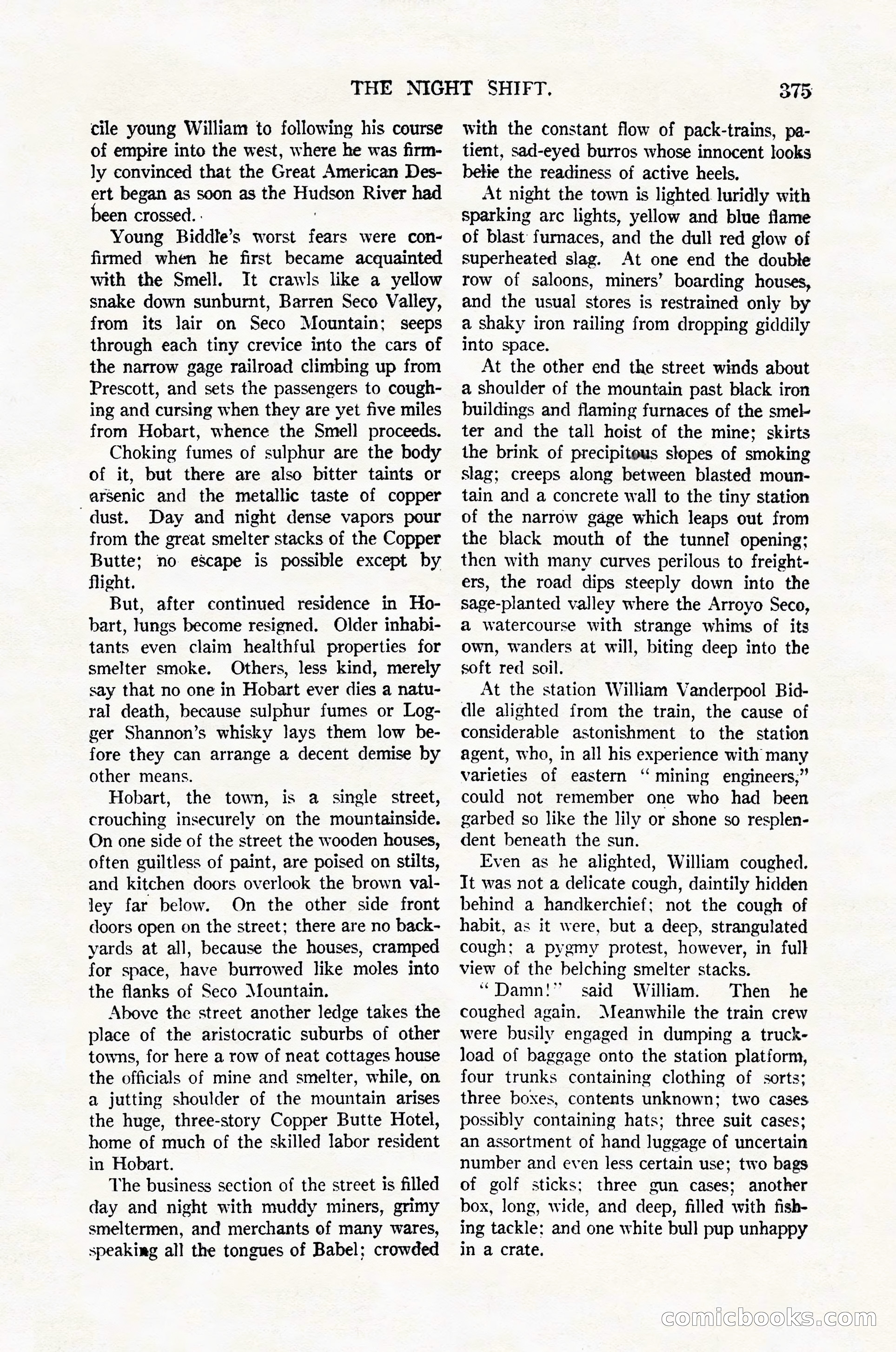
A restored page from Pulp Fiction, 1922. Page through the whole issue in the reader above.
📄 Transcribed text from this page (OCR, searchable)
Machine-transcribed from the original scan — historical spelling and the odd misread are preserved.
THE NIGHT SHIFT, cile young William to following his course of empire into the west, where he was firm- ly convinced that the Great American Des- ert began as soon as the Hudson River had een crossed. : : Young Biddle’s worst fears were con- firmed when he first became acquainted with the Smell. It crawls like a yellow snake down sunburnt, Barren Seco Valley, from its lair on Seco Mountain; seeps through each tiny crevice into the cars of the narrow gage railroad climbing up from Prescott, and sets the passengers to cough- ing and cursing when they are yet five miles from Hobart, whence the Smell proceeds. Choking fumes of sulphur are the body of it, but there are also bitter taints or arsenic and the metallic taste of copper dust. Day and night dense vapors pour from the great smelter stacks of the Copper Butte; no escape is possible except by flight. But, after continued residence in Ho- bart, lungs become resigned. Older inhabi- tants even claim healthful properties for smelter smoke. Others, less kind, merely say that no one in Hobart ever dies a natu- ral death, because sulphur fumes or Log- ger Shannon’s whisky lays them low be- fore they can arrange a decent demise by other means. Hobart, the town, is a single street, crouching insecurely on the mountainside. On one side of the street the wooden houses, often guiltless of paint, are poised on stilts, and kitchen doors overlook the brown val- ley far below. On the other side front doors open on the street; there are no back- yards at all, because the houses, cramped for space, have burrowed like moles into the flanks of Seco Mountain. Above the street another ledge takes the place of the aristocratic suburbs of other towns, for here a row of neat cottages house the officials of mine and smelter, while, on a jutting shoulder of the mountain arises the huge, three-story Copper Butte Hotel, home of much of the skilled labor resident in Hobart. The business section of the street is filled day and night with muddy miners, grimy smeltermen, and merchants of many wares, speaking all the tongues of Babel; crowded o1D with the constant flow of pack-trains, pa- tient, sad-eyed burros whose innocent looks belie the readiness of active heels. At night the town is lighted luridly with sparking arc lights, yellow and blue flame of blast furnaces, and the dull red glow of superheated slag. At one end the double row of saloons, miners’ boarding houses, and the usual stores is restrained only by a shaky iron railing from dropping giddily Into space. At the other end the street winds about a shoulder of the mountain past black iron buildings and flaming furnaces of the sme ter and the tall hoist of the mine; skirts the brink of precipitous slopes of smoking slag; creeps along between blasted moun- tain and a concrete wall to the tiny station of the narrow gage which leaps out from the black mouth of the tunnel opening; then with many curves perilous to freight- ers, the road dips steeply down into the sage-planted valley where the Arroyo Seco, a watercourse with strange whims of its own, wanders at will, biting deep into the soft red soil. At the station William Vanderpool Bid- dle alighted from the train, the cause of considerable astonishment to the station agent, who, in all his experience with many varieties of eastern “‘ mining engineers,” could not remember one who had been garbed so like the lily or shone so resplen- dent beneath the sun. Even as he alighted, William coughed. It was not a delicate cough, daintily hidden behind a handkerchief; not the cough of habit, as it were, but a deep, strangulated cough: a pygmy protest, however, in full view of the belching smelter stacks. “Damn!” said William. Then he coughed again. Meanwhile the train crew were busily engaged in dumping a truck- load of baggage onto the station platform, four trunks containing clothing of sorts; three boxes, contents unknown; two cases possibly containing hats; three suit cases; an assortment of hand luggage of uncertain number and even less certain use; two bags of golf sticks: three gun cases; another box, long, wide, and deep, filled with fish- ing tackle: and one white bull pup unhappy in a crate. COmiclbooks.Gom