
Pulp Fiction, 1922 · page 69 of 178
Argosy All-Story Weekly, February 4, 1922 — page 69: what you’re looking at
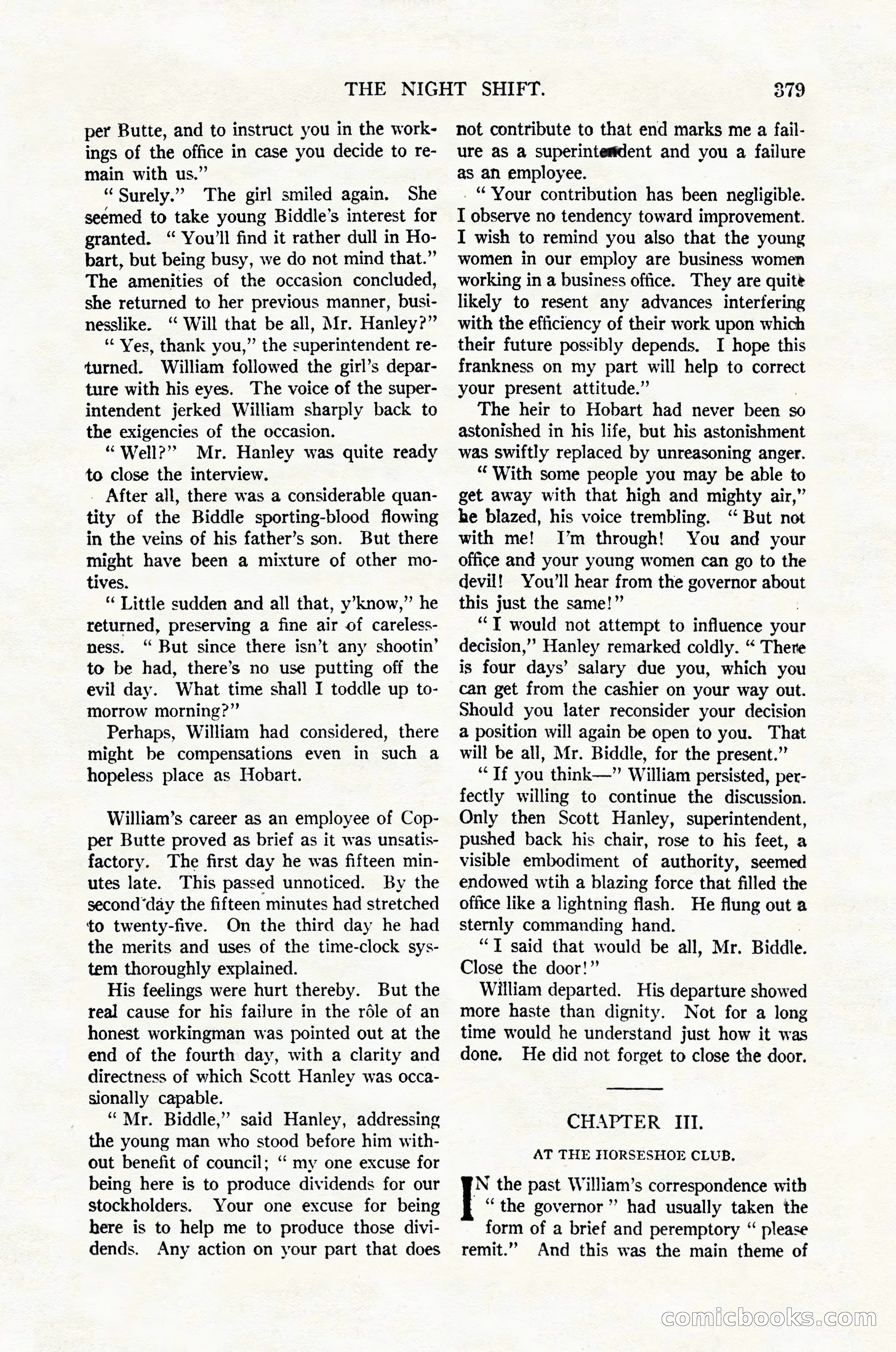
A restored page from Pulp Fiction, 1922. Page through the whole issue in the reader above.
📄 Transcribed text from this page (OCR, searchable)
Machine-transcribed from the original scan — historical spelling and the odd misread are preserved.
THE NIGHT SHIFT. O19 per Butte, and to instruct you in the work- ings of the office in case you decide to re- main with us.” “ Surely.” The girl smiled again. She seemed to take young Biddle’s interest for granted. “ You'll find it rather dull in Ho- bart, but being busy, we do not mind that.” The amenities of the occasion concluded, she returned to her previous manner, busi- nesslike. ‘ Will that be all, Mr. Hanley?” ‘Ves, thank you,” the superintendent re- turned. William followed the girl’s depar- ture with his eyes. The voice of the super- intendent jerked William sharply back to the exigencies of the occasion. “ Well?’ Mr. Hanley was quite ready to close the interview. _ After all, there was a considerable quan- tity of the Biddle sporting-blood flowing in the veins of his father’s son. But there might have been a mixture of other mo- tives. “ Little sudden and all that, y’know,”’ he returned, preserving a fine air of careless- ness. ‘“ But since there isn’t any shootin’ to be had, there’s no use putting off the evil day. What time shall I toddle up to- morrow morning?” Perhaps, William had considered, there might be compensations even in such a hopeless place as Hobart. William’s career as an employee of Cop- per Butte proved as brief as it was unsatis- factory. The first day he was fifteen min- utes late. This passed unnoticed. By the second ‘day the fifteen minutes had stretched to twenty-five. On the third day he had the merits and uses of the time-clock sys- tem thoroughly explained. His feelings were hurt thereby. But the real cause for his failure in the role of an honest workingman was pointed out at the end of the fourth day, with a clarity and directness of which Scott Hanley was occa- sionally capable. “Mr. Biddle,” said Hanley, addressing the young man who stood before him with- out benefit of council; ‘‘ my one excuse for being here is to produce dividends for our stockholders. Your one excuse for being here is to help me to produce those divi- dends. Any action on your part that does not contribute to that end marks me a fail- ure as a superintesident and you a failure as an employee. _“ Your contribution has been negligible. I observe no tendency toward improvement. I wish to remind you also that the young women in our employ are business women working in a business office. They are quite likely to resent any advances interfering with the efficiency of their work upon which their future possibly depends. I hope this frankness on my part will help to correct your present attitude.” The heir to Hobart had never been so astonished in his life, but his astonishment was swiftly replaced by unreasoning anger. “With some people you may be able to get away with that high and mighty air,” he blazed, his voice trembling. ‘‘ But not with me! I’m through! You and your office and your young women can go to the devil! You'll hear from the governor about this just the same!” ‘““T would not attempt to influence your decision,” Hanley remarked coldly. “ There is four days’ salary due you, which you can get from the cashier on your way out. Should you later reconsider your decision a position will again be open to you. That will be all, Mr. Biddle, for the present.” “If you think—” William persisted, per- fectly willing to continue the discussion. Only then Scott Hanley, superintendent, pushed back his chair, rose to his feet, a visible embodiment of authority, seemed endowed wtih a blazing force that filled the office like a lightning flash. He flung out a sternly commanding hand. “IT said that would be all, Mr. Biddle. Close the door!” William departed. His departure showed more haste than dignity. Not for a long time would he understand just how it was done. He did not forget to close the door. CHAPTER -ITT. AT THE HORSESHOE CLUB. N the past William’s correspondence with | “the governor” had usually taken the form of a brief and peremptory “ please remit.” And this was the main theme of COmiclbooks.Gonmn