
Pulp Fiction, 1922 · page 105 of 176
Argosy All-Story Weekly, Vol. 146 No. 4 — page 105: what you’re looking at
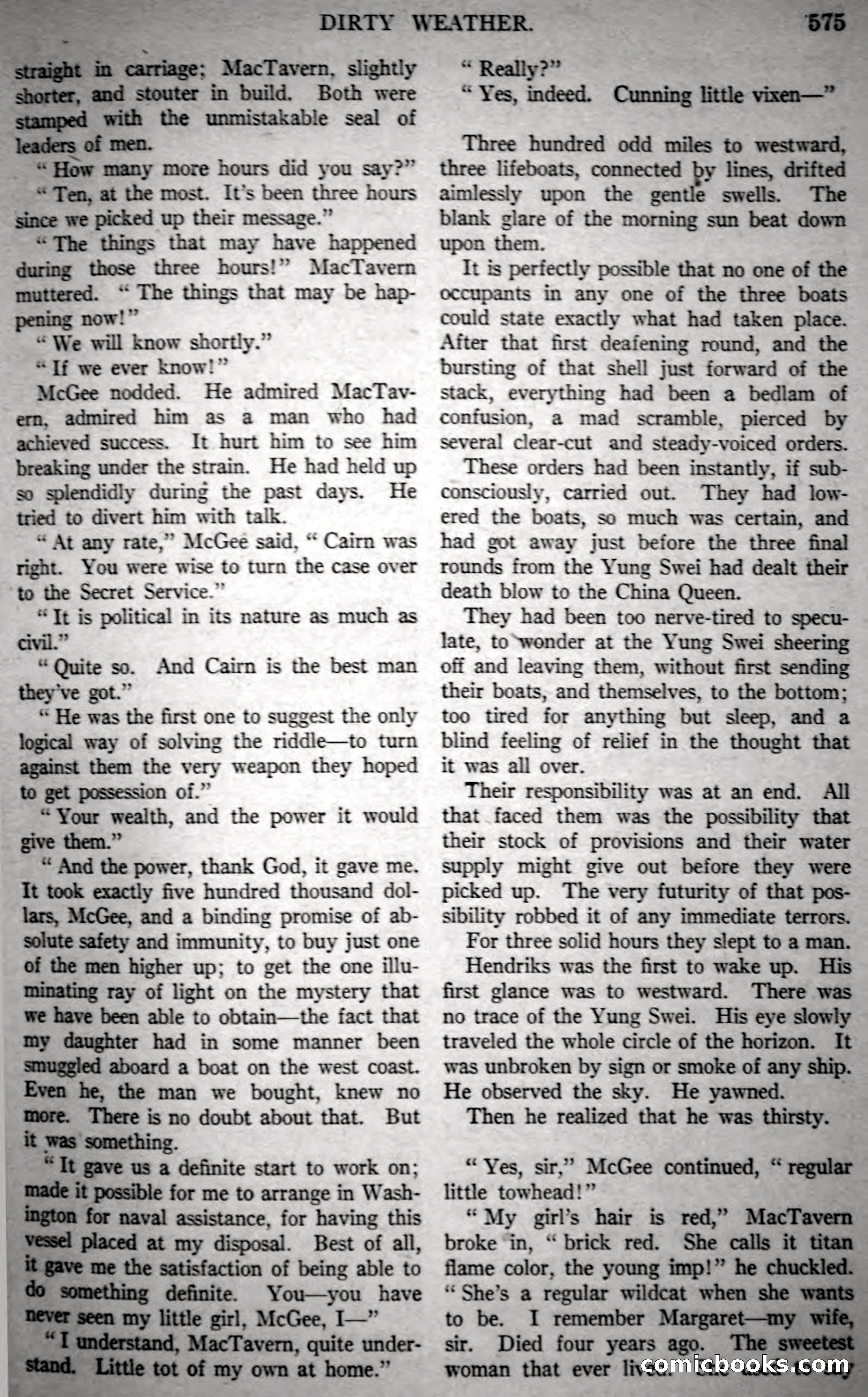
A restored page from Pulp Fiction, 1922. Page through the whole issue in the reader above.
📄 Transcribed text from this page (OCR, searchable)
Machine-transcribed from the original scan — historical spelling and the odd misread are preserved.
; ~« How many more hours did you say?” “Ten, at the most. It’s been three hours are we picked up their message.” “The things that may have happened during those three hours!” MacTavern muttered, “The things that may be hap- '*? now! “We will know shortly.” “Tf we ever know!” McGee nodded. He admired MacTav- em, admired him as a man who had achieved success. It hurt him to see him breaking under the strain. He had held up So splendidly during the past days. He tried to divert him with talk. * At any rate,” McGee said, “ Cairn was right. You were wise to turn the case over to the Secret Service.” “Tt is political in its nature as much as civil.” “Quite so. And Cairn is the best man “ He was the first one to suggest the only logical way of solving the riddle—to turn against them the very weapon they hoped to get possession of.” “Your wealth, and the power it would give them.” “ And the power, thank God, it gave me. Tt took exactly five hundred thousand dol- lars, McGee, and a binding promise of ab- solute safety and immunity, to buy just one men higher up; to get the one illu- Minating ray of light on the mystery that have been able to obtain—the fact that had in some manner been aboard a boat on the west coast. the man we bought, knew no is no doubt about that. But 2, : at us a ‘Geimite start to work on; : it possible for me to arrange in Wash- ington for naval assistance, for having this Vessel placed at my disposal. Best of all, tg akan a satisfaction of being able to “ Really?” - “Yes, indeed. Cunning little vixen—” Three hundred odd miles to westward, three lifeboats, connected by lines, drifted aimlessly upon the gentle swells. The blank glare of the morning sun beat down upon them. It is perfectly possible that no one of the occupants in any one of the three boats could state exactly what had taken place. After that first deafening round, and the bursting of that shell just forward of the stack, everything had been a bedlam of confusion, a mad scramble, pierced by several clear-cut and steady-voiced orders. These orders had been instantly, if sub- consciously, carried out. They had low- ered the boats, so much was certain, and had got away just before the three final rounds from the Yung Swei had dealt their death blow to the China Queen. They had been too nerve-tired to specu- late, to wonder at the Yung Swei sheering off and leaving them, without first sending their boats, and themselves, to the bottom; too tired for anything but sleep, and a blind feeling of relief in the thought that it was all over. Their responsibility was at an end. All that faced them was the possibility that their stock of provisions and their water supply might give out before they were picked up. The very futurity of that pos- sibility robbed it of any immediate terrors. For three solid hours they slept to a man. Hendriks was the first to wake up. His first glance was to westward. There was no trace of the Yung Swei. His eye slowly traveled the whole circle of the horizon. It was unbroken by sign or smoke of any ship. He observed the sky. He yawned. Then he realized that he was thirsty. “ Yes, sir,” McGee continued, “regular little towhead! “ “My girl’s hair is red, broke ‘in, “ brick