
Pulp Fiction, 1922 · page 123 of 176
Argosy All-Story Weekly, Vol. 146 No. 4 — page 123: what you’re looking at
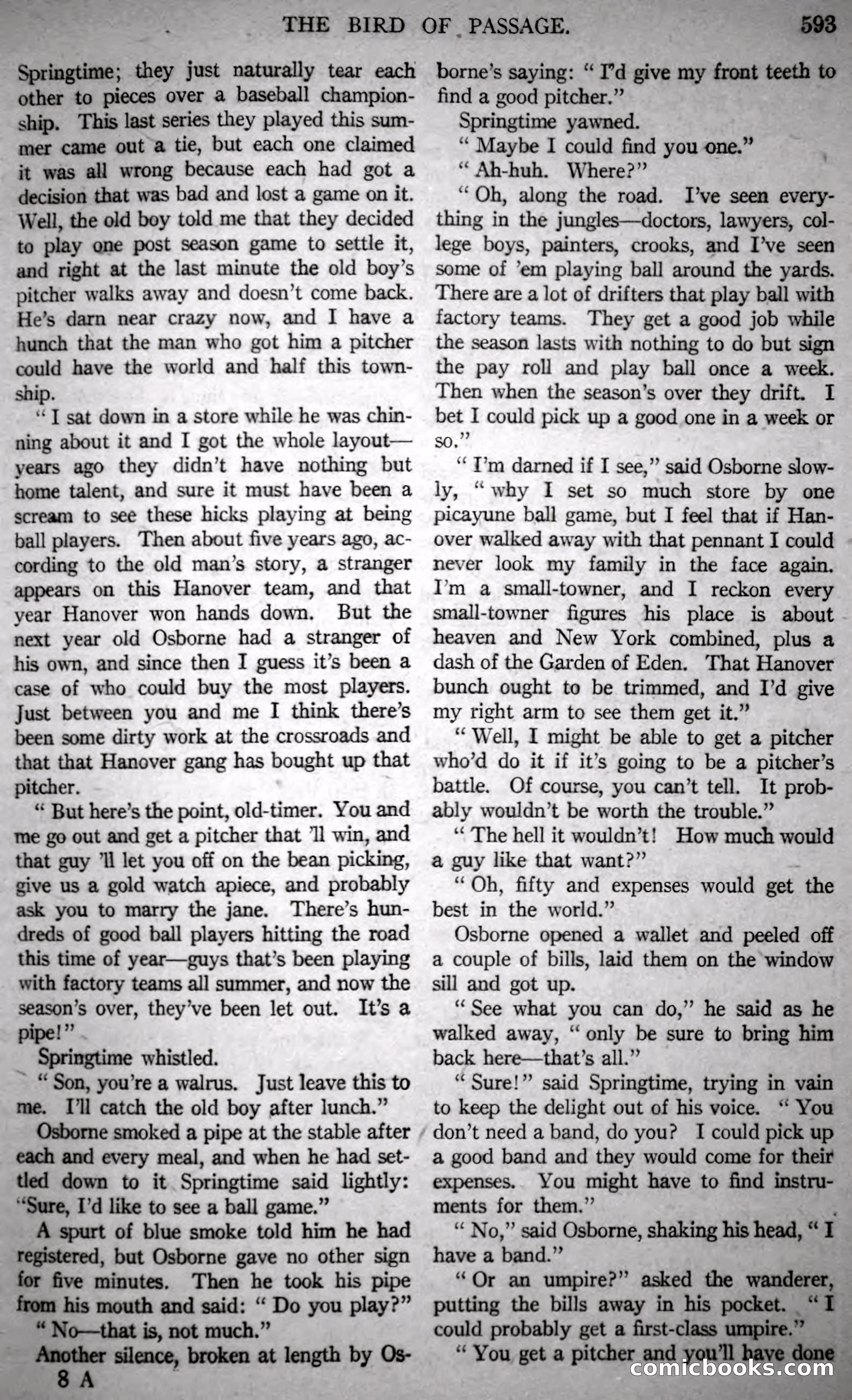
A restored page from Pulp Fiction, 1922. Page through the whole issue in the reader above.
📄 Transcribed text from this page (OCR, searchable)
Machine-transcribed from the original scan — historical spelling and the odd misread are preserved.
THE BIRD OF _ PASSAGE. Springtime; ces just naturally tear each borne’s saying: «Ta give my tesa ea other to pieces over a baseball champion- ship. This last series they played this sum- mer came out a tie, but each one claimed it was all wrong because each had got a decision that was bad and lost a game on it. Well, the old boy told me that they decided to play one post season game to settle it, and right at the last minute the old boy’s pitcher walks away and doesn’t come back. He’s darn near crazy now, and I have a hunch that the man who got him a pitcher could have the world and half this town- “T sat down in a store while he was chin- ning about it and I got the whole layout— years ago they didn’t have nothing but home talent, and sure it must have been a scream to see these hicks playing at being ball players. Then about five years ago, ac- cording to the old man’s story, a stranger appears on this Hanover team, and that year Hanover won hands down. But the next year old Osborne had a stranger of his own, and since then I guess it’s been a case of who could buy the most players. Just between you and me I think there’s been some dirty work at the crossroads and that that Hanover gang has bought up that pitcher. “ But here’s the point, old-timer. You and me go out and get a pitcher that ll win, and that guy ‘ll let you off on the bean picking, give us a gold watch apiece, and probably ask you to marry the jane. There’s hun- dreds of good ball players hitting the road this time of year—guys that’s been playing with factory teams all summer, and now the season’s over, they’ve been let out. It’s a pipe! 7 Springtime whistled. ~ “Son, you’re a walrus. Just leave this to me. I'll catch the old boy after lunch.” Osborne smoked a pipe at the stable after each and every meal, and when he had set- tled down to it Springtime said lightly: “Sure, I'd like to see a ball game.” A spurt of blue smoke told him he had registered, but Osborne gave no other sign for five minutes. Then he took his pipe from his mouth and said: “‘ Do you play?” “ No—that is, not much.” ere silence, broken at length by Os- ae find a good pitcher.” Springtime yawned. “ Maybe I aw find you one.” ‘““ Ah-huh. Where?” “Oh, along the road. I’ve seen every- thing in the jungles—doctors, lawyers, col- lege boys, painters, crooks, and I’ve seen some of ’em playing ball around the yards. There are a lot of drifters that play ball with factory teams. They get a good job while the season lasts with nothing to do but sign the pay roll and play ball once a week. Then when the season’s over they drift. I bet I could pick up a good one in a week or ag.” ‘“T’m darned if I see,”’ said Osborne slow- ly, “why I set so much store by one picayune ball game, but I feel that if Han- over walked away with that pennant I could never look my family in the face again. I’m a small-towner, and I reckon every small-towner figures his place is about heaven and New York combined, plus a dash of the Garden of Eden. That Hanover bunch ought to be trimmed, and I’d give my right arm to see them get it.” ‘Well, I might be able to get a pitcher who’d do it if it’s going to be a pitcher’s battle. Of course, you can’t tell. It prob- ably wouldn’t be worth the trouble.” “The hell it wouldn’t! How much would a guy like that want?” “Oh, fifty and expenses would get the best in the world.” Osborne opened a wallet and peeled off a couple of bills, laid them on the window sill and got up. ‘““See what you can do,” he said as he walked away, “only be sure to bring him back here—that’s all.” “Sure!” said Springtime, trying in vain to keep the delight out of his voice. ‘“ You don’t need a band, do you? I could pick up a good band and they would come for their expenses. You might have to find instru- ments for them.” “ No,” said Osborne, shaking his head, “I have a band. ¥ “Or an umpire?” asked the putting the bills away in his pocket. “ it could probably get a first-class umpit 2 a “ You get a > comicho hav oi ne ’