
Pulp Fiction, 1922 · page 132 of 176
Argosy All-Story Weekly, Vol. 146 No. 4 — page 132: what you’re looking at
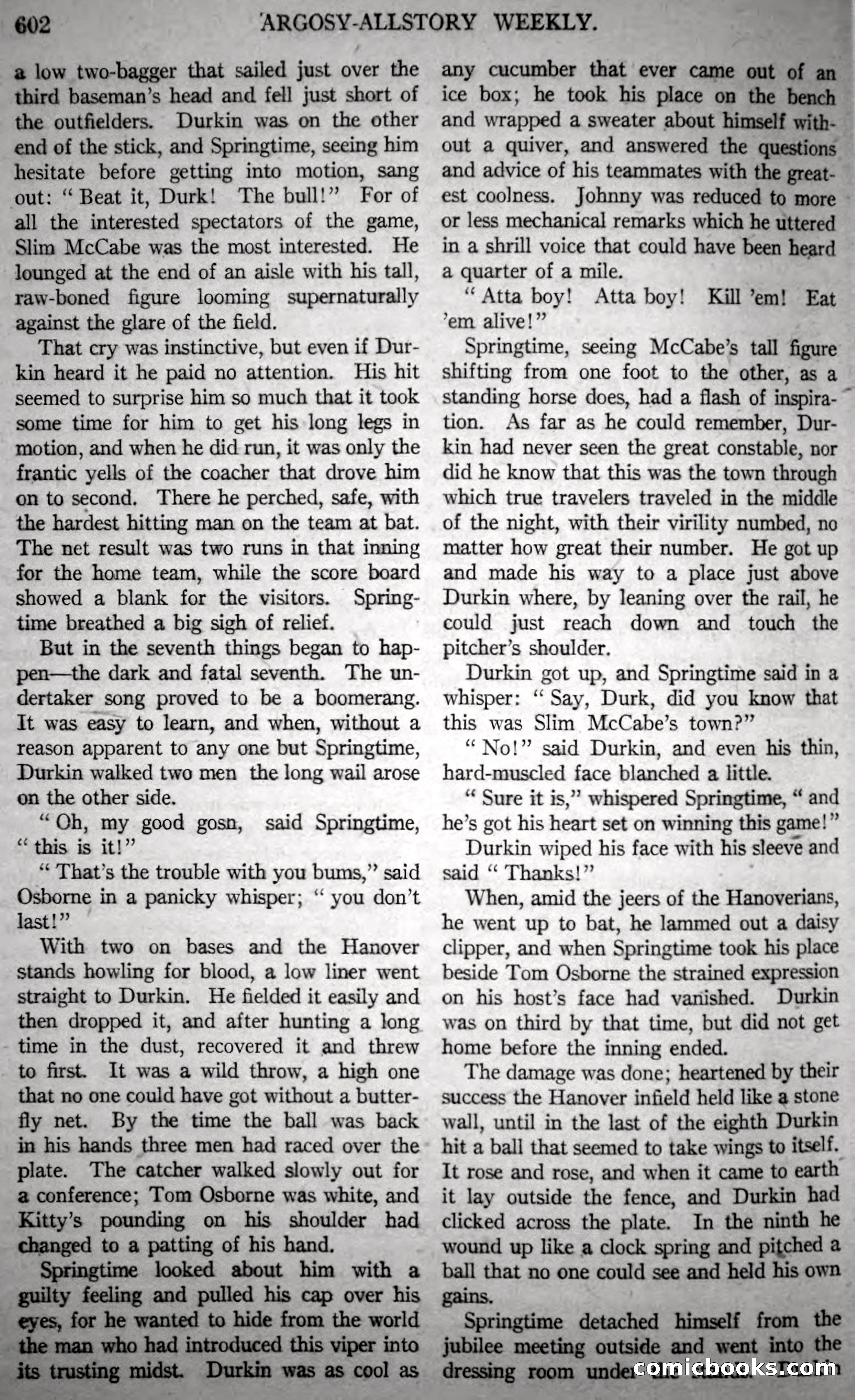
A restored page from Pulp Fiction, 1922. Page through the whole issue in the reader above.
📄 Transcribed text from this page (OCR, searchable)
Machine-transcribed from the original scan — historical spelling and the odd misread are preserved.
- - — 602 ‘ _@ low two-bagger that sailed just over the third baseman’s head and fell just short of the outfielders. Durkin was on the other end of the stick, and Springtime, seeing him hesitate before getting into motion, sang out: “ Beat it, Durk! The bull!” For of all the interested spectators of the game, Slim McCabe was the most interested. He lounged at the end of an aisle with his tall, raw-boned figure looming supernaturally against the glare of the field. That cry was instinctive, but even if Dur- kin heard it he paid no attention. His hit seemed to surprise him so much that it took some time for him to get his long legs in motion, and when he did run, it was only the frantic yells of the coacher that drove him on to second, There he perched, safe, with the hardest hitting man on the team at bat. The net result was two runs in that inning for the home team, while the score board showed a blank for the visitors. Spring- time breathed a big sigh of relief. But in the seventh things began to hap- pen—the dark and fatal seventh. The un- dertaker song proved to be a boomerang. It was easy to learn, and when, without a reason apparent to any one but Springtime, Durkin walked two men the long wail arose on the other side. “Oh, my good gosn, said Springtime, “this is it!” ** 'That’s the trouble with you bums,” said Osborne in a panicky whisper; ‘“‘ you don’t last!” With two on bases and the Hanover stands howling for blood, a low liner went straight to Durkin. He fielded it easily and then dropped it, and after hunting a long - time in the dust, recovered it and threw to first. It was a wild throw, a high one that no one could have got without a butter- fly net. By the time the ball was back in his hands three men had raced over the plate. The catcher walked slowly out for a conference; Tom Osborne was white, and Kitty’s pounding on his shoulder had ? oe. toa h patting of his hand. ARGOSY-ALLSTORY WEEKLY. bi Pa” fo FT any cucumber that ever came out o an ice box; he took his place on the bench - and wrapped a sweater about himself with- out a quiver, and answered the questions — and advice of his teammates with the great- est coolness. Johnny was reduced to more or less mechanical remarks which he uttered in a shrill voice that could have been heard — a quarter of a mile. ‘Atta boy! Atta boy! em alive!” Springtime, seeing McCabe’s tall figure shifting from one foot to the other, as a standing horse does, had a flash of inspira-~ tion. As far as he could remember, Dur- kin had never seen the great constable, nor did he know that this was the town through which true travelers traveled in the middle of the night, with their virility numbed, no matter how great their number. He got up and made his way to a place just above Durkin where, by leaning over the rail, he could just reach down and touch the pitcher’s shoulder. Durkin got up, and Springtime said in a whisper: ‘‘ Say, Durk, did you know that this was Slim McCabe’s town?” “No!” said Durkin, and even his thin, hard-muscled face blanched a little. “ Sure it is,” whispered Springtime, “ and he’s got his heart set on winning this game!” Durkin wiped his face with his sleeve and said “ Thanks!” When, amid the jeers of the Hanoverians, he went up to bat, he lammed out a daisy clipper, and when Springtime took his place beside Tom Osborne the strained expression on his host’s face had vanished. Durkin was on third by that time, but did not get home before the inning ended. The damage was done; heartened by their success the Hanover infield held like a stone wall, until in the last of the eighth Durkin hit a ball that seemed to take wings to itself. It rose and rose, and when it came to earth it lay outside the fence, and Durkin had clicked across the plate. In the ninth he wound up like a clock spring and pitched a ball that no one could. see and Jheld Biesgrem ye Kill ’em! Eat