
Pulp Fiction, 1922 · page 135 of 176
Argosy All-Story Weekly, Vol. 146 No. 4 — page 135: what you’re looking at
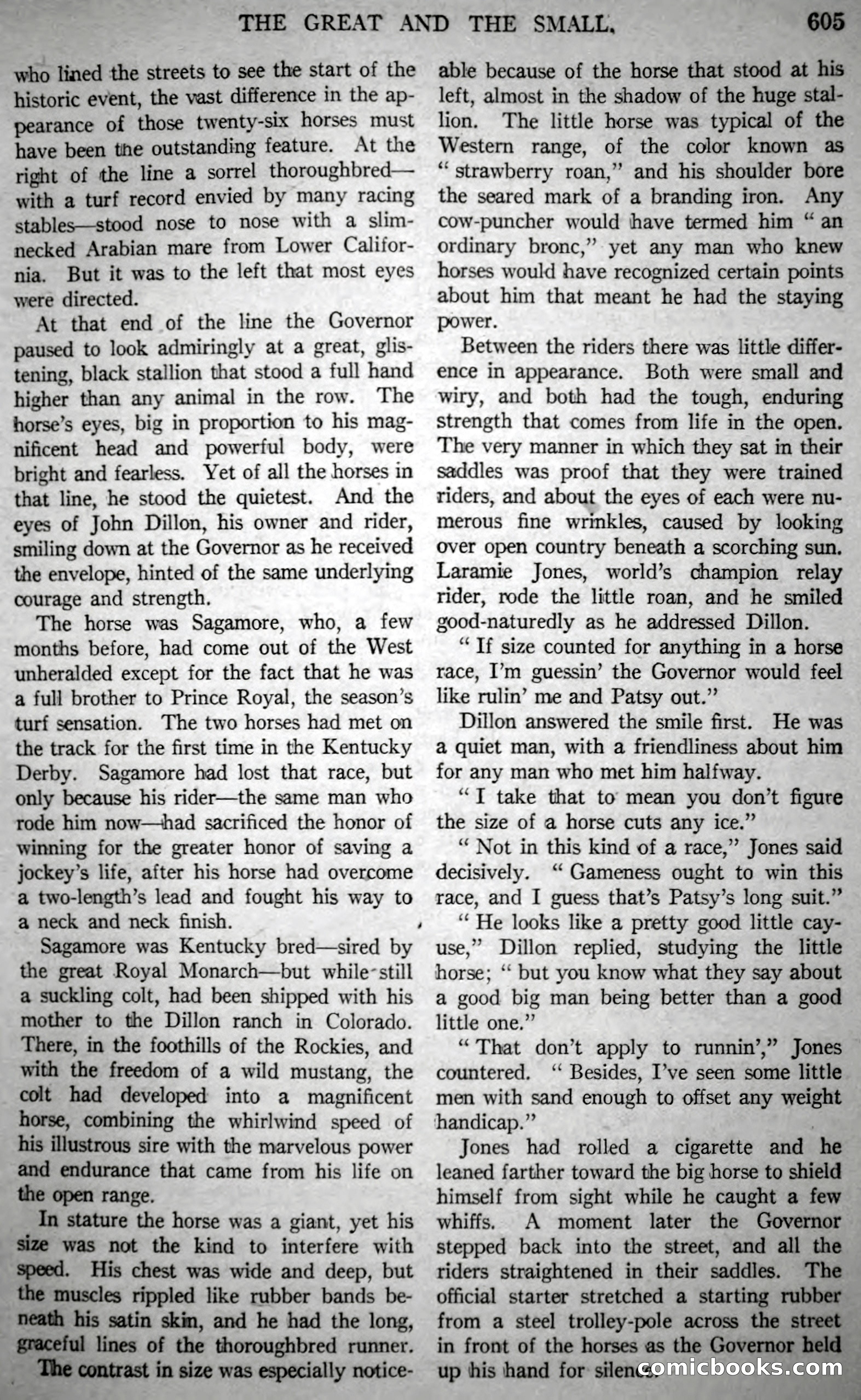
A restored page from Pulp Fiction, 1922. Page through the whole issue in the reader above.
📄 Transcribed text from this page (OCR, searchable)
Machine-transcribed from the original scan — historical spelling and the odd misread are preserved.
THE GREAT AND THE SMALL, who lined the streets to see the start of the historic event, the vast difference in the ap- pearance of those twenty-six horses must have been the outstanding feature. At the right of the line a sorrel thoroughbred— with a turf record envied by many racing stables—stood nose to nose with a slim- necked Arabian mare from Lower Califor- nia. But it was to the left that most eyes were directed. At that end of the line the Governor paused to look admiringly at a great, glis- tening, black stallion that stood a full hand higher than any animal in the row. The horse’s eyes, big in proportion to his mag- nificent head and powerful body, were bright and fearless. Yet of all the horses in that line, he stood the quietest. And the eyes of John Dillon, his owner and rider, smiling down at the Governor as he received the envelope, hinted of the same underlying courage and strength. The horse was Sagamore, who, a few months before, had come out of the West unheralded except for the fact that he was a full brother to Prince Royal, the season’s turf sensation. The two horses had met on the track for the first time in the Kentucky Derby. Sagamore had lost that race, but only because his rider—the same man who rode him now—had sacrificed the honor of winning for the greater honor of saving a jockey’s life, after his horse had overcome a two-length’s lead and fought his way to a neck and neck finish. Sagamore was Kentucky bred—sired by the great Royal Monarch—but while-still a suckling colt, had been shipped with his mother to the Dillon ranch in Colorado. There, in the foothills of the Rockies, and with the freedom of a wild mustang, the colt had developed into a magnificent horse, combining the whirlwind speed of his illustrous sire with the marvelous power and endurance that came from his life on the open range. In stature the horse was a giant, yet his size was not the kind to interfere with ‘speed. His chest was wide and deep, but muscles rippled like rubber bands be- neath his satin skin, and he had the long, lines of the thoroughbred runner. contrast in size was especially notice- gf “ ~ *. ~~ . nr , handicap.” - ss 605 able because of the horse that stood at his left, almost in the shadow of the huge stal- lion. The little horse was typical of the Western range, of the color known as “strawberry roan,”’ and his shoulder bore the seared mark of a branding iron. Any cow-puncher would have termed him “ an ordinary bronc,” yet any man who knew horses would have recognized certain points about him that meant he had the staying power. Between the riders there was little differ- ence in appearance. Both were small and wiry, and both had the tough, enduring strength that comes from life in the open. The very manner in which they sat in their saddles was proof that they were trained riders, and about the eyes of each were nu- merous fine wrinkles, caused by looking over open country beneath a scorching sun. Laramie Jones, world’s champion relay rider, rode the little roan, and he smiled good-naturedly as he addressed Dillon. “If size counted for anything in a horse race, I’m guessin’ the Governor would feel like rulin’ me and Patsy out.” Dillon answered the smile first. He was @ quiet man, with a friendliness about him for any man who met him halfway. “T take that to mean you don’t figure the size of a horse cuts any ice.” ‘“ Not in this kind of a race,”’ Jones said decisively. ‘“‘ Gameness ought to win this race, and I guess that’s Patsy’s long suit.” ‘‘ He looks like a pretty good little cay- use,” Dillon replied, studying the little horse; “‘ but you know what they say about a good big man being better than a good little one.” “That don’t apply to runnin’,” Jones countered. ‘‘ Besides, I’ve seen some little men with sand enough to offset any weight Jones had rolled a cigarette and he leaned farther toward the big horse to shield himself from sight while he caught a few whiffs. A moment later the Governor stepped back into the street, and all the riders straightened in their saddles. The official starter stretched a starting rubber — from a steel trolley-pole across the street in front of the horses as the ( or held up this hand for silen(#oVi)(< sXe%o) Xeon