
Pulp Fiction, 1922 · page 141 of 176
Argosy All-Story Weekly, Vol. 146 No. 4 — page 141: what you’re looking at
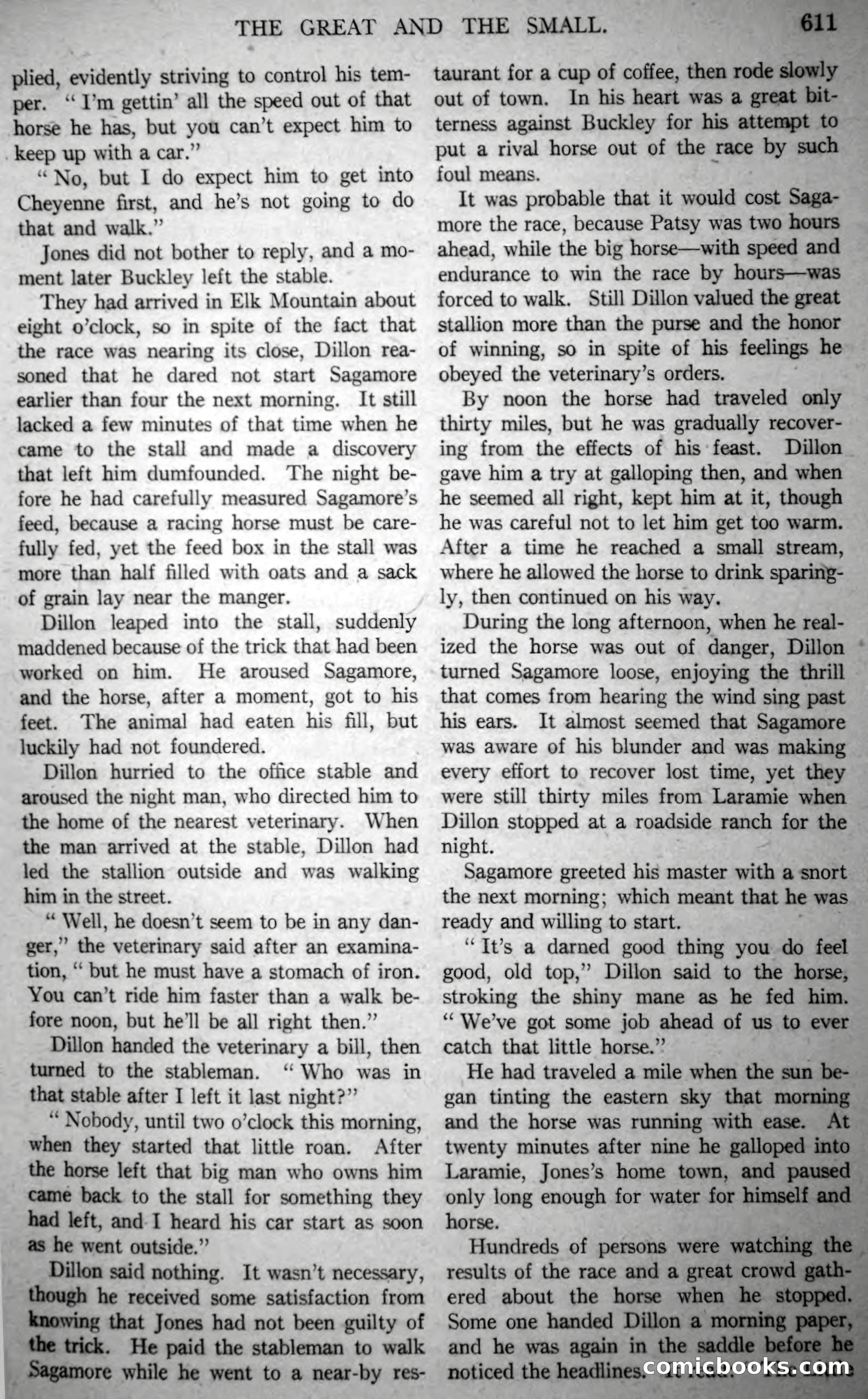
A restored page from Pulp Fiction, 1922. Page through the whole issue in the reader above.
📄 Transcribed text from this page (OCR, searchable)
Machine-transcribed from the original scan — historical spelling and the odd misread are preserved.
THE GREAT AND THE SMALL. plied, sivitbeddhy striving to control his tem- per. “I’m gettin’ all the speed out of that horse he has, but you can’t expect him to keep up with a car.” “No, but I do expect him to get into Cheyenne first, and he’s not going to do that and walk.” Jones did not bother to reply, and a mo- ment later Buckley left the stable. They had arrived in Elk Mountain about eight o’clock, so in spite of the fact that the race was nearing its close, Dillon rea- soned that he dared not start Sagamore earlier than four the next morning. It still lacked a few minutes of that time when he came to the stall and made a discovery that left him dumfounded. The night be- fore he had carefully measured Sagamore’s feed, because a racing horse must be care- fully fed, yet the feed box in the stall was more than half filled with oats and a sack of grain lay near the manger. Dillon leaped into the stall, suddenly maddened because of the trick that had been worked on him. He aroused Sagamore, and the horse, after a moment, got to his feet. The animal had eaten his fill, but luckily had not foundered. Dillon hurried to the office stable and aroused the night man, who directed him to the home of the nearest veterinary. When the man arrived at the stable, Dillon had led the stallion outside and was walking him in the street. “Well, he doesn’t seem to be in any dan- ger,” the veterinary said after an examina- tion, “ but he must have a stomach of iron. You can’t ride him faster than a walk be- fore noon, but he’ll be all right then.”’ Dillon handed the veterinary a bill, then turned to the stableman. ‘ Who was in that stable after I left it last night?” ‘* Nobody, until two o’clock this morning, when they started that little roan. After the horse left that big man who owns him came back to the stall for something they had left, and-I heard his car start as soon as he went outside.” Dillon said nothing. It wasn’t necessary, _ though he received some satisfaction from oe that Jones had not been guilty of the trick. He paid the stableman to walk vamos while he went to a near-by res- taurant for a cup of coffee, then eswty out of town. In his heart was + a terness against Buckley for his attempt to put a rival horse out of the race So such foul means. It was probable that it would cost Saga- more the race, because Patsy was two hours ahead, while the big horse—with speed and endurance to win the race by hours—was forced to walk. Still Dillon valued the great stallion more than the purse and the honor of winning, so in spite of his feelings he obeyed the veterinary’s orders. By noon the horse had traveled only thirty miles, but he was gradually recover- ing from the effects of his feast. Dillon gave him a try at galloping then, and when he seemed all right, kept him at it, though he was careful not to let him get too warm. After a time he reached a small stream, where he allowed the horse to drink sparing- ly, then continued on his way. During the long afternoon, when he real- ized the horse was out of danger, Dillon turned Sagamore loose, enjoying the thrill © that comes from hearing the wind sing past his ears. It almost seemed that Sagamore was aware of his blunder and was making every effort to recover lost time, yet they were still thirty miles from Laramie when ~ Dillon stopped at a roadside panes for the — night. 3 Sagamore greeted his master with a snort — the next morning; which meant that he was — ready and willing to start. “It’s a darned good thing you do feel good, old top,” Dillon said to the horse, stroking the shiny mane as he fed him. ““'We’ve got some job ahead of us to ever catch that little horse.” 3 He had traveled a mile when the sun be gan tinting the eastern Sky that morning — x and the horse was running with ease. At twenty minutes after nine he galloped into Laramie, Jones’s home town, and only long enough for water for himse! horse. a. Hundreds of persons were ] results of the race and a g iv crowd ered about the horse bmn Some one handed Dillon a : { and he was pert in the ) noticed the head cormicbooks. com a et sd