
Pulp Fiction, 1922 · page 144 of 176
Argosy All-Story Weekly, Vol. 146 No. 4 — page 144: what you’re looking at
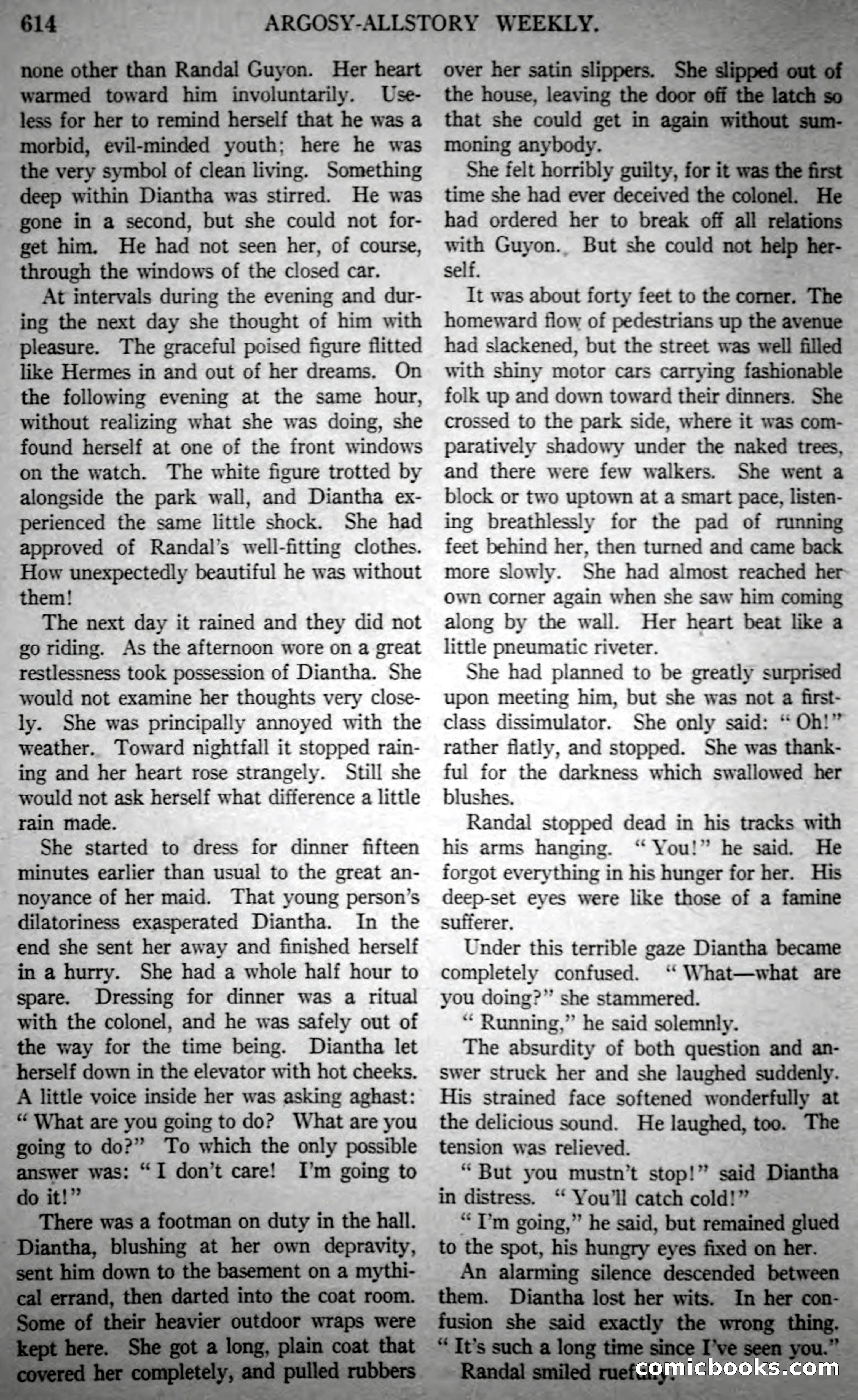
A restored page from Pulp Fiction, 1922. Page through the whole issue in the reader above.
📄 Transcribed text from this page (OCR, searchable)
Machine-transcribed from the original scan — historical spelling and the odd misread are preserved.
| Neciined toward him involuntarily. Use- less for her to remind herself that he was a _ morbid, evil-minded youth; here he was the very symbol of clean living. Something deep within Diantha was stirred. He was _ gone in a second, but she could not for- get him. He had not seen her, of course, through the windows of the closed car. At intervals during the evening and dur- ing the next day she thought of him with pleasure. The graceful poised figure flitted like Hermes in and out of her dreams. On the following evening at the same hour, without realizing what she was doing, she found herself at one of the front windows on the watch. The white figure trotted by alongside the park wall, and Diantha ex- perienced the same little shock. She had approved of Randal’s well-fitting clothes. How unexpectedly beautiful he was without them! The next day it rained and they did not go riding. As the afternoon wore on a great restlessness took possession of Diantha. She would not examine her thoughts very close- ly. She was principally annoyed with the weather. Toward nightfall it stopped rain- ing and her heart rose strangely. Still she would not ask herself what difference a little rain made. She started to dress for dinner fifteen minutes earlier than usual to the great an- noyance of her maid. That young person’s dilatoriness exasperated Diantha. In the end she sent her away and finished herself in a hurry. She had a whole half hour to spare. Dressing for dinner was a ritual with the colonel, and he was safely out of the way for the time being. Diantha let - herself down in the elevator with hot cheeks. A little voice inside her was asking aghast: “ What are you going to do? What are you going to do?” To which the only possible was: “I don’t care! I’m going to ¥ Sei tate We Biron .dopeavity, ~~ | ~ anne time she had ever ected tea a ‘He } had ordered her to break off all relations with Guyon., But she could not a her- self. It was about forty feet to the corner. The homeward flow of pedestrians up the avenue had slackened, but the street was well filled with shiny motor cars carrying fashionable folk up and down toward their dinners. She crossed to the park side, where it was com- paratively shadowy under the naked trees, and there were few walkers. She went a block or two uptown at a smart pace, listen- ing breathlessly for the pad of minning feet behind her, then turned and came back more slowly. She had almost reached her own corner again when she saw him coming along by the wall. Her heart beat like a little pneumatic riveter. She had planned to be greatly surprised upon meeting him, but she was not a first- class dissimulator. She only said: “Oh!” rather flatly, and stopped. She was thank- ful for the darkness which swallowed her blushes. Randal stopped dead in his tracks with his arms hanging. “‘ You!” he said. He forgot everything in his hunger for her. His deep-set eyes were like those of a famine sufferer. Under this terrible gaze Diantha became completely confused. “‘ What—what are you doing?” she stammered. “ Running,” he said solemnly. The absurdity of both question and an- swer struck her and she laughed suddenly. His strained face softened wonderfully at the delicious sound. He laughed, too. The tension was relieved. “But you mustn’t stop!” said Diantha in distress. “ You'll catch cold!” — “I'm going,” he said, but remained glued to So canvas Uk nee me ' rE BOOKE coin