
Pulp Fiction, 1922 · page 151 of 176
Argosy All-Story Weekly, Vol. 146 No. 4 — page 151: what you’re looking at
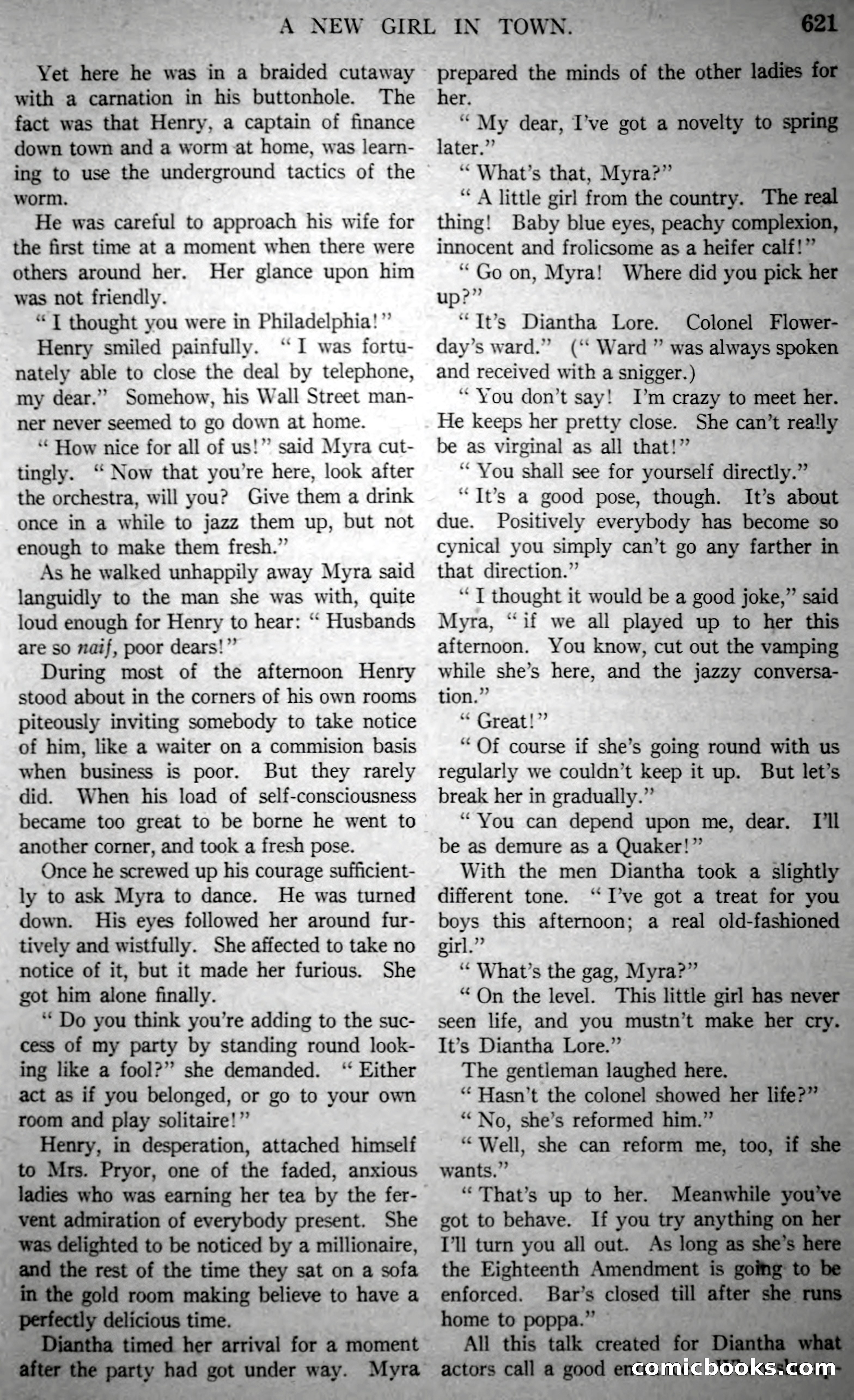
A restored page from Pulp Fiction, 1922. Page through the whole issue in the reader above.
📄 Transcribed text from this page (OCR, searchable)
Machine-transcribed from the original scan — historical spelling and the odd misread are preserved.
A NEW GIRL IN TOWN. Yet here he was in a braided cutaway with a carnation in his buttonhole. The fact was that Henry, a captain of finance down town and a worm at home, was learn- ing to use the underground tactics of the worm. He was careful to approach his wife for the first time at a moment when there were others around her. Her glance upon him was not friendly. “T thought you were in Philadelphia!” Henry smiled painfully. “I was fortu- nately able to close the deal by telephone, my dear.’’ Somehow, his Wall Street man- ner never seemed to go down at home. ‘“* How nice for all of us!’ said Myra cut- tingly. “ Now that you're here, look after the orchestra, will you? Give them a drink once in a while to jazz them up, but not enough to make them fresh.” As he walked unhappily away Myra said languidly to the man she was with, quite loud enough for Henry to hear: “ Husbands are so naif, poor dears!”’ During most of the afternoon Henry stood about in the corners of his own rooms piteously inviting somebody to take notice of him, like a waiter on a commision basis when business is poor. But they rarely did. When his load of self-consciousness became too great to be borne he went to another corner, and took a fresh pose. Once he screwed up his courage sufficient- ly to ask Myra to dance. He was turned down. His eyes followed her around fur- tively and wistfully. She affected to take no notice of it, but it made her furious. She got him alone finally. “ Do you think you’re adding to the suc- cess of my party by standing round look- ing like a fool?’ she demanded. “ Either act as if you belonged, or go to your own room and play solitaire!” Henry, in desperation, attached himself to Mrs. Pryor, one of the faded, anxious ladies who was earning her tea by the fer- _ vent admiration of everybody present. She jo regan to be noticed by a millionaire, | the gold room making believe to have a re “a ‘ “4 y 5 oe Dini ha ‘ined nee arrival for a moment prepared the minds of the she + ladit 3 her. ae ‘My dear, I’ve got a novelty to spring later. = ‘“ What’s that, Myra?” “A little girl from the country. The real ; thing! Baby blue eyes, peachy complexion, innocent and frolicsome as a heifer calf!” ‘Go on, Myra! Where did you pick her up?” “It’s Diantha Lore. Colonel Flower- day’s ward.” (‘‘ Ward ” was always spoken and received with a snigger.) “You don’t say! I’m crazy to meet her. He keeps her pretty close. She can’t really be as virginal as all that!” “You shall see for yourself directly.” “It’s a good pose, though. It’s about due. Positively everybody has become so cynical you simply can’t go any farther in that direction.” ‘T thought it would be a good joke,” said Myra, “if we all played up to her this afternoon. You know, cut out the vamping while she’s here, and the jazzy conversa- jan “ Great!” “Of course if she’s going round with us regularly we couldn’t keep it up. But let’s break her in gradually.” “You can depend upon me, dear. be as demure as a Quaker!” With the men Diantha took a slightly different tone. “I’ve got a treat for you boys this afternoon; a real old-fashioned girl.” ‘“* What’s the gag, Myra?” “On the level. This little girl has never seen life, and you mustn’t make her me , It’s Diantha Lore.” The gentleman laughed here. 3 “ Hasn’t the colonel showed her ite?” “No, she’s reformed him.” wee “Well, she can reform me, toy it sh = « That’s up to her. ‘Mesnititie! you" got to behave. If you try anything on he I'll turn you all out. As long as she’s her the pe Ss AERO pe: y to Tl