
Pulp Fiction, 1922 · page 153 of 176
Argosy All-Story Weekly, Vol. 146 No. 4 — page 153: what you’re looking at
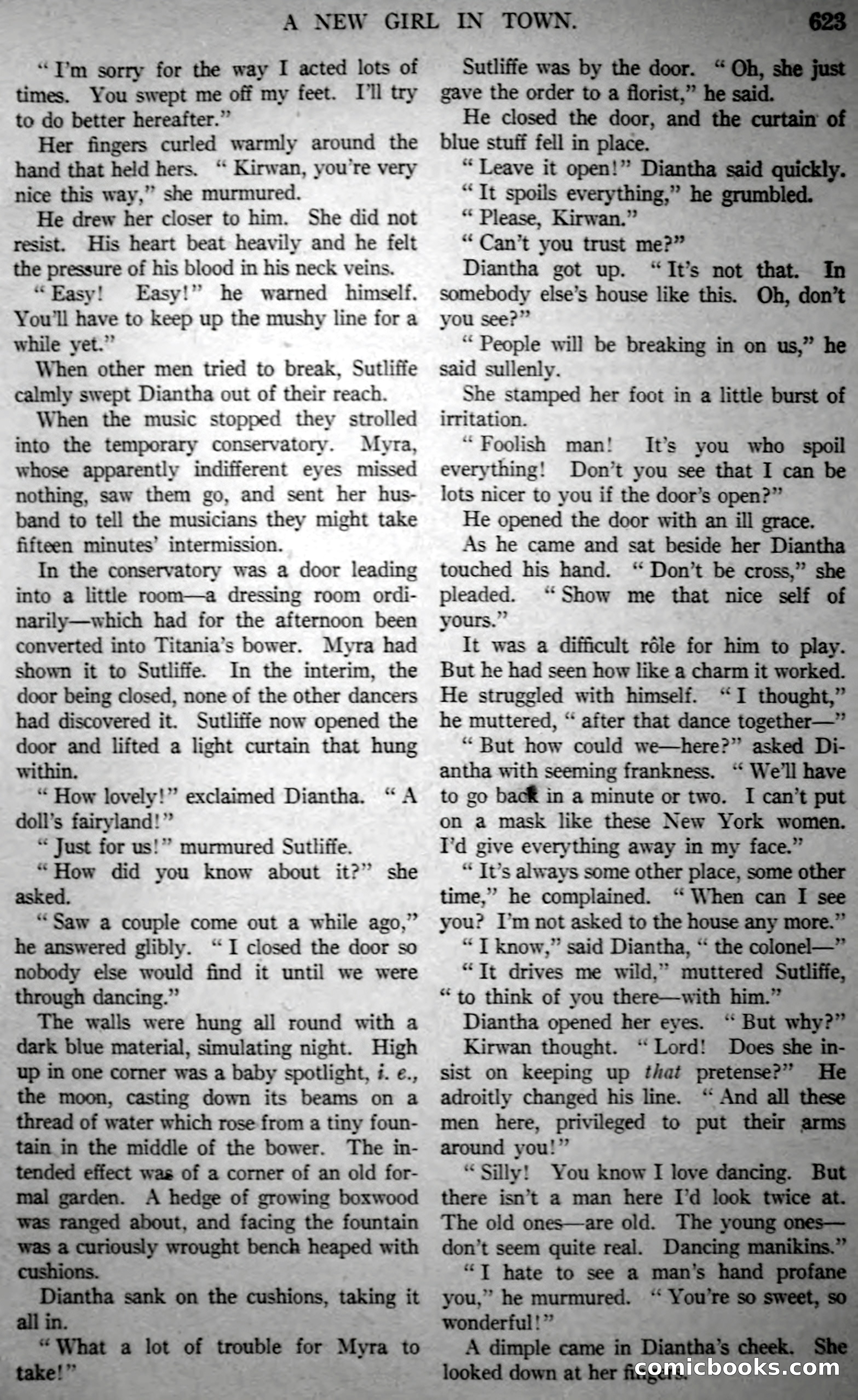
A restored page from Pulp Fiction, 1922. Page through the whole issue in the reader above.
📄 Transcribed text from this page (OCR, searchable)
Machine-transcribed from the original scan — historical spelling and the odd misread are preserved.
A NEW GIRL IN bia “I’m sorry for the way I acted lots of times. You swept me off my feet. I'll try to do better hereafter.” Her fingers curled warmly around the hand that held hers. “ Kirwan, you're very nice this way,” she murmured. He drew her closer to him. She did not resist. His heart beat heavily and he felt the pressure of his blood in his neck veins. “Easy! Easy!” he warned himself. You'll have to keep up the mushy line for a while yet.” When other men tried to break, Sutliffe calmly swept Diantha out of their reach. When the music stopped they strolled into the temporary conservatory. Myra, whose apparently indifferent eyes missed nothing, saw them go, and sent her hus- band to tell the musicians they might take fifteen minutes’ intermission. In the conservatory was a door leading into a little room—a dressing room ordi- narily—which had for the afternoon been converted into Titania’s bower. Myra had shown it to Sutliffe. In the interim, the door being closed, none of the other dancers had discovered it. Sutliffe now opened the door and lifted a light curtain that hung within. “ How lovely!” exclaimed Diantha. doll’s fairyland!” * Just for us!” murmured Suttiffe. “How did you know about it?” she asked. “Saw a couple come out a while ago,” he answered glibly. “I closed the door so nobody else would find it until we were through dancing.” The walls were hung all round with a dark blue material, simulating night. High up in one corner was a baby spotlight, i. e., the moon, casting down its beams on a thread of water which rose from a tiny foun- tain in the middle of the bower. The in- tended effect was of a corner of an old for- mal garden. A hedge of growing boxwood was ranged ae and facing the fountain cushions. Diantha sank on the cushions, taking it “A LeZWWist & lot of trouble for Myra to _ ony... es *. gave the order toa phe e sai a, He closed the door, and the curtain’ blue stuff fell in place. ee eal “ Leave it open!” Diantha sid uickly. “It spoils everything,” he grumbled. _ “ Please, Kirwan.” “ Can’t you trust me?” | Diantha got up. “It’s not that. somebody else’s house like this. Oh, don’t you see?” ‘People will be breaking in on us,” he said sullenly. She stamped her foot in a little burst of irritation. ‘Foolish man! It’s you who spoil everything! Don’t you see that I can be lots nicer to you if the door’s open?” He opened the door with an ill grace. As he came and sat beside her Diantha touched his hand. “ Don’t be cross,” she pleaded. “Show me that nice self of yours.” It was a difficult rdle for him to play. But he had seen how like a charm it worked. He struggled with himself. “I rng he muttered, “ after that dance “ But how could we—here?” asked Di- antha with seeming frankness. “‘ We'll have to go bac in a minute or two. I can’t put on a mask like these New York women. I'd give everything away in my face.” “ It’s always some other place, some other time,” he complained. ‘“ When can I see you? I’m not asked to the house any more.” “ T know,” said Diantha, “ the colonel—” “Tt drives me wild,” muttered oe “to think of you there—with him.” Diantha opened her eyes. “ But wi Kirwan thought. “Lord! Does she - sist on keeping up that pretense?” adroitly changed his line. “ And all t men here, privileged to put their os around you!” ay “ Silly! You know I love ¢ there isn’t a man here I'd “ The old ones—are old. The ¥ ou e ;