
Pulp Fiction, 1922 · page 165 of 176
Argosy All-Story Weekly, Vol. 146 No. 4 — page 165: what you’re looking at
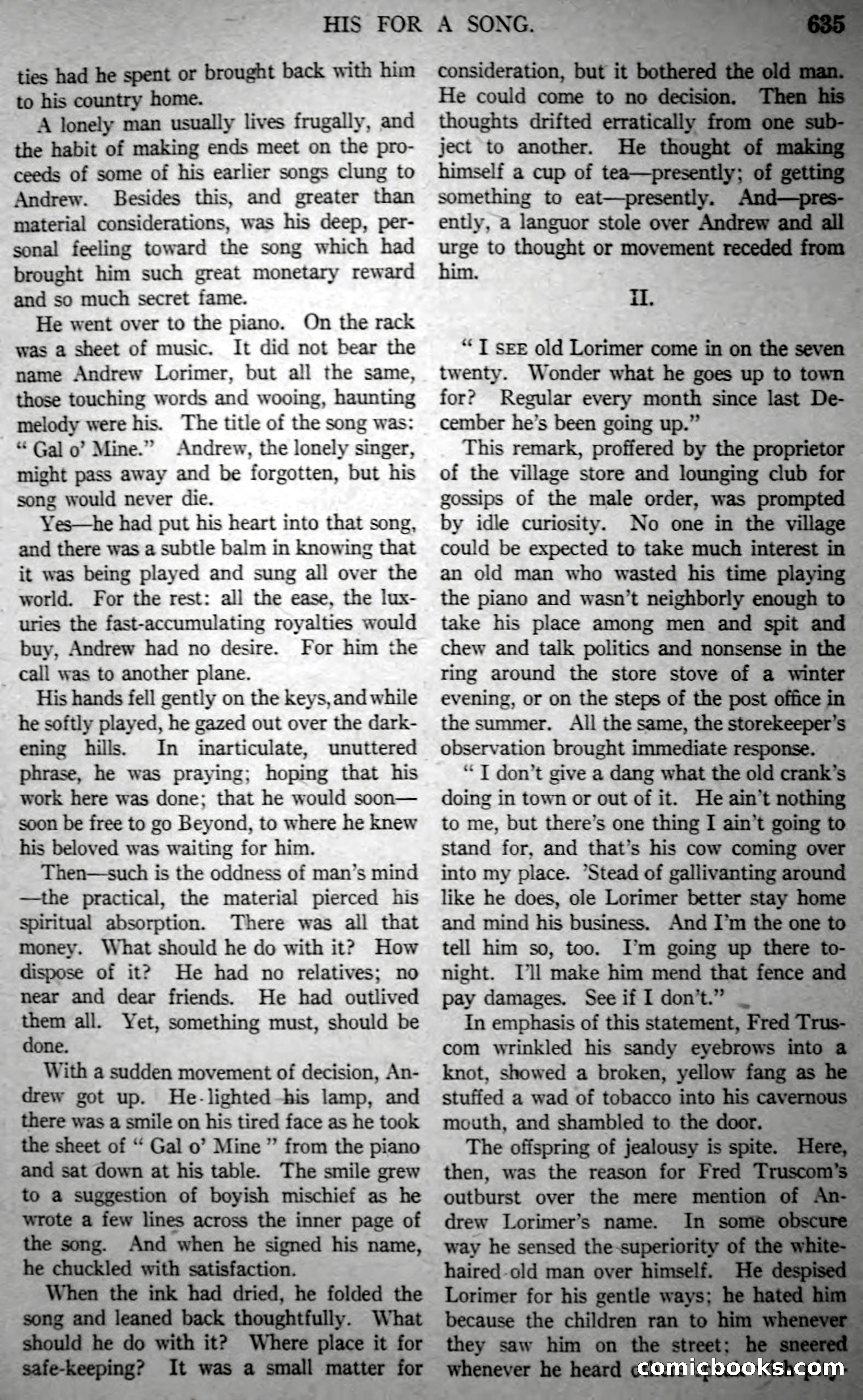
A restored page from Pulp Fiction, 1922. Page through the whole issue in the reader above.
📄 Transcribed text from this page (OCR, searchable)
Machine-transcribed from the original scan — historical spelling and the odd misread are preserved.
“s HIS FOR A SONG. ties had he spent or brought back with him to his country home. A lonely man usually lives frugally, and the habit of making ends meet on the pro- ceeds of some of his earlier songs clung to Andrew. Besides this, and greater than material considerations, was his deep, per- sonal feeling toward the song which had brought him such great monetary reward and so much secret fame. He went over to the piano. On the rack was a sheet of music. It did not bear the name Andrew Lorimer, but all the same, those touching words and wooing, haunting melody were his. The title of the song was: “ Gal o’ Mine.” Andrew, the lonely singer, might pass away and be forgotten, but his song would never die. Yes—he had put his heart into that song, and there was a subtle balm in knowing that it was being played and sung all over the world. For the rest: all the ease, the lux- uries the fast-accumulating royalties would buy, Andrew had no desire. For him the call was to another plane. His hands fell gently on the keys, and while he softly played, he gazed out over the dark- ening hills. In inarticulate, unuttered phrase, he was praying; hoping that his work here was done; that he would soon— soon be free to go Beyond, to where he knew his beloved was waiting for him. Then—such is the oddness of man’s mind —the practical, the material pierced his Spiritual absorption. There was all that money. What should he do with it? How dispose of it? He had no relatives; no near and dear friends. He had outlived them all. Yet, something must, should be done. With a sudden movement of decision, An- drew got up. He-lighted-his lamp, and there was a smile on his tired face as he took the sheet of “ Gal o’ Mine ” from the piano and sat down at his table. The smile grew to a suggestion of boyish mischief as he He could come to oo aaa ‘ thoughts drifted from ject to another. He thought of : himself a cup of tea—presently; of gettir something to eat—presently. And—pres- ently, a languor stole over Andrew oa all ; urge to thought or movement receded from him. il. f ‘‘ T sEE old Lorimer come in on the seven twenty. Wonder what he goes up to town for? Regular every month since last De- cember he’s been going up.” This remark, proffered by the proprietor of the village store and lounging club for gossips of the male order, was prompted by idle curiosity. No one in the village could be expected to take much interest in an old man who wasted his time playing the piano and wasn’t neighborly enough to take his place among men and spit and chew and talk politics and nonsense in the ring around the store stove of a winter evening, or on the steps of the post office in the summer. All the same, the storekeeper’s observation brought immediate response. “ T don’t give a dang what the old crank’s doing in town or out of it. He ain’t nothing to me, but there’s one thing I ain't going to stand for, and that’s his cow coming over into my place. ’Stead of gallivanting around like he does, ole Lorimer better stay home — and mind his business. And I’m the one to ~ tell him so, too. I’m going up there to- night. I'll make him mend thet Smee Say pay damages. See if I don’t.” . In emphasis of this statement, ‘Fred T com wrinkled his sandy eyebrows it knot, showed a broken, yellow tag. stuffed a wad of tobacco into his Vvernous: mouth, and shambled to the door, The offspring of jealousy is spite. Here, then, was the reason for Fred Trust A outburst over the mere mention of — drew Lorimer’s name. in