
Pulp Fiction, 1922 · page 70 of 176
Argosy All-Story Weekly, Vol. 146 No. 4 — page 70: what you’re looking at
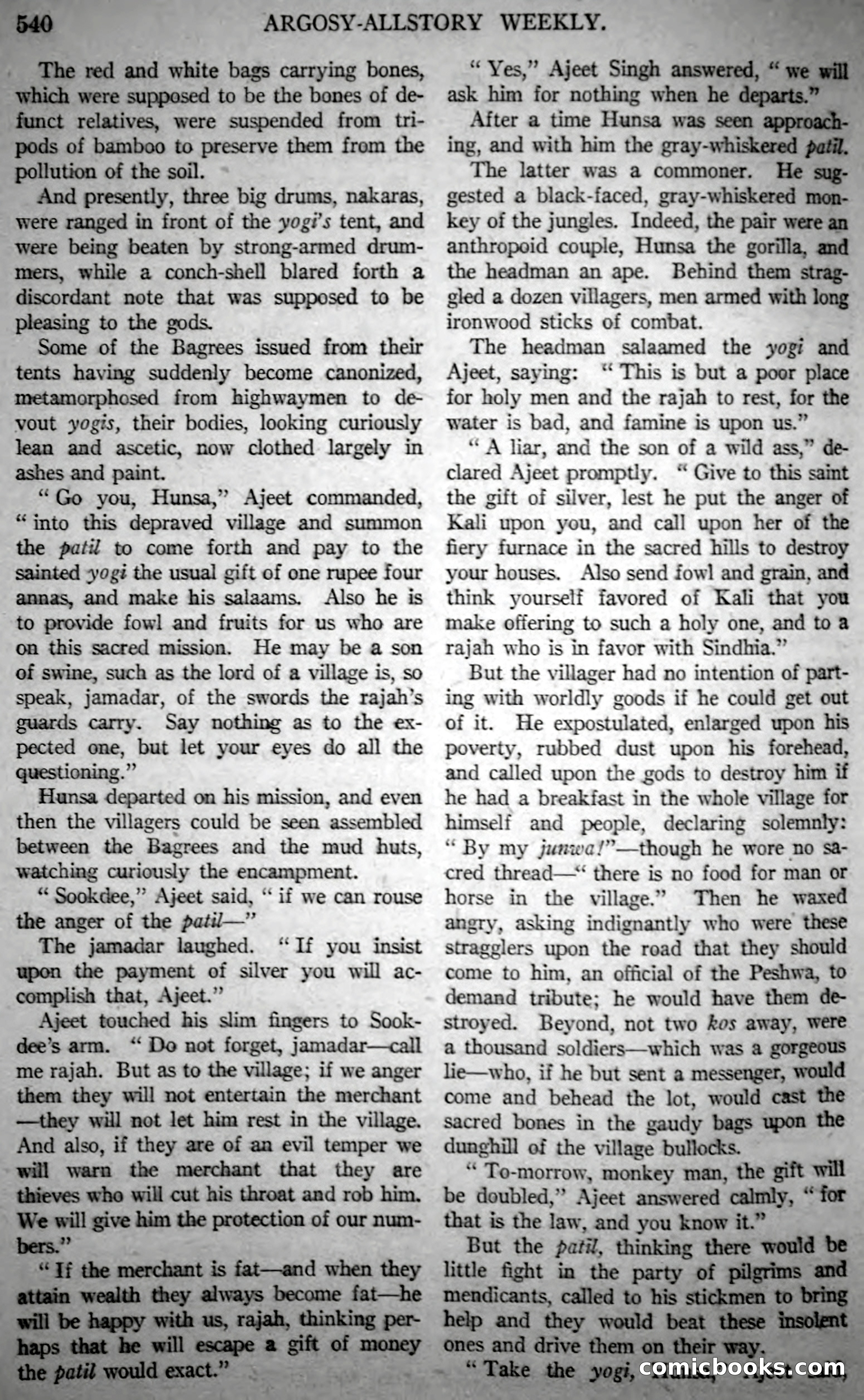
A restored page from Pulp Fiction, 1922. Page through the whole issue in the reader above.
📄 Transcribed text from this page (OCR, searchable)
Machine-transcribed from the original scan — historical spelling and the odd misread are preserved.
Re coigasel to be te Lowes of do "pods of bamboo to preserve them from the were ranged in front of the yog#’s tent, and were being beaten by strong-armed drum- mers, while a conch-shell blared forth a discordant note that was supposed to be pleasing to the gods. Some of the Bagrees issued from their tents having suddenly become canonized, metamorphosed from highwaymen to de- vout yogis, their bodies, looking curiously lean and ascetic, now clothed largely in ashes and paint. “Go you, Hunsa,” Ajeet commanded, “into this depraved village and summon the patil to come forth and pay to the sainted yogi the usual gift of one rupee four annas, and make his salaams. Also he is to provide fowl and fruits for us who are on this sacred mission. He may be a son of swine, such as the lord of a village is, so speak, jamadar, of the swords the rajah’s guards carry. Say nothing as to the ex- pected one, but let your eyes do all the questioning.” Hunsa departed on his mission, and even then the villagers could be seen assembled between the Bagrees and the mud huts, watching curiously the encampment. “ Sookdee,” Ajeet said, “ if we can rouse the anger of the pati/—” The jamadar laughed. “If you insist upon the payment of silver you will ac- complish that, Ajeet.” Ajeet touched his slim fingers to Sook- dee’s arm. “ Do not forget, jamadar—call me rajah. But as to the village; if we anger them they will not entertain the merchant —they will not let him rest in the village. And also, if they are of an evil temper we will warn the merchant that they are _ thieves who will cut his throat and rob him. a oy eae Faiths when ped ARGOSY-ALLSTORY WEEKLY. “Yes,” Ajeet Singh answered, “ ask him for nothing when he ley rts. After a time Hunsa was seen appro: ing, and with him the gray-whiskered pe il, - The latter was a commoner. He ‘sug: gested a black-faced, gray-whiskered key of the jungles. Indeed, the pair were an anthropeid couple, Hunsa the gorilla, and the headman an ape. Behind them strag- gled a dozen villagers, men armed with long ironwood sticks of combat. The headman salaamed the yogi and Ajeet, saying: “ This is but a poor place for holy men and the rajah to rest, for the water is bad, and famine is upon us.” “A liar, and the son of a wild ass,” de- clared Ajeet promptly. “ Give to this samt the gift of silver, lest he put the anger of Kali upon you, and call upon her of the fiery furnace in the sacred hills to destroy your houses. Also send fowl and grain, and think yourself favored of Kali that you make offering to such a holy one, and to a rajah who is in favor with Sindhia.” But the villager had no intention of part- ing with worldly goods if he could get out of it. He expostulated, enlarged upon his poverty, rubbed dust upon his forehead, and called upon the gods to destroy him if he had a breakfast in the whole village for himself and people, declaring solemnly: “ By my junwa!”—though he wore no sa- “‘ there is no food for man or horse in the village.’ Then he waxed angry, asking indignantly who were these stragglers upon the road that they should come to him, an official of the Peshwa, to demand tribute; he would have them de- stroyed. Beyond, not two kos away, were a thousand soldiers—which was a gorgeous lie—who, if he but sent a messenger, would come and behead the lot, would cast the sacred bones in the gaudy bags upon the dunghill of the village bullocks. “ To-morrow, monkey man, the gift will be doubled,” Ajeet answered cel ain, “for that is the law, and you know he But the patil, pene ba little fight in the 2 i sk te ele <n ns Pen > . . 4 ‘ Stee - ne Nik Neoniebooke com * % «bie