
Pulp Fiction, 1922 · page 82 of 176
Argosy All-Story Weekly, Vol. 146 No. 4 — page 82: what you’re looking at
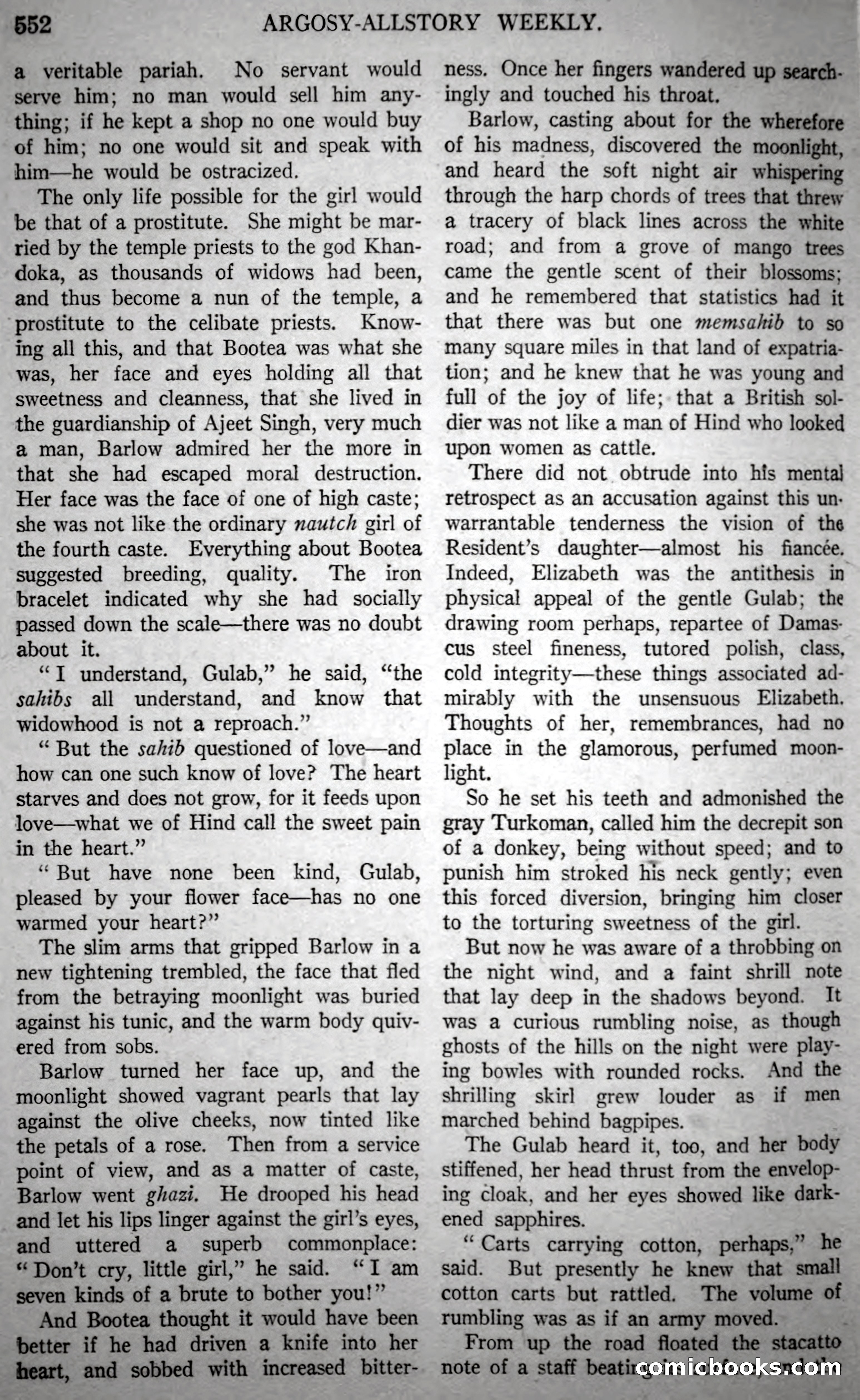
A restored page from Pulp Fiction, 1922. Page through the whole issue in the reader above.
📄 Transcribed text from this page (OCR, searchable)
Machine-transcribed from the original scan — historical spelling and the odd misread are preserved.
“652 ‘prostitute to the celibate priests. a veritable pariah. No servant would serve him; no man would sell him any- thing; if he kept a shop no one would buy of him; no one would sit and speak with him—he would be ostracized. The only life possible for the girl would be that of a prostitute. She might be mar- ried by the temple priests to the god Khan- doka, as thousands of widows had been, and thus become a nun of the temple, a Know- ing all this, and that Bootea was what she was, her face and eyes holding all that sweetness and cleanness, that she lived in the guardianship of Ajeet Singh, very much a man, Barlow admired her the more in that she had escaped moral destruction. Her face was the face of one of high caste; she was not like the ordinary mautch girl of the fourth caste. Everything about Bootea suggested breeding, quality. The iron bracelet indicated why she had socially passed down the scale—there was no doubt about it. “JT understand, Gulab,” he said, “the sahibs all understand, and know that widowhood is not a reproach.” “ But the sahib questioned of love—and how can one such know of love? The heart starves and does not grow, for it feeds upon love—what we of Hind call the sweet pain in the heart.” “ But have none been kind, Gulab, pleased by your flower face—has no one warmed your heart?” The slim arms that gripped Barlow in a new tightening trembled, the face that fled from the betraying moonlight was buried against his tunic, and the warm body quiv- ered from sobs. Barlow turned her face up, and the moonlight showed vagrant pearls that lay against the olive cheeks, now tinted like the petals of a rose. Then from a service point of view, and as a matter of caste, Barlow went ghazi. He drooped his head _ and let his lips linger against the girl’s eyes, and uttered a superb commonplace: * Don’t cry, little girl,” he said. “I am _ seven kinds of a brute to bother you!” And Bootea thought it would have been better if he hed 4 driven a knife into her ARGOSY-ALLSTORY WEEKLY, ness. Once her fingers wandered eae 7 ingly and touched his throat, me Barlow, casting about for the wherefore of his madness, discovered the moonlight, - and heard the soft night air whispering through the harp chords of trees that threw a tracery of black lines across the white road; and from a grove of mango trees came the gentle scent of their blossoms; and he remembered that statistics had it that there was but one memsahib to so many square miles in that land of expatria- tion; and he knew that he was young and full of the joy of life; that a British sol- dier was not like a man of Hind who looked upon women as Cattle. There did not obtrude into his mental retrospect as an accusation against this un- warrantable tenderness the vision of the Resident’s daughter—almost his fiancée. Indeed, Elizabeth was the antithesis in physical appeal of the gentle Gulab; the drawing room perhaps, repartee of Damas- cus steel fineness, tutored polish, class, cold integrity—these things associated ad- mirably with the unsensuous Elizabeth. Thoughts of her, remembrances, had no place in the glamorous, perfumed moon- light. So he set his teeth and admonished the gray Turkoman, called him the decrepit son of a donkey, being without speed; and to punish him stroked his neck gently; even this forced diversion, bringing him closer to the torturing sweetness of the girl. But now he was aware of a throbbing on the night wind, and a faint shrill note that lay deep in the shadows beyond. It was a curious rumbling noise, as though ghosts of the hills on the night were play- ing bowles with rounded rocks. And the shrilling skirl grew louder as if men marched behind bagpipes. The Gulab heard it, too, and her body stiffened, her head thrust from the envelop- ing loak, and her eyes showed like dark- ened sapphires. “Carts carrying cotton, perhaps,” he said. But presently he knew that small cotton carts but rattled. The rumbling was as if an army moved. From up this road L see th ape * a a) ; ak @) | ad ™