
Pulp Fiction, 1922 · page 118 of 176
Argosy All-Story Weekly, December 2, 1922 — page 118: what you’re looking at
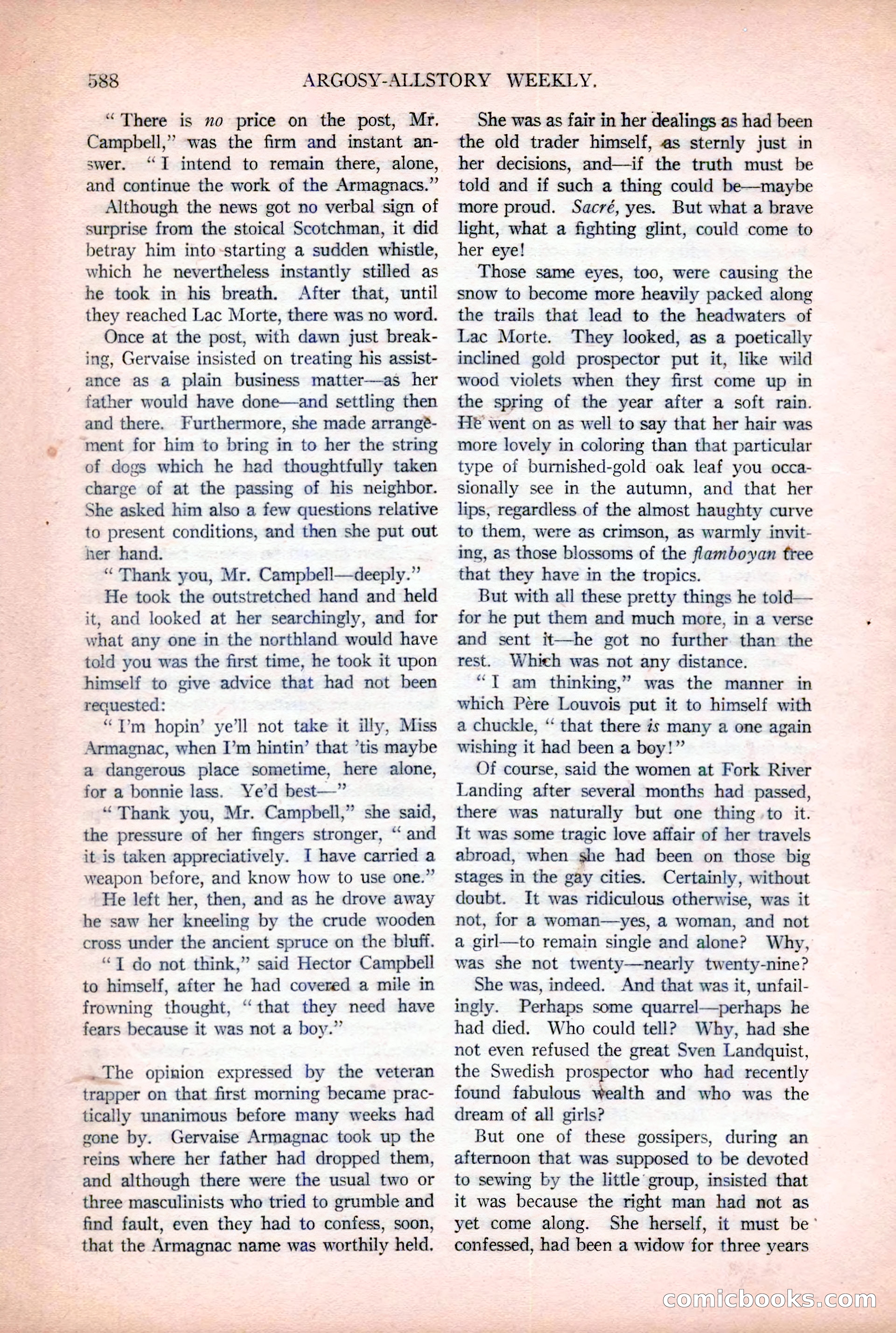
A restored page from Pulp Fiction, 1922. Page through the whole issue in the reader above.
📄 Transcribed text from this page (OCR, searchable)
Machine-transcribed from the original scan — historical spelling and the odd misread are preserved.
588 “There is zo price on the post, Mr. Campbell,” was the firm and instant an- swer. “I intend to remain there, alone, and continue the work of the Armagnacs.” Although the news got no verbal sign of surprise from the stoical Scotchman, it did betray him into-starting a sudden whistle, which he nevertheless instantly stilled as he took in his breath. After that, until they reached Lac Morte, there was no word. Once at the post, with dawn just break- ing, Gervaise insisted on treating his assist- _ ance as a plain business matter—as her father would have done—and settling then and there. Furthermore, she made arrangé- ment for him to bring in to her the string of dogs which he had thoughtfully taken charge of at the passing of his neighbor. She asked him also a few questions relative to present conditions, and then she put out her hand. “Thank you, Mr. Campbell—deeply.”’ He took the outstretched hand and held it, and looked at her searchingly, and for what any one in the northland would have told you was the first time, he took it upon himself to give advice that had not been requested: “Tm hopin’ ye’ll not take it illy, Miss Armagnac, when I’m hintin’ that ’tis maybe a dangerous place sometime, here alone, for a bonnie lass. Ye’d best—” “Thank you, Mr. Campbell,” she said, the pressure of her fingers stronger, “ and it is taken appreciatively. I have carried a weapon before, and know how to use one.” He left her, then, and as he drove away he saw her kneeling by the crude wooden cross under the ancient spruce on the bluff. “T do not think,” said Hector Campbell to himself, after he had covered a mile in frowning thought, “that they need have fears because it was not a boy.” ..The opinion expressed by the veteran trapper on that first morning became prac- tically unanimous before many weeks had gone by. Gervaise Armagnac took up the reins where her father had dropped them, and although there were the usual two or three masculinists who tried to grumble and find fault, even they had to confess, soon, that the Armagnac name was worthily held. ARGOSY-ALLSTORY WEEKLY. She was as fair in her dealings as had been the old trader himself, as sternly just in her decisions, and—if the truth must be told and if such a thing could be—maybe more proud. Sacré, yes. But what a brave light, what a fighting glint, could come to her eye! Those same eyes, too, were causing the snow to become more heavily packed along the trails that lead to the headwaters of Lac Morte. They looked, as a poetically inclined gold prospector put it, like wild wood violets when they first come up in the spring of the year after a soft rain. He went on as well to say that her hair was more lovely in coloring than that particular type of burnished-gold oak leaf you occa- sionally see in the autumn, and that her lips, regardless of the almost haughty curve to them, were as crimson, as warmly invit- ing, as those blossoms of the flamboyan free that they have in the tropics. But with all these pretty things he told— for he put them and much more, in a verse and sent it—he got no further than the rest. Which was not any distance. “TY am thinking,” was the manner in which Pere Louvois put it to himself with a chuckle, “ that there is many a one again wishing it had been a boy!” Of course, said the women at Fork River Landing after several months had passed, there was naturally but one thing .to it. It was some tragic love affair of her travels abroad, when she had been on those big stages in the gay cities. Certainly, without doubt. It was ridiculous otherwise, was it not, for a woman—yes, a woman, and not a girl—to remain single and alone? Why, was she not twenty—nearly twenty-nine? She was, indeed. And that was it, unfail- ingly. Perhaps some quarrel—perhaps he had died. Who could tell? Why, had she not even refused the great Sven Landquist, the Swedish prospector who had recently found fabulous Wealth and who was the dream of all girls? But one of these gossipers, during an afternoon that was supposed to be devoted to sewing by the little group, insisted that it was because the right man had not as yet come along. She herself, it must be’ confessed, had been a widow for three years . Gomichbookszcom « al . \ _-