
Pulp Fiction, 1922 · page 124 of 176
Argosy All-Story Weekly, December 2, 1922 — page 124: what you’re looking at
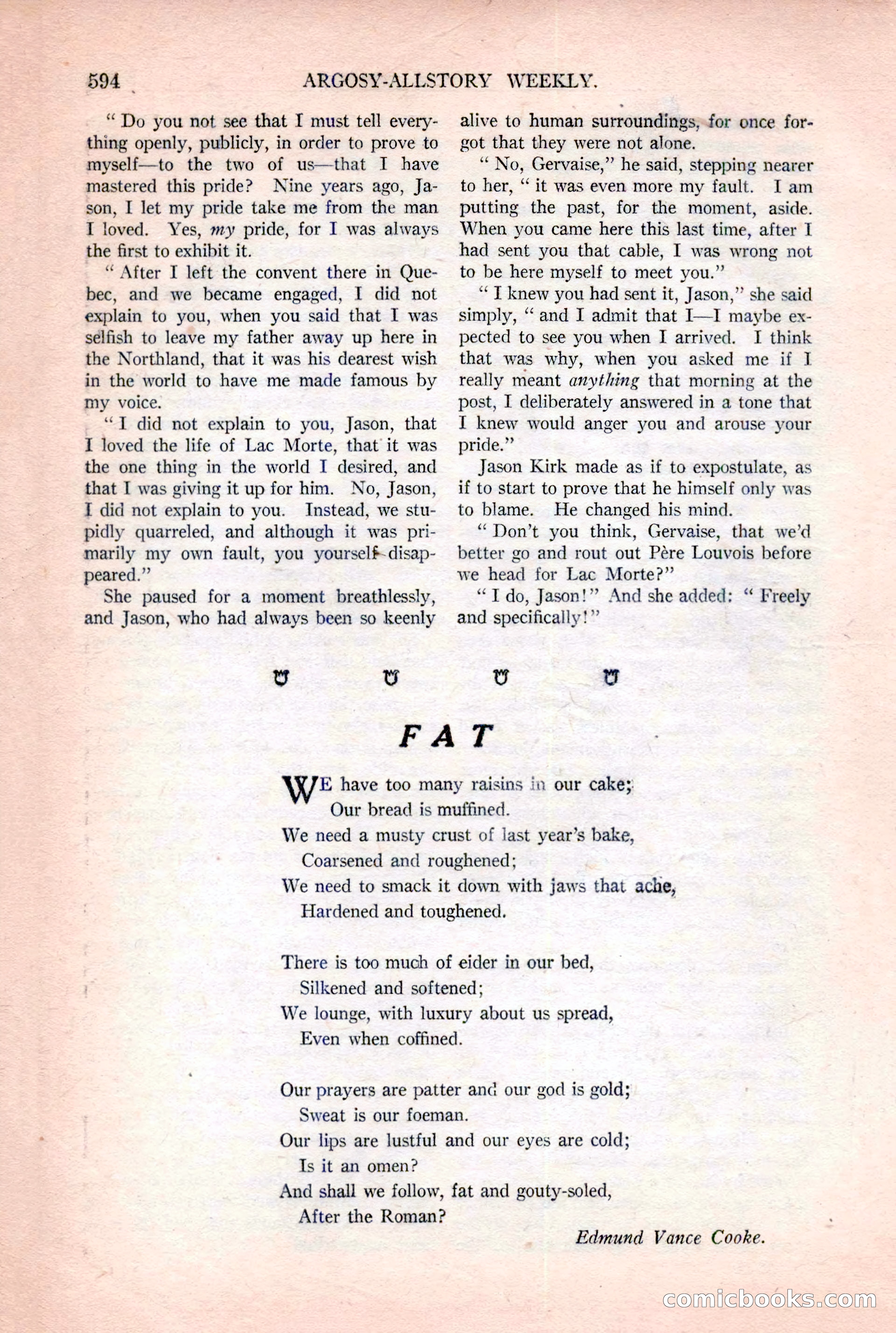
A restored page from Pulp Fiction, 1922. Page through the whole issue in the reader above.
📄 Transcribed text from this page (OCR, searchable)
Machine-transcribed from the original scan — historical spelling and the odd misread are preserved.
594 “Do you not see that I must tell every- thing openly, publicly, in order to prove to myself—to the two of us—that I have mastered this pride? Nine years ago, Ja- son, I let my pride take me from the man I loved. Yes, my pride, for I was always the first to exhibit it. “ After I left the convent there in Que- bec, and we became engaged, I did not explain to you, when you said that I was selfish to leave my father away up here in the Northland, that it was his dearest wish in the world to have me made famous by my voice. “T did not explain to you, Jason, that I loved the life of Lac Morte, that it was the one thing in the world I desired, and that I was giving it up for him. No, Jason, { did not explain to you. Instead, we stu- pidly quarreled, and although it was pri- marily my own fault, you yoursel&disap- peared.” She paused for a moment breathlessly, and Jason, who had always been so keenly u U ARGOSY-ALLSTORY WEEKLY. alive to human surroundings, for once for- got that they were not alone. “No, Gervaise,” he said, stepping nearer to her, “ it was even more my fault. I am putting the past, for the moment, aside. When you came here this last time, after I had sent you that cable, I was wrong not to be here myself to meet you.” ‘“‘T knew you had sent it, Jason,” she said simply, “and I admit that I—I maybe ex- pected to see you when J arrived. I think that was why, when you asked me if I really meant anything that morning at the post, I deliberately answered in a tone that I knew would anger you and arouse your pride.” Jason Kirk made as if to expostulate, as if to start to prove that he himself only was to blame. He changed his mind. “Don’t you think, Gervaise, that we’d better go and rout out Pére Louvois before we head for Lac Morte?” “IT do, Jason!”’ And she added: “ Freely and specifically!” U u FAT E have too many raisins in our cakes: Our bread is muffined. We need a musty crust of last year’s bake, Coarsened and roughened; We need to smack it down with jaws that ache, Hardened and toughened. There is too much of eider in our bed, Silkened and softened; We lounge, with luxury about us spread, Even when coffined. Our prayers are patter ana our god is gold; Sweat is our foeman. Our lips are lustful and our eyes are cold; Is it an omen? And shall we follow, fat and gouty-soled, After the Roman? Edmund Vance Cooke. COMmmicooOokkS COR