
Pulp Fiction, 1922 · page 127 of 176
Argosy All-Story Weekly, December 2, 1922 — page 127: what you’re looking at
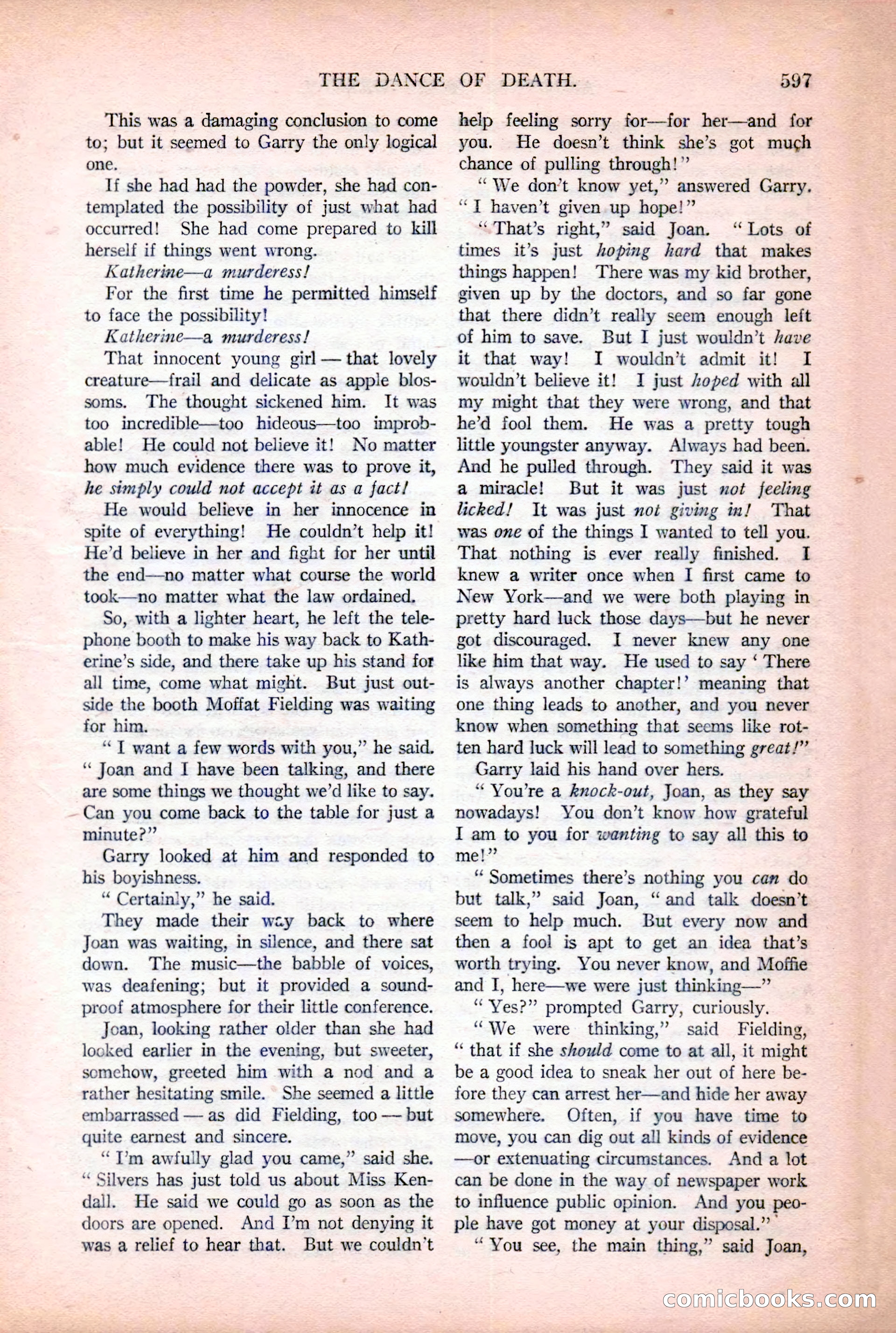
A restored page from Pulp Fiction, 1922. Page through the whole issue in the reader above.
📄 Transcribed text from this page (OCR, searchable)
Machine-transcribed from the original scan — historical spelling and the odd misread are preserved.
THE DANCE This was a damaging conclusion to come to; but it seemed to Garry the only logical one. If she had had the powder, she had con- templated the possibility of just what had occurred! She had come prepared to kill herself if things went wrong. Katherine—a murderess! For the first time he permitted himself to face the possibility! Katherine—a murderess! That innocent young girl — that lovely creature—frail and delicate as apple blos- soms. The thought sickened him. It was too incredible—too hideous—too improb- able! He could not believe it! No matter how much evidence there was to prove it, he simply could not accept it as a fact! He would believe in her innocence in spite of everything! He couldn’t help it! He’d believe in her and fight for her until the end—no matter what course the world took—no matter what the law ordained. So, with a lighter heart, he left the tele- phone booth to make his way back to Kath- erine’s side, and there take up his stand for all time, come what might. But just out- side the booth Moffat Fielding was waiting for him. “IT want a few words with you,” he said. ‘““ Joan and I have been talking, and there are some things we thought we’d like to say. Can you come back to the table for just a minute?” Garry looked at him and responded to his boyishness. “ Certainly,” he said. They made their way back to where Joan was waiting, in silence, and there sat down. The music—the babble of voices, was deafening; but it provided a sound- proof atmosphere for their little conference. Joan, looking rather older than she had looked earlier in the evening, but sweeter, somehow, greeted him with a nod and a rather hesitating smile. She seemed a little embarrassed — as did Fielding, too — but quite earnest and sincere. “T’m awfully glad you came,” said she. ‘“ Silvers has just told us about Miss Ken- dail. He said we could go as soon as the doors are opened. And I’m not denying it was a relief to hear that. But we couldn’t OF DEATH. help feeling sorry for—for her—and for you. He doesn’t think she’s got much chance of pulling through!” “We don’t know yet,” answered Garry. “1 haven’t given up hope!” ‘“That’s right,” said Joan. “Lots of times it’s just hoping hard that makes things happen! There was my kid brother, given up by the doctors, and so far gone that there didn’t really seem enough left of him to save. But I just wouldn’t dave it that way! I wouldn’t admit it! I wouldn’t believe it! I just Zoped with all my might that they were wrong, and that he’d fool them. He was a pretty tough little youngster anyway. Always had been. And he pulled through. They said it was a miracle! But it was just mot feeling licked! It was just noi giving in! That was one of the things I wanted to tell you. That nothing is ever really finished. I knew a writer once when I first came to New York—and we were both playing in pretty hard luck those days—but he never got discouraged. I never knew any one like him that way. He used to say ‘ There is always another chapter!’ meaning that one thing leads to another, and you never know when something that seems like rot- ten hard luck will lead to something great!” Garry laid his hand over hers. “You're a knock-out, Joan, as they say nowadays! You don’t know how grateful I am to you for wanting to say all this to me!” Sometimes there’s nothing you can do but talk,” said Joan, “and talk doesn’t seem to help much. But every now and then a fool is apt to get an idea that’s worth trying. You never know, and Moffie and I, here—we were just thinking—” “Yes?” prompted Garry, curiously. “We were thinking,” said Fielding, “ that if she should come to at all, it might be a good idea to sneak her out of here be- fore they can arrest her—and hide her away somewhere. Often, if you have time to move, you can dig out all kinds of evidence —or extenuating circumstances. And a lot can be done in the way of newspaper work to influence public opinion. And you peo- ple have got money at your disposal.” ‘You see, the main thing,” said Joan, Comicbooks:com > SS Selita , oe eee