
Pulp Fiction, 1922 · page 141 of 176
Argosy All-Story Weekly, December 2, 1922 — page 141: what you’re looking at
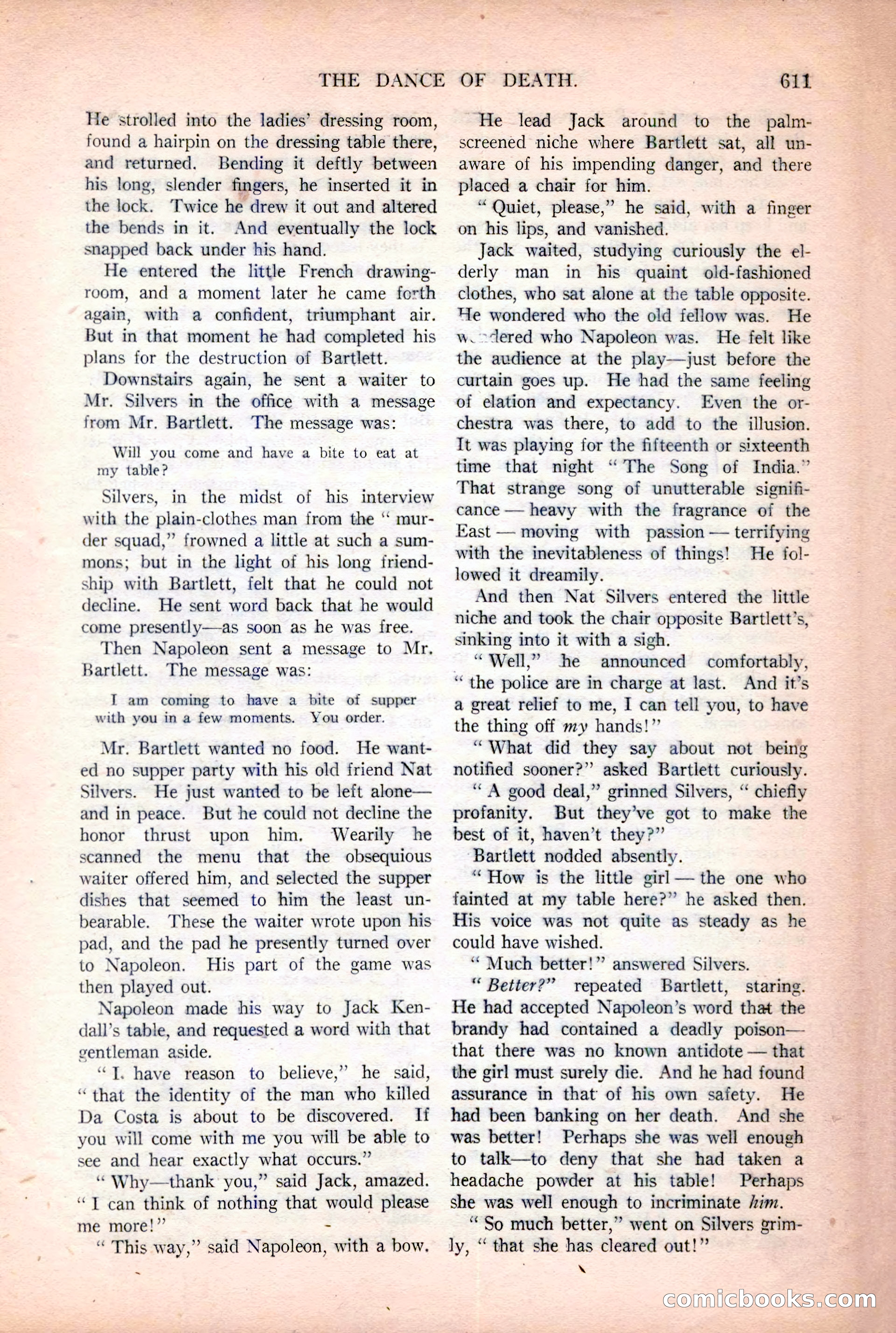
A restored page from Pulp Fiction, 1922. Page through the whole issue in the reader above.
📄 Transcribed text from this page (OCR, searchable)
Machine-transcribed from the original scan — historical spelling and the odd misread are preserved.
THE DANCE He strolled into the ladies’ dressing room, found a hairpin on the dressing table there, and returned. Bending it deftly between his long, slender fingers, he inserted it in the lock. Twice he drew it out and altered the bends in it. And eventually the lock snapped back under his hand. He entered the little French drawing- room, and a moment later he came forth again, with a confident, triumphant. air. But in that moment he had completed his plans for the destruction of Bartlett. Downstairs again, he sent a waiter to Mr. Silvers in the office with a message from Mr. Bartlett. The message was: Will you come and have a bite to eat at my table? Silvers, in the midst of his interview with the plain-clothes man from the “ mur- der squad,” frowned a little at such a sum- mons; but in the light of his long friend- ship with Bartlett, felt that he could not decline. He sent word back that he would come presently—as soon as he was free. Then Napoleon sent a message to Mr, Bartlett. The message was: T am coming to have a bite of supper with you in a few moments. You order. Mr. Bartlett wanted no food. He want- ed no supper party with his old friend Nat Silvers. He just wanted to be left alone— and in peace. But he could not decline the honor thrust upon him, Wearily he scanned the menu that the obsequious waiter offered him, and selected the supper dishes that seemed to him the least un- bearable. These the waiter wrote upon his pad, and the pad he presently turned over to Napoleon. His part of the game was then played out. Napoleon made his way to Jack Ken- dall’s table, and requested a word with that gentleman aside. “T. have reason to believe,” he said, “that the identity of the man who killed Da Costa is about to be discovered. If you will come with me you will be able to see and hear exactly what occurs.” “ Why—thank you,” said Jack, amazed. “T can think of nothing that would please me more!” - ‘“ This way,” said Napoleon, with a bow. ~ OF DEATH. 611 He lead Jack around to the palm- screened niche where Bartlett sat, all un- aware of his impending danger, and there placed a chair for him. “Quiet, please,” he said, with a finger on his lips, and vanished. Jack waited, studying curiously the el- derly man in his quaint old-fashioned clothes, who sat alone at the table opposite. He wondered who the old fellow was. He w. -dered who Napoleon was. He felt like the audience at the play—just before the curtain goes up. He had the same feeling of elation and expectancy. Even the or- chestra was there, to add to the illusion. It was playing for the fifteenth or sixteenth time that night “The Song of India.” That strange song of unutterable signifi- cance — heavy with the fragrance of the East — moving with passion — terrifying with the inevitableness of things! He fol- lowed it dreamily. And then Nat Silvers entered the little niche and took the chair opposite Bartlett’s, sinking into it with a sigh. “Well,” he announced comfortably, ‘“ the police are in charge at last. And it’s a great relief to me, I can tell you, to have the thing off my hands!”’ “What did they say about not being notified sooner?” asked Bartlett curiously. ‘A good deal,” grinned Silvers, “ chiefly profanity. But they’ve got to make the best of it, haven’t they?” Bartlett nodded absently. “ How is the little girl— the one who fainted at my table here?” he asked then. His voice was not quite as steady as he could have wished. “Much better!”’ answered Silvers. ‘* Better?” repeated Bartlett, staring. He had accepted Napoleon’s word that the brandy had contained a deadly poison— that there was no known antidote — that the girl must surely die. And he had found assurance in that of his own safety. He had been banking on her death. And she was better! Perhaps she was well enough to talk—to deny that she had taken a headache powder at his table! Perhaps she was well enough to incriminate /im. “So much better,” went on Silvers grim- ly, “ that she has cleared out!” ; \ COMUICOOOKS. COL