
Pulp Fiction, 1922 · page 159 of 176
Argosy All-Story Weekly, December 2, 1922 — page 159: what you’re looking at
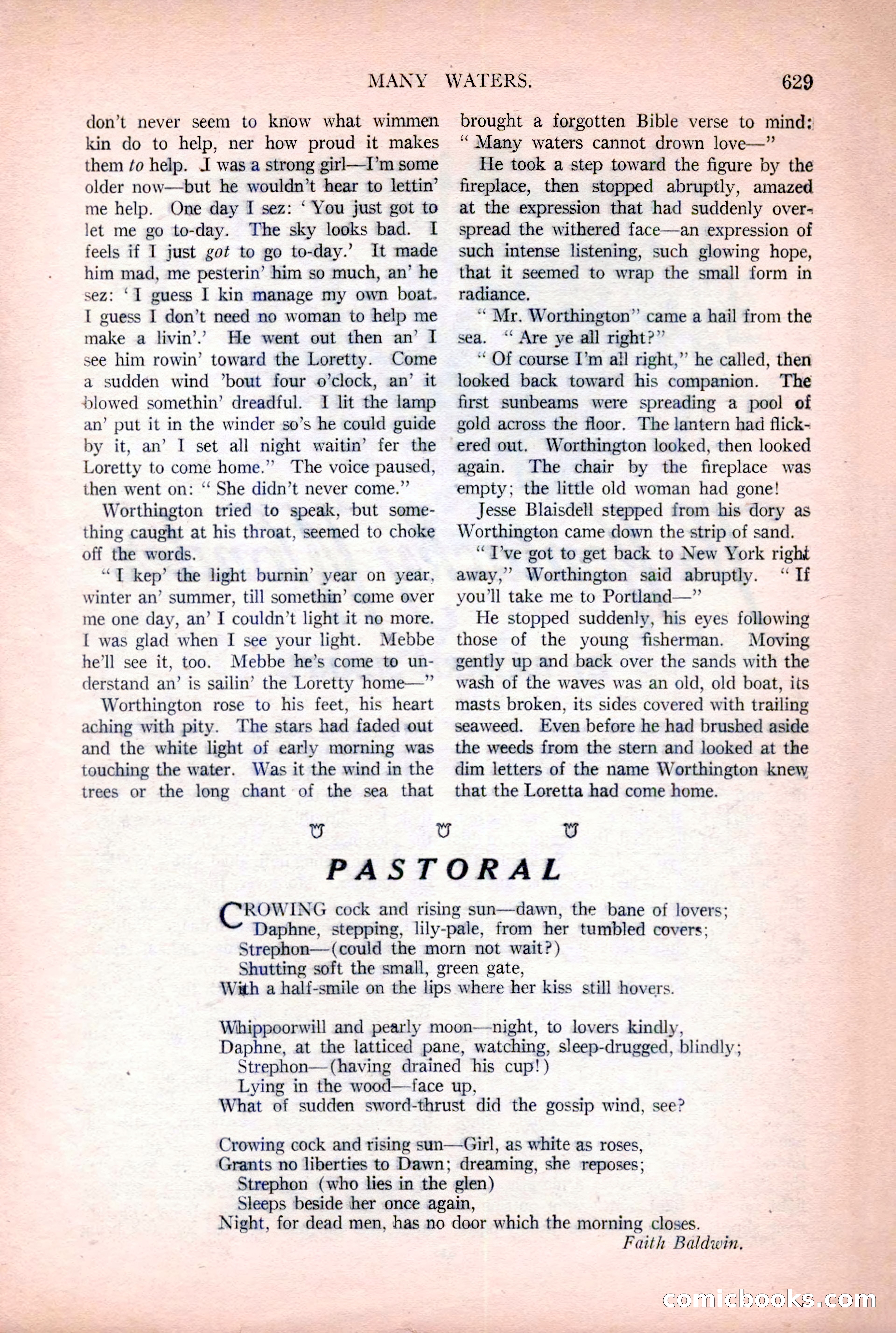
A restored page from Pulp Fiction, 1922. Page through the whole issue in the reader above.
📄 Transcribed text from this page (OCR, searchable)
Machine-transcribed from the original scan — historical spelling and the odd misread are preserved.
MANY WATERS. don’t never seem to know what wimmen kin do to help, ner how proud it makes them ¢o help. I was a strong girl—I’m some older now—but he wouldn’t hear to lettin’ me help. One day I sez: ‘ You just got to let me go to-day. The sky looks bad. I feels if I just got to go to-day.’ It made him mad, me pesterin’ him so much, an’ he sez: ‘I guess I kin manage my own boat. I guess I don’t need no woman to help me make a livin’. He went out then an’ I see him rowin’ toward the Loretty. Come a sudden wind ’bout four o’clock, an’ it blowed somethin’ dreadful. I lit the lamp an’ put it in the winder so’s he could guide by it, an’ I set all night waitin’ fer the Loretty to come home.” The voice paused, then went on: ‘‘ She didn’t never come.” Worthington tried to speak, but some- thing caught at his throat, seemed to choke off the words. “T kep’ the light burnin’ year on year, winter an’ summer, till somethin’ come over me one day, an’ I couldn’t light it no more. [ was glad when I see your light. Mebbe he'll see it, too. Mebbe he’s come to un- derstand an’ is sailin’ the Loretty home—” Worthington rose to his feet, his heart aching with pity. The stars had faded out and the white light of early morning was touching the water. Was it the wind in the trees or the long chant of the sea that U 629 brought a forgotten Bible verse to mind: ‘“Many waters cannot drown love—” He took a step toward the figure by the fireplace, then stopped abruptly, amazed at the expression that had suddenly over- spread the withered face—an expression of such intense listening, such glowing hope, that it seemed to wrap the small form in radiance, ‘Mr. Worthington” came a hail from the sea. “‘ Are ye all right?” ‘Of course I’m all right,” he called, then looked back toward his companion. The first sunbeams were spreading a pool of gold across the floor. The lantern had flick- ered out. Worthington looked, then looked again. The chair by the fireplace was empty; the little old woman had gone! Jesse Blaisdell stepped from his dory as Worthington came down the strip of sand. “T’ve got to get back to New York righi away,” Worthington said abruptly. “ Tf you'll take me to Portland—” He stopped suddenly, his eyes following those of the young fisherman. Moving gently up and back over the sands with the wash of the waves was an old, old boat, its masts broken, its sides covered with trailing seaweed. Even before he had brushed aside the weeds from the stern and looked at the dim letters of the name Worthington knew that the Loretta had come home. U PASTORAL ROWING cock and rising sun—dawn, the bane of lovers; Daphne, stepping, lily-pale, from her tumbled covers; Strephon—(could the morn not wait?) Shutting soft the small, green gate, With a hali-smile on the lips where her kiss still hovers. Whippoorwill and pearly moon—night, to lovers kindly, Daphne, at the latticed pane, watching, sleep-drugged, blindly; Strephon—(having drained his cup!) Lying in the wood—face up, What of sudden sword-thrust did the gossip wind, see? Crowing cock and rising sun—Girl, as white as roses, Grants no liberties to Dawn; dreaming, she reposes; Strephon (who lies in the glen) Sleeps beside her once again, Night, for dead men, has no door which the morning closes. Faith Baldwin. Gomichbooks.com